Excerpted from Professor Lu Zuyin’s “Scientific Qigong Exploration”, a survey of qigong research experiments conducted in China between 1978 and 1992.
Scientific research in the last ten years has captured many external qi phenomena and qualitatively recognized certain characteristics of external qi. On the whole, research on external qi is still at a qualitative stage. It is not easy to establish quantitative laws and phenomenological theories thereby moving to a quantitative stage.
The difficulty is mainly due to insufficient investigation of external qi and the resulting lack of scientific means to express the level of external qi. With more than a thousand qigong schools and numerous different qigong methods, it is difficult to establish common standards.
In addition, a qigong master’s qi-emission power is closely related to his own physical, mental, emotional state at the time of qi emission. As a result, each external qi emission is at best only roughly the same, and it is not as precisely reproducible as an instrument. Experiments seeking basic laws of external qi are not easy to accomplish because they require tens or even hundreds of strictly repeated experiments.
[As demonstrated by our previous experimental results,] qigong is more advanced than contemporary science, thus it is difficult to fit into the framework of contemporary science. However, like all fields of scholarship, if qigong research does not pass strict scientific examination, it will not survive in contemporary society, let alone be accepted in international academic circles. This is a fundamental contradiction. [Read more →]
Chi (qi) is an ancient Chinese term, which can be translated as energy. Like energy, the word chi is used in both abstract and concrete terms, and applied to both general concepts and specific phenomena. In other words, chi is ambiguous. (People who use the term often have a specific meaning in mind.)
In the broadest sense of the word, chi is generally understood to be pervasive, present in everyone and everything, but it is not uniformly distributed.
Chi moves freely around the universe, assuming various forms along the way. Disciplines such as Chi Kung (Qigong) and Feng Shui purport to observe and manipulate chi, for the specific benefit of human life.
Do you know how martial artists spell irony? R-B-S-D.
RBSD, or reality-based self-defense, is a blanket term for martial arts training that purports to focus on practical applications. In truth, however, these applications—gross motor skills such as the straight punch and Thai-style knee strike—can only be deemed “practical” within a fiat-based reality.
Reality as measured by the CDC is strikingly different. Among the leading causes of death in 2005, assault ranks in 15th place—behind heart disease, diabetes, and a host of other illnesses. In the USA, death by suicide is 50% more common than homicide. Statistically speaking, influenza is far deadlier than any fatigue-clad RBSD play-warrior, or the threats they would prepare you to face.
Despite the indisputable fact that sickness is the greatest danger to the average person, martial arts for health have somehow earned a bad reputation. [Read more →]
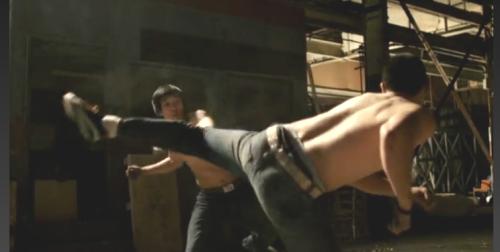
In the proceeding video, mentalist Darren Brown knocks a martial artist down from behind. That proves his skill is real.
On the other hand, Darren Brown did not touch him. That proves his skill is fake.
As for Darren Brown’s explanation, “It’s all in your mind,” that proves…what?[Read more →]
Many martial arts bloggers (Striking Thoughts, Mokuren Dojo and Dojo Rat to name a few) have published their opinions on the veracity of chi projection, empty force (ling kong jing) and no-touch knockouts. Naturally, I have a few opinions of my own–but I do not intend to share them here and now. No, my purpose today is a humble and scientific one: to gather data.
The plural of anecdote is data, right? So, please take this multiple choice poll. [Read more →]
內功 neigong (pronounced nay-gung): the science of observing, strengthening and directing bio-energy, or chi.
A repository of extraordinary skills such as telekinesis, pyrogenesis, telepathy, remote viewing and levitation, the esoteric Eastern school known as Mo-Pai has been described as a real-life order of Jedi Knights. Some have even speculated that its history inspired George Lucas’ script for Attack of the Clones.
Among the ancient neigong lineages still in existence today, the Mo-Pai is characterized by an unusual openness. The school and its headmaster, known by the alias “John Chang”, has been the subject of two recent books and a video documentary.
Jim McMillan, who identifies himself as a longtime disciple of John Chang, has graciously agreed to share a few of his experiences with Martial Development readers: [Read more →]
Welcome to the fourth edition of Qigong and Energy Arts Forum, a regularly updated collection of the best new articles on qigong (chi kung), reiki, ayurveda, kundalini yoga, and other related disciplines.
Why Energy Healing Is Often Considered “Woo-Woo” by Loolwa Khazzoom (Dancing with Pain) The vast majority of people who would say that energy work or energy medicine is “woo woo” are also people who hold strong religious beliefs. For example, Christians believe that there was a man who lived in a whale…
The Key to Natural Healing by Anmol Mehta (Mastery of Meditation, Enlightenment and Kundalini Yoga) The key to natural healing is to be positive, relaxed and at peace mentally. The concepts of you are not your body, and the body’s fantastic inbuilt healing capacities greatly help facilitate this state…[Read more →]
Appreciating the interweaving religious, philosophical and political stakes [in 18th century medicine] is important, because it can help us make sense of an episode whose significance we might otherwise misinterpret: the showdown between the German exorcist Father Johann Joseph Gassner and the Viennese physician Anton Mesmer.
Gassner was an exorcist whose ability to cast out devils was legendary. People came from all over to be healed, and in dramatic public performances—witnessed by crowds from all sectors of society—Gassner would oblige. Official records were made; competent witnesses testified to the extraordinary happenings. All agreed on the basic facts. On being presented with a supplicant, Gassner would typically wave a crucifix over his or her body and demand in Latin that, if the disease he was seeing had a “preternatural” source, this fact must be made manifest. The patient would then typically collapse into convulsions, and Gassner would proceed to exorcise the offending spirit.
Sometimes he added flourishes to this basic routine: in one dramatic instance, for example, he ordered the demon inside a woman to increase the poor woman’s heartbeat and then to slow it down. [Read more →]
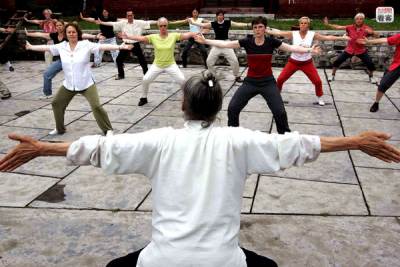
There were no officially sanctioned qigong activities in China until its rehabilitation in 1978, after the end of the Cultural Revolution. However, one woman, Guo Lin, an artist and cancer victim from Guangdong province who had cured herself by practicing qigong during the 1960s, was brave enough to teach other cancer patients in the parks of Beijing as early as 1970. Her ‘New Qigong Therapy’ inaugurated a new, collective form of qigong teaching and practice that would later be adopted by most qigong masters. Guo Lin can thus be said to have triggered the qigong wave of the 1980s.
Born near Zhongshan, Guangdong in 1909, Guo Lin was trained as a young girl in traditional body technologies by her paternal grandfather, a Taoist in Macau, where her family had fled following the 1911 revolution. Later, as a student of landscape painting, she visited several holy mountains; the breathing technique she used when climbing the steep slopes would become the basis for her future qigong method.
In 1949 Guo Lin was hit by uterine cancer, which was treated by hysterectomy. The cancer recurred in 1959 while she was teaching at the new Beijing Painting Academy. Guo Lin remembered the techniques that she had learned in her youth, and decided to practice them to treat her cancer. [Read more →]