Excerpted from Beyond Biofeedback, a record of Elmer and Alyce Green’s research on theta brainwave training, which they describe as an accelerated form of meditation.
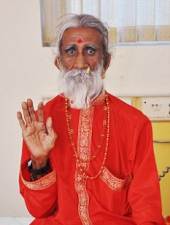
When Jack Schwarz was in his early teens, he saw a stage hypnotist enter a self-induced trance and then push pins into his arm while he talked about the power of mind to control pain and bleeding. Jack had the normal response to pain until he saw that demonstration, and then, for no particular reason, he knew that he would be able to do the same thing. He got some pins and tried it, and sure enough he could turn pain off. What a conversation piece, he thought.
Jack said that at first he never tired of amazing his friends. He developed a cocky attitude, in spite of the fact that he had not had to develop his skills, but “woke up one morning and found all the diplomas were on the wall.” He could stop pain, stop bleeding, influence people through hypnosis, remove pains in other people by putting his hands on them and thinking about the pain going away, and could often “guess” other people’s thoughts precisely.
We did not make a focused effort to interrogate Jack when we began the laboratory work. As with Swami Rama, we asked him to tell us what he would like to demonstrate. Dale and Alyce wired him in the same way we prepared college-student subjects in other research. When he sat down in the experimental room he produced an envelope with two 6-inch steel sailmaker’s needles. [Read more →]

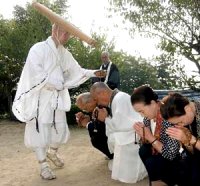
For more than seven years, Genshin Fujinami dressed in white from head to toe while covering the backwoods trails of Mount Hiei in one of the world’s most grueling feats–a punishing quest that combined starvation, isolation and the equivalent of a lap around the equator.
For 1,000 days, rising well before dawn, Fujinami embarked alone, rain or shine, on his journey, running or briskly walking more than 50 miles–that’s almost two marathons–each day as the trial neared its climax. Along with his white robes, his only gear was a pair of straw sandals, a long straw hat, candles, a shovel, a length of rope and a short sword.
The rope and sword weren’t for survival. If for some reason he could not complete his daily trek, he was to use them to kill himself.
[Read more →]
Excerpted from Breathing Spaces: Qigong, Psychiatry, and Healing in China by Nancy N. Chen

Qigong in the Scientific Community
Qigong began to be actively debated within the [Chinese] scientific community during the 1980s, when scientists, especially physicians, sought to legitimate the phenomenon of qi. While popular publications focused on practice or gave life histories of particular masters, the discussions of qigong among scientists addressed questions of how to measure the force field of qi energy. Qi as a material phenomenon had to be quantified. This interest paralleled attention to the phenomenon of teyigongneng, or special psychic abilities.
…The doors of scientific research opened when Qian Xuesen, the prominent founder of China’s space research, declared that teyigongneng merited serious study. In his account of this movement, Paul Dong, a US-based qigong master, described how young children in China were tested for their abilities to “hear” characters being written and to perform psychokinesis (the power to move objects with their minds); there were reports of pills disappearing from bottles only to materialize outside their containers.
Scientific experiments also commenced during this period, as many researchers believed that special abilities could be enhanced with qigong. Over a dozen scientific journals and publications, among them, Zhiran Zazhi (Nature magazine) and Dongfang Qigong (Eastern qigong), began to discuss human potential and somatic science. [Read more →]
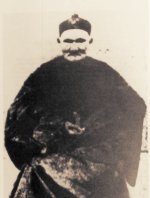
When the Chinese herbalist Li Ching-Yuen died in 1933, newspapers around the world reported the news of his passing. According to his own testimony, he was 197 years old.
An investigation, however, suggested Li had forgotten his actual birthday. Official government records recorded the birth year as 1677, making him 256. Here is a copy of the obituary as printed in the New York Times on May 6, 1933:
LI CHING-YUN DEAD; GAVE HIS AGE AS 197.
“Keep a Quiet Heart, Sit Like a Tortoise, Sleep Like a Dog,” His Advice for a Long Life.

Li Ching-Yuen
Inquiry Put Age At 256.
Reported to have buried 23 wives and had 180 descendents – sold herbs for first 100 years.
Peiping, May 5 – Li Ching-Yun, a resident of Kaihsien, in the Province of Szechwan, who contended that he was one of the world’s oldest men and said he was born in 1736 – which would make him 197 years old – died today.
A Chinese dispatch from Chungking telling of Mr. Li’s death said he attributed his longevity to peace of mind and that it was his belief every one could live at least a century by attaining inward calm. [Read more →]
October 31st, 2007 · 3 Comments
The True Story of Sadhu Haridas, a 19th Century Yogi Phenomenon
Originally published in the London Telegraph, August 22, 1880
We are not told whether the Seven Sleepers who retired to a cave in Ephesus during the reign of the Christian-killing Emperor Decius, and only woke up 155 years afterward, when Theodosins II was on the throne, made any special preparation, but probably they did not. Perhaps it was not necessary. Those were stirring times for members of the new faith, and they had little opportunity to grow obese.
But, as a rule, to fast successfully it is said to be necessary for a man to abstain beforehand, and reduce himself more carefully to the required condition by a long course of preparation. Pre-eminent at this art of suspending animation—for an art it becomes—are the Easterns, and most wonderful stories are told of the natives of India, which, whether they powers are due to narcotics or any other process, seem to open up—if true—a wide field of medical study.
Once of the Indian stories, not easily accessible, but of considerable interest on account of the known veracity of the witnesses, will probably be read with interest at the present time, and is inserted here. [Read more →]
Every person’s body has an aura (light). All living things have auras. Even nonliving things have auras. Physicists refer to the aura as a field, a space which contains active magnetic or electrical lines. The aura of the human body is the qi field of the body. Some individuals are born with the ability to see auras. Others are able to see auras with qigong training, as well as after a session of meditation. With the ability to see human auras, it is possible to understand the workings in the human body. Depending on the colors and the intensity of the aura around the individual, the condition of the individual can be deciphered.

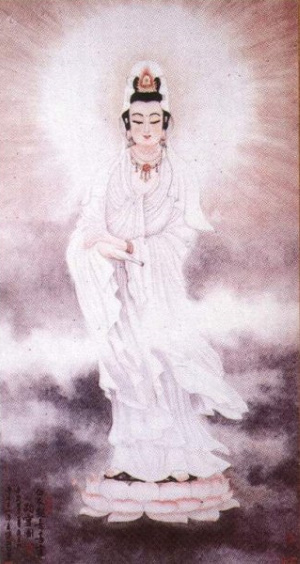
Guanyin
With the ability to see auras, one can also decipher the depth of another person’s energy cultivation. The aura of Laozi was described as purple. The auras of Sakyamuni Buddha and Avalokiteshvara (Guan Yin) were described as a ring with multiple radiating colors. Drawings of Jesus Christ and the Virgin Mary also showed auras. Indian yogis, Chinese Daoist and Buddhist cultivators all have large beautiful auras.
Training Methods: [Read more →]
There is a man in Indonesia who is a master of the ancient Chinese science of neikung, or “internal power.” His name is John Chang, and he is my teacher. Mr. Chang was first presented to the world in the award-winning documentary series Ring of Fire, filmed by the brothers Lorne and Lawrence Blair; his privacy was protected by the rather ignominious pseudonym Dynamo Jack. [Read more →]
September 24th, 2006 · 53 Comments
This video clip from Ripley’s Believe It or Not showcases the qigong skills of master Zhou Ting-Jue.
In the first portion of the video, Zhou raises the temperature of a damp paper towel (containing a sheet of foil) above 200 degrees Fahrenheit. Steam rises from the towel. [Read more →]