
zhu: concentrate; focus
What do you get when you combine Nichiren Buddhist chanting, Tae Kwon Do, four booty shakers in short cheongsam dresses, a muk yan jong and a pimped out Cadillac?
My New Year’s Eve plans? No, it’s an Xzibit music video.
Unlocking human potential through martial arts
zhu: concentrate; focus
What do you get when you combine Nichiren Buddhist chanting, Tae Kwon Do, four booty shakers in short cheongsam dresses, a muk yan jong and a pimped out Cadillac?
My New Year’s Eve plans? No, it’s an Xzibit music video.
The principle of Subjective Reality—that the universe is consciousness and nothing more—has been employed by authentic spiritual traditions for millennia. Its intended function is not to reveal Universal Truth, but to prepare a seeker for the next stage in their development by dispelling their material illusions.
In other words, Subjective Reality is a spiritual colonic, which for best results must be followed by healthy wisdom food. New-age teachers who skip this critical lesson are like surgeons who excise a tumor, but neglect to close the incision afterwards.
Ebb and flow – rise and fall by Patrick Parker (Mokuren Dojo)
One of the main philosophical and strategic principles of the ancient Kito school, from which both aikido and judo took root, was the idea that ki (energy) is always rising and falling, ebbing and flowing and changing forms. This article at Mokuren Dojo describes this concept and gives a couple of hints for harmonizing with the ebb and flow of someone’s energy.
Qigong Yiquan Review and Impressions by Jacob (Parapsychology Articles and Blog)
I’ve written before about my first qigong lesson. Nowadays, I still go the classes and am much more knowledgeable on this subject.
 Nourishing the Liver by Joanne Hay (Nourished Magazine)
Cleansing the Liver looks very different when seen through the soft, clear eyes of Nourishment. How do we treat Liverish symptoms that pop up in Spring without falling for the old cleanse, purge, no pain no gain paradigm? Some of our Nourishing recommendations may surprise you.
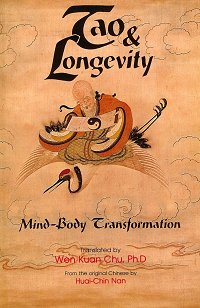
Excerpted from the book Tao and Longevity by Nan Huaijin
…There are many [Taoist] descriptions of being pregnant for ten months, suckling the baby for three years, and facing the wall for nine years that have led some people to believe that successful meditation must involve astral projection. The supposition is that the spirit or divine self has a fetal body of its own which ultimately shoots out of the top of the head and ascends into heaven itself. To believe that this is the way of transforming chi into shen is a serious mistake.
According to the Tan Tao school, yang shen (or positive spirit) and yin shen (or negative spirit) may both account for the projection of the spirit from out of the body.
Originally published in the London Telegraph, August 22, 1880
We are not told whether the Seven Sleepers who retired to a cave in Ephesus during the reign of the Christian-killing Emperor Decius, and only woke up 155 years afterward, when Theodosins II was on the throne, made any special preparation, but probably they did not. Perhaps it was not necessary. Those were stirring times for members of the new faith, and they had little opportunity to grow obese.
But, as a rule, to fast successfully it is said to be necessary for a man to abstain beforehand, and reduce himself more carefully to the required condition by a long course of preparation. Pre-eminent at this art of suspending animation—for an art it becomes—are the Easterns, and most wonderful stories are told of the natives of India, which, whether they powers are due to narcotics or any other process, seem to open up—if true—a wide field of medical study.
Once of the Indian stories, not easily accessible, but of considerable interest on account of the known veracity of the witnesses, will probably be read with interest at the present time, and is inserted here.
Every person’s body has an aura (light). All living things have auras. Even nonliving things have auras. Physicists refer to the aura as a field, a space which contains active magnetic or electrical lines. The aura of the human body is the qi field of the body. Some individuals are born with the ability to see auras. Others are able to see auras with qigong training, as well as after a session of meditation. With the ability to see human auras, it is possible to understand the workings in the human body. Depending on the colors and the intensity of the aura around the individual, the condition of the individual can be deciphered.
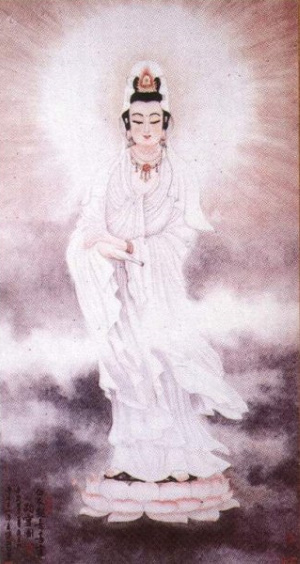
With the ability to see auras, one can also decipher the depth of another person’s energy cultivation. The aura of Laozi was described as purple. The auras of Sakyamuni Buddha and Avalokiteshvara (Guan Yin) were described as a ring with multiple radiating colors. Drawings of Jesus Christ and the Virgin Mary also showed auras. Indian yogis, Chinese Daoist and Buddhist cultivators all have large beautiful auras.
Training Methods:
Excerpted from Learn How to Meditate by William Bodri
Everyone is looking for a way to still their thoughts, shed their worries, and attain mental peace. That is the purpose of meditation…
There are all sorts of meditations in the world that can help you learn how to cultivate a peaceful mind… They work using different principles of mental pacification, but they all involve teaching you how to detach from the thoughts and impulses in your head (and in your body) that normally bother you, distract you and impel you…
Confucius was actually one of the people who taught the steps of this process in the most detail. He said the first thing to cultivate, when dealing with every facet of life–and not just spiritual or character development–was mental “awareness…”
First you have awareness, then stopping, and then stillness which is almost, but not quite complete. If you keep cultivating this stillness through meditation, it will expand so that you achieve the fourth step of the path, which is a state of true peacefulness…
That’s a state that Eastern sages call “samadhi.”
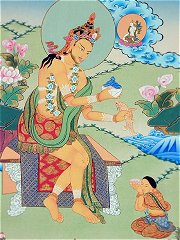
Mi-mno, mi-bsam, mi-dpyad-ching,
Mi-bsgom, msmi-sems,
rang-bas-bzhag.
In English…
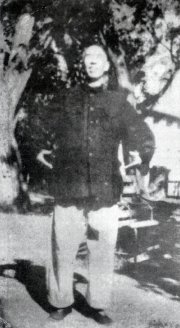
In 1939, Wang Xiangzhai issued a public challenge through a Beijing newspaper. His objective: to test and prove the new martial arts training system of Yiquan, a system that placed standing meditation (zhan zhuang) at its core.
Expert fighters from across China, Japan and even Europe traveled to answer Wang’s challenge. None could beat him or his senior students. His standing meditation training produced superior results in a shorter time period, when compared to methods used in boxing, Judo, and other styles of Kung Fu.
Considering the proven value of standing meditation, surprisingly few people undertake the practice today. Why is this? As Wang himself noted, the exercise is plagued by logical contradictions.

In the ancient spiritual text Bhagavad-Gita, Krishna defined two paths to the highest realization of human potential. For those inclined towards introspection and contemplation, Krishna recommended the path of transcendent wisdom, or Jnana Yoga. For more active and extroverted people, he suggested the path of selfless service, or Karma Yoga.
Blogger Steve Pavlina discussed these paths in his recent article Are You a Lightworker or a Darkworker? After insisting that mastery requires a polarizing commitment to one path—and one alone—Steve denigrated the path of self-knowledge:
If you polarize as a lightworker, you are dedicating your life to serving the greater good. If you polarize as a darkworker, you are dedicating your life to serving yourself. To use a Star Wars analogy, it is similar to deciding whether or not to become a Jedi or a Sith.
For a darkworker the level of unconditional love is directed inwardly as love of self. It’s like a highly concentrated form of arrogance. It may not be expressed outwardly in the form of a smug attitude, but inwardly the person comes to embrace the idea that s/he is the most important person on earth and should act accordingly. Honoring this perspective can actually lead to a state of peace that is virtually the opposite of humility.
While some might label the darkworker path as evil path, I dislike using words like good or evil to describe these paths. They’re really two different sides of the same coin.
Are the paths of lightworking and darkworking truly exclusive? To understand the flaw in this theory, let’s examine a tool that is literally dedicated to gathering cosmic light: the Hubble Space Telescope.