November 26th, 2009 · 6 Comments
As shown in The 20 Best Martial Arts Quotes of all Time, many of the most intelligent and insightful observations on martial arts originate outside its community. Let us now select a few more choice quotations from the art world at large.
A man paints with his brains and not with his hands.
~ Michelangelo [Read more →]

The skills that engender competence in a particular domain are often the very same skills necessary to evaluate competence in that domain—one’s own or anyone else’s. Because of this, incompetent individuals lack what cognitive psychologists variously term metacognition, metacomprehension, or self-monitoring skills. These terms refer to the ability to know how well one is performing, when one is likely to be accurate in judgment, and when one is likely to be in error.
Several lines of research are consistent with the notion that incompetent individuals lack the metacognitive skills necessary for accurate self-assessment. Work on the nature of expertise, for instance, has revealed that novices possess poorer metacognitive skills than do experts. In physics, novices are less accurate than experts in judging the difficulty of physics problems. In chess, novices are less calibrated than experts about how many times they need to see a given chessboard position before they are able to reproduce it correctly. In tennis, novices are less likely than experts to successfully gauge whether specific play attempts were successful.
We propose that those with limited knowledge in a domain suffer a dual burden: Not only do they reach mistaken conclusions and make regrettable errors, but their incompetence robs them of the ability to realize it.
~ From “Unskilled and Unaware” by Justin Kruger and David Dunning
Learning a martial art is inevitably a process of trial and error. So, to some degree, we are all inventors of our own unique style of martial arts.

Some ambitious individuals choose to go further. Rather than building on the experiential framework provided by a living martial arts expert, these innovators attempt to create a superior new system from first principles.
Is it harmless creative expression, or dangerous folly? [Read more →]
In thousands of halls across our great nation, an archaic manuscript hangs on the wall. Written many decades ago, in a time and place quite foreign to our own, this inscrutable document anchors us to a primitive culture that we would do well to forget. I submit to you that it holds no value to us today; as rational men and women, we should put our sentiments aside and discard this anachronism immediately. Our traditions must not be allowed to stand in the way of progress.
What makes this document so odious? Simply put, it is subjective. Instead of identifying specific behaviors for its reader to follow, it describes general principles and leaves each reader to interpret them as they see fit. These statements are so vague and meaningless that they could conceivably be used to justify anything.
Who decides what this document really means? [Read more →]

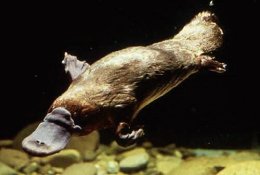
Platypus: The Unofficial Mascot of MMA
Sporting a duck’s bill, otter’s feet and beaver tail, the platypus is considered by some to be the greatest combination of all animals.
Photo credit: striatic
While many Chinese martial arts take inspiration from animals—Tibetan Crane Kung Fu, Monkey’s Fist, Dragon Style, and White Ape Boxing are just a few popular examples—Tai Chi Chuan uses dreary references to binary arithmetic. Small wonder, then, that most people consider Tai Chi boring. It has a serious image problem.
To remain competitive with the thrilling spectacle of mixed martial arts, Tai Chi Chuan should adopt a provocative animal mascot. But what kind of animal best embodies Tai Chi’s unique qualities? [Read more →]
Two underappreciated facts about self-defense:
- The time for avoidance is before the fight starts. Once it has started, you should abandon any notions of yielding or appeasement, and focus on not losing the fight. To honor this distinction, you must be able to recognize the seeds of violence before they sprout.
- Statistically speaking, your probable attacker does not care about you. It’s nothing personal, really. If someone else had walked into the wrong place at the wrong time, they would have been assaulted instead.
No martial arts training should be required to appreciate these points, which can be derived from basic human empathy. The worst Karate move I ever learned, however, flagrantly disregards both of them. Before examining that inferior technique—and a superior alternative—let’s briefly consider the context in which it is taught. [Read more →]
My teachers have disagreed on many things, but in these two points they are all in accord:
- If you want to excel in martial arts, you must touch hands (spar) with as many people as possible; preferably, hundreds or thousands.
- For a great achievement, you must use the correct training methods in a disciplined fashion. Avoid deviant and inferior methods, and refuse to entertain the people who use them.
In theory, there is no contradiction between these two ideals. In practice, compromise is required. Nobody agrees on what the correct training methods are, and everyone measures their progress by a different standard—except for those who reject the concepts of “progress” and “standards” altogether.
Of all the frustrations that hinder interaction among martial artists from different schools, lineages and styles—money, reputation, physical safety—this is perhaps the most difficult to address: everybody else is practicing incorrectly! [Read more →]

A Socratic Dialogue
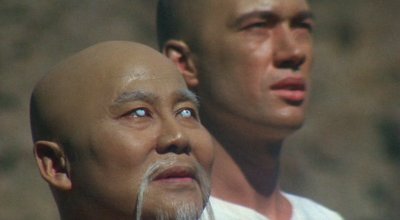
Master Po: Grasshopper, soon you must leave the mountain. We shall now begin preparations for the day that you accept disciples of your own.
Kwai Chang Caine: Be not concerned, master. I have committed each of your Kung Fu fighting techniques to memory.
Po: Grasshopper, these techniques are trifles. It is most important to transmit wude, the moral principles of Kung Fu.
Caine: Yes master, I have also memorized the 377 rules of virtuous conduct, and I will require my students to do the same. Rule number one: “Don’t show up drunk.” Rule number two…
Po: Stop right there. It is not the teacher’s job to recite these rules; it is the teacher’s job to embody them. They are descriptive, not prescriptive. Wude is not something you do, it is something you are.
Caine: Master, I do not understand. On the day I arrived in the temple, I took an oath to follow these rules. Are they not important?
Po: Grasshopper, that stuff is just for the newbies. It is time for you to receive the inner gate teaching on martial morality. [Read more →]

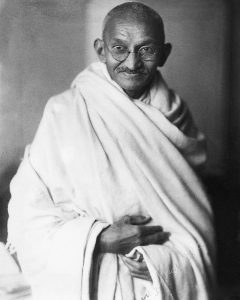
Mohandas Gandhi
Where there is only a choice between cowardice and violence, I would advise violence.
~ Mohandas Gandhi
The nation that will insist upon drawing a broad line of demarcation between the fighting man and the thinking man is liable to find its fighting done by fools and its thinking by cowards.
~ William Francis Butler
He who is taught only by himself has a fool for a master.
~ Ben Jonson
The weakest of all weak things is a virtue that has not been tested in the fire.
~ Mark Twain
Courage first; power second; technique third.
~ Author unknown [Read more →]

Credit: Mark Hirschey
A Fake Interview with Real* Quotes
Martial Development: First of all, congratulations: a recent surge in Berkshire Hathaway’s stock price has made you the richest man in the world. $62 billion dollars, I hear. According to my estimates, you could literally buy up all the tea in China.
Warren Buffett: I drink Coca-Cola.
Martial Development: Fair enough. You know, kung fu is all about profitably investing time and effort. As one of the world’s greatest investors, I thought you might have some unique insights to share with us.
Warren Buffett: I’ve never even made a hostile acquisition! What do I know about kung fu?
Martial Development: More than you realize. [Read more →]
The principle of Subjective Reality—that the universe is consciousness and nothing more—has been employed by authentic spiritual traditions for millennia. Its intended function is not to reveal Universal Truth, but to prepare a seeker for the next stage in their development by dispelling their material illusions.
In other words, Subjective Reality is a spiritual colonic, which for best results must be followed by healthy wisdom food. New-age teachers who skip this critical lesson are like surgeons who excise a tumor, but neglect to close the incision afterwards. [Read more →]