September 8th, 2009 · 7 Comments

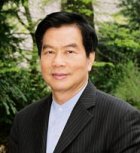
Mantak Chia
Mantak Chia was born in Bangkok, Thailand in 1944. His pursuit of Taoist teachings led him to meet the White Cloud Hermit Master Yi, a Taoist Master living in the mountains near from Hong Kong.
Over a period of five years, Master Yi transmitted to Master Mantak Chia the most sacred and closely held Taoist practices, formulas and methods of internal alchemy, culminating in the Reunion of Heaven and Man.
The author of dozens of books, booklets, videos and CDs describing these practices, Master Mantak Chia has taught hundreds of thousands of eager students the principles of Taoist internal practice over the past 40 years.
Following is an excerpt from a recent Blog Talk Radio interview with Mantak Chia:
Lama Tantrapa: What is the purpose of qigong practice?
Mantak Chia: The initial purpose of qigong practice is to become stronger, to heal yourself, and increase your wisdom and knowledge. The early stages are like Taiji, and afterwards we can begin what we call supreme inner alchemy practice. [Read more →]
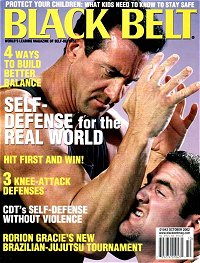
Pick up an issue of Black Belt or Inside Kung Fu magazine. Watch a self-defense DVD. Browse a martial arts website. If you had to write captions under each picture, what would they say?

My hands are deadly weapons.
I am nobody’s victim.
Don’t mess with me, or you’ll regret it.
These poses remind your would-be attacker what they stand to lose. And sure, they are intimidating, to a degree.
The problem is, your attacker doesn’t harbor any intention of losing, and so the potential downside may just be disregarded. [Read more →]
Written by the apocryphal Taoist philosopher Liezi, between 400 B.C. and 300 A.D.
The Earl of Kung-yi was famous among the rulers of the states for his strength. The Duke of T’ang-hsi mentioned him to King Hsuan of Chou, who invited him to court with the highest honors. When the Earl of Kung-yi arrived, the King examined his physique and found him a puny fellow. He was puzzled and asked doubtfully:
“How strong are you?”
[Read more →]
November 10th, 2007 · 6 Comments

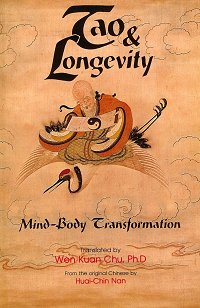
Excerpted from the book Tao and Longevity by Nan Huaijin
Does the spirit actually leave the body during the transformation of chi into shen?
…There are many [Taoist] descriptions of being pregnant for ten months, suckling the baby for three years, and facing the wall for nine years that have led some people to believe that successful meditation must involve astral projection. The supposition is that the spirit or divine self has a fetal body of its own which ultimately shoots out of the top of the head and ascends into heaven itself. To believe that this is the way of transforming chi into shen is a serious mistake.
According to the Tan Tao school, yang shen (or positive spirit) and yin shen (or negative spirit) may both account for the projection of the spirit from out of the body. [Read more →]
September 28th, 2007 · 7 Comments
There are two kinds of agnostics in the world. The first are lazy and ignorant fools; the second reject the philosophy of Baruch Spinoza.
On further consideration, maybe there is only one kind of agnostic?

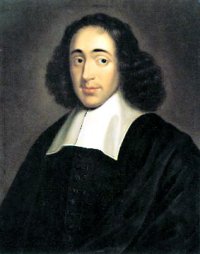
Baruch Spinoza
Baruch Spinoza was one of the great thinkers in the history of the West, celebrated by his peers as a “prince of philosophers”. His work recognized a unity of the human mind and body, science and spirituality, God and Nature, in a manner more commonly associated today with Asian than with European thought.
Like the Taoist sage Lao Tzu, Spinoza was a champion of Monism. [Read more →]
September 18th, 2007 · 6 Comments
Excerpted from Learn How to Meditate by William Bodri
Everyone is looking for a way to still their thoughts, shed their worries, and attain mental peace. That is the purpose of meditation…
There are all sorts of meditations in the world that can help you learn how to cultivate a peaceful mind… They work using different principles of mental pacification, but they all involve teaching you how to detach from the thoughts and impulses in your head (and in your body) that normally bother you, distract you and impel you…
Confucius was actually one of the people who taught the steps of this process in the most detail. He said the first thing to cultivate, when dealing with every facet of life–and not just spiritual or character development–was mental “awareness…”
First you have awareness, then stopping, and then stillness which is almost, but not quite complete. If you keep cultivating this stillness through meditation, it will expand so that you achieve the fourth step of the path, which is a state of true peacefulness…
That’s a state that Eastern sages call “samadhi.” [Read more →]
Duke Wen of Zhao was so fond of dueling that he kept three thousand swordplayers at his residence. Day and night, they competed against another to entertain the duke. Though more than a hundred were killed every year, the duke’s fondness for swordplay never faded. Three years went by and as the state of Zhao declined, other states plotted to attack it.
Li, the crown prince, was greatly worried. He consulted his officials, promising, “Whoever can persuade the duke to give up swordplay will be rewarded with one thousand pieces of gold.” The officials all agreed, “Only Zhuangzi can accomplish the mission.” [Read more →]
Wuji zhuang is the weakest stance in Chinese martial arts. Standing straight and still with their arms down at their sides, the practitioner of the wuji stance is in no position to deliver an attack, or to defend against one. They are sitting ducks, utterly unable to resist force from any of the four directions. So why is wuji zhuang so esteemed among high hands, and considered an important part of training in taijiquan, yiquan, and other arts?
The practice of wuji zhuang, or standing meditation, releases the hidden power of self-knowledge. [Read more →]
November 27th, 2006 · 4 Comments
Ji Shengzi was training a fighting cock for King Xuan of Zhou.

After ten days of training passed, King Xuan asked, “Is the cock ready for a fight?” Ji Shengzi said, “Not yet. He is still haughty and conceited.”
Another ten days went by. King Xuan asked again, and Ji said “Not yet. He is still glaring and domineering.”
After another ten days went by, King Xuan asked once more. Ji Shengzi replied, “He is about ready for the fight. When other cocks crow, he is not affected. He looks like a cock made of wood. Other cocks dare not challenge him, they will simply run away.”
From the Taoist classic book Zhuangzi.
The classification of Chinese martial arts into two families—internal and external—is generally accepted without question. Despite its popularity, the precise definition and significance of these families is not universally agreed upon.
What is the origin of the internal/external categorization? And what should it mean to you as a martial artist? [Read more →]