August 18th, 2010 · 1 Comment

- The inaugural Crossing The Pond Martial Expo was held last weekend in West Seattle. This seminar brought together
five six well-known and highly skilled instructors of martial arts and self-defense from across the United States and United Kingdom.
- Over the weekend, two one-hour workshops were held by instructors Al Peasland, Nicholas Yang, Kris Wilder, Rory Miller, Marc “Animal” MacYoung, and Iain “Tuna Fish Pizza” Abernethy.
- Approximately thirty-five people were in attendance. Among the students, at least one third appeared to be black belts and/or instructors themselves.
- Participants were open-minded, polite, and patient–especially with this author, who hadn’t done any Karate training since elementary school. Egoism, inappropriate competition, and input from self-declared “assistant instructors” was minimal. This is a credit to the affable seminar host, Kris Wilder, and the other teachers as well, who together set the right tone for the event.
[Read more →]
Nobody karate chops me on the street anymore.
Once upon a time, this was the standard response to meeting someone with a martial arts interest: yelp a few times, wave your arms around, do a judo/ninja/karate chop, then hold for applause. But times have changed. People no longer believe televised ninja movies are real. Now they believe televised MMA competitions are real, and nobody uses a karate chop in the UFC. (It’s illegal to strike the trachea, in case you were wondering.)
Don’t get me wrong–I’m not complaining. The classic ninja pantomime has given way to more intelligent comments and questions, such as, “Have you won any tournaments?”
Common sense dictates that the best martial artists are those who win tournaments, while the middling ones participate and lose, and the worst avoid competition altogether. This is only half-true, but the issues are too complex to address during small talk. So, until now, I have answered the question with a simple No, and endured a stigma otherwise reserved for the tea-sipping pajama dancer with delusions of lethality.
Let this be my catharsis. There are perfectly good reasons to abstain from tournament competition, and they deserve an airing. So here we go… [Read more →]

Single combat is a wicked problem. It is a problem that resists a straightforward explanation. It can only be understood after it is solved, and only to the extent that it has been solved.
We tame a wicked problem by defining it clearly. Thus, in the field of software development, we often plan to “build one (solution) to throw away.” The product of this effort is not intended to be a final solution, but a restatement of the original problem in more concrete terms.
The benefit of such throwaway prototypes is that we do not become too invested in refining the right solution to the wrong problem. Solving the correct problem is the difference between a successful engineering project and a piece of abstract art.
To my eyes, The Deadliest Warrior TV series is a work of art [Read more →]
Americans do not usually see themselves, when they are in the United States, as representatives of their country. They see themselves as individuals who are different from all other individuals, whether those others are Americans or foreigners. Americans may say they have no culture, since they often conceive of culture as an overlay of arbitrary customs to be found only in other countries. Individual Americans may think they chose their own values, rather than having had their values and the assumptions on which they are based imposed on them by the society in which they were born. If you ask them to tell you something about “American culture,” they may be unable to answer and they may even deny that there is an “American culture.”
(from Handbook for Foreign Students and Scholars)
Karate Informality
A few minutes prior to the start of class, karateka (students) enter through the front door, immediately bowing to the sensei (teacher) and/or the kamidana (dojo shrine). The karateka remove their shoes, and enter the changing room to don their training uniforms. [Read more →]
Science is what we understand well enough to explain to a computer. Art is everything else we do.
~ Donald Knuth

You’ll never appreciate the true complexity of a mundane, everyday task, until you’ve tried explaining it to a computer.
Contrary to popular perception, computers are not smart. Actually, they are stone dumb. Given a lengthy set of precise instructions, your computer can follow them well enough, most of the time, but when asked to exhibit the tiniest bit of reasoning or creativity, your cutting-edge laptop PC is helpless and hopeless. Ditto for the Mac. Sorry, Linux won’t help either.
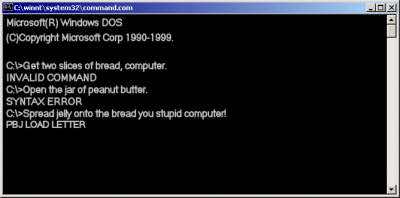
Consider the simple act of making a peanut butter and jelly sandwich. You can teach the average six year-old child this skill in a few minutes; writing the equivalent instructions for a general-purpose computer could literally take weeks or months of effort.

Knowing all this, I was amazed by the concept and promise of Spike TV’s new show, Deadliest Warrior:
In Los Angeles, CA, we’ve created a high-tech fight club, with scientists, martial arts experts, and lots and lots of weapons. It’s all here to create a virtual battle between two legendary warriors. We’ll test their weapons and fighting techniques on high-tech dummies—stand-ins for human victims. Based on this data, a battle simulation program will stage a true-to-life fight to the death. The winner will be The Deadliest Warrior.
Could it possibly be true? Would the endless debates over the ultimate fighting style finally be put to rest, by indisputable scientific evidence? [Read more →]

Chris Brown
Chris Brown must wish he was R. Kelly right now.
After reportedly beating up his celebrity girlfriend, Rihanna, R&B singer Brown has become the newest target of the Internet Vengeance League. Everybody wants in on the action, including LA Boxing president Anthony Geisler.
Geisler recently contacted Chris Brown’s manager, inviting him to step into the boxing ring for a few rounds, and copied the invitation to a Facebook group (“I Want to Fight Chris Brown”). Personally, I find this obscene. [Read more →]
Last week, we considered the evolution of mixed martial arts, specifically:
How do we define the ecosystem of mixed martial arts? Where are its boundaries?
The most obvious boundaries of MMA are its official competition rules. Techniques carrying the highest risk of injury are typically banned:
- Headbutting
- Eye gouging
- Hair pulling
- Biting
- Fish-hooking
- Attacking the groin
- Striking the back of the head, or spine
- Striking the trachea
Significant as they are, these explicit rules do not fully capture the difference between a sporting event and a “martial art” (when conventionally defined as an art of life and death, killing and self-preservation). The majority of rules governing MMA fights are implicit. [Read more →]
In thousands of halls across our great nation, an archaic manuscript hangs on the wall. Written many decades ago, in a time and place quite foreign to our own, this inscrutable document anchors us to a primitive culture that we would do well to forget. I submit to you that it holds no value to us today; as rational men and women, we should put our sentiments aside and discard this anachronism immediately. Our traditions must not be allowed to stand in the way of progress.
What makes this document so odious? Simply put, it is subjective. Instead of identifying specific behaviors for its reader to follow, it describes general principles and leaves each reader to interpret them as they see fit. These statements are so vague and meaningless that they could conceivably be used to justify anything.
Who decides what this document really means? [Read more →]
Nothing fails like success because we don’t learn from it. We learn only from failure. ~Kenneth E. Boulding
Want to become an admired and successful martial artist? It’s easy: just find a style and dojo where the rules favor your natural traits and talents, and insist that everyone follows the rules.
Do you have long legs and flexible hips? Try sport Taekwondo.
Overweight? Take up Tai Chi or knife fighting.
Prefer horizontal combat? Enroll in a BJJ class.
If this sounds like ridiculous advice, it is because you expect more than comfort and fraternity from your martial art. You want a practice that enables you to grow, and to realize your latent potential. Martial arts are supremely useful for this purpose because, at their most basic level, they have no rules; with no impermissible attacks, no fault is too small to remain uncorrected.
How to Become a Failure
Immanent success in martial arts is always a simple matter of lowering your standards. Failure, in contrast, becomes increasingly difficult to achieve. And as the opportunity for failure decreases, the rate of learning slows.

Progress in martial arts tends to follow a logarithmic curve. When a ten-year veteran of the arts possesses only three years worth of skill, it is probably because they long ago exhausted their opportunities to fail.
There are many ways for a student to increase their failure rate. [Read more →]

EliteXC Primetime, headlined by Kimbo Slice and Gina Carano
I’ve always known that, sooner or later, the Chinese art of Wing Chun Kuen would be represented in a professional mixed martial arts bout. I just didn’t expect to see it in MMA’s historic prime-time debut.

Robbie Lawler
On May 31, 2008, “Ruthless” Robbie Lawler forever settled any reasonable doubts about Wing Chun’s viability in real combat. And he did it by accident. [Read more →]