April 12th, 2010 · 1 Comment

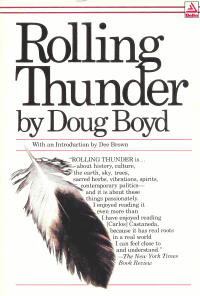
The following short story was excerpted from Rolling Thunder: A Personal Exploration into the Secret Healing Powers of an American Indian Medicine Man. In this section, Doug Boyd sits by the campfire with Rolling Thunder, sharing stories he heard from other spiritual teachers.
On the train to Brindavan a Swami sits beside a common man who asks him if indeed he has attained self-mastery, as the name “Swami” implies.
“I have,” says the Swami.
“And have you mastered anger?”
“I have.”
“You mean you can control your anger?”
“I can.”
“And you do not feel anger?”
“I do not.”
“Is this the truth, Swami?”
“It is.”
After a silence the man asks again, “Do you really feel that you have controlled your anger?”
“I have, as I told you,” the Swami answers.
“Then do you mean to say, you never feel anger, even–”
“You are going on and on–what do you want?” the Swami shouts. [Read more →]

John Chang was a practical joker. I had been on an elevator with him one evening along with twenty other people. The elevator was a glass-walled unit that ferried people up and down the floors of a shopping mall; there was a steel railing all around that people rested their backs on. We were going out to eat that evening at a local restaurant on the top floor of the mall.
Suddenly a burst of current pulsed through the steel backstop. Women screamed and everyone pulled away, suspecting a short circuit. John pulled away too, as I had, but I needed only one look at the barely suppressed grin on his face to realize what had really happened: He had sent a pulse of bio-energy through the railing!
Serious training in meditation, qigong, or kundalini yoga is long, hard, often boring, and sometimes downright bitter. Yet when a student reports their discovery of an exciting fringe benefit, such as heightened or extrasensory perception, certain other members of the community are quick to scold them.
“Pay no attention to such things,” the lecturer instructs. “They will only distract you from the ultimate goal of cosmic union.” Well, maybe so, and maybe not, but in the meantime, I think it is important to keep one’s sense of humor intact. [Read more →]
November 6th, 2009 · 4 Comments
Did you know?
In 1982, Chuck Norris was choked out by the famous Gracie Jujitsu family. A decade later, everybody started copying him. We now know this phenomenon as the UFC.
(pg. 57)
On the set of “Walker, Texas Ranger,” Chuck Norris once took a live rattlesnake by surprise. Then he set it down on the ground, and grabbed it again. The director fleed the scene in terror. (pg. 2)
Chuck Norris is half Irish, and half leg. (pg. 20)
In the interest of full disclosure: I owe Chuck Norris a favor. It was by introducing his “facts” to the mainstream audience back in 2006, that I first established this blog as a premier source for martial arts humor, news, fact and opinion. As payback, he has kindly allowed me to review his latest book, [Read more →]
From Chuck Norris’ recent column in World Net Daily…

God and guns were so important to our founders that they established our protection to exercise them in the first two amendments to our Constitution-–the uninhibited and unrestricted freedom to choose our own religion and bear our own firearms.
But, more and more, these pillars of American life and liberty are being attacked and abandoned, not only out of sheer bias but ignorance of our founders, the Revolutionary period and our Constitution. Instead, these pivotal American rights have become the brunt end of cultural jokes and are often regarded as biased lifestyle components of “rednecks” and rural citizens.
The indifference, lack of education about and passion for all of our Bill of Rights gravely concerns me. [Read more →]
September 9th, 2009 · 4 Comments
The enigmatic Drew Hempel—activist, author, polymath, and accomplished qigong practitioner—shares his fascinating story in this Martial Development exclusive interview.
Drew, how were you first introduced to the ancient art of qigong?
I first discovered Taoism back in the 1970s, in first grade. My best friend at the time was adopted from Korea. He told me he always got his lunch from “Tao Foods” [a local grocery store], so that made me wonder what it was about.
Later, in 1995 I noticed a flyer posted to see qigong master Effie P. Chow, a Chinese master who lives in San Francisco. Immediately I wanted to go, but I was also skeptical of New Age gimmicks. I actually called to request a lower entrance fee, [Read more →]

Excerpted from Beyond Biofeedback, a record of Elmer and Alyce Green’s research on theta brainwave training, which they describe as an accelerated form of meditation.
When Jack Schwarz was in his early teens, he saw a stage hypnotist enter a self-induced trance and then push pins into his arm while he talked about the power of mind to control pain and bleeding. Jack had the normal response to pain until he saw that demonstration, and then, for no particular reason, he knew that he would be able to do the same thing. He got some pins and tried it, and sure enough he could turn pain off. What a conversation piece, he thought.
Jack said that at first he never tired of amazing his friends. He developed a cocky attitude, in spite of the fact that he had not had to develop his skills, but “woke up one morning and found all the diplomas were on the wall.” He could stop pain, stop bleeding, influence people through hypnosis, remove pains in other people by putting his hands on them and thinking about the pain going away, and could often “guess” other people’s thoughts precisely.
We did not make a focused effort to interrogate Jack when we began the laboratory work. As with Swami Rama, we asked him to tell us what he would like to demonstrate. Dale and Alyce wired him in the same way we prepared college-student subjects in other research. When he sat down in the experimental room he produced an envelope with two 6-inch steel sailmaker’s needles. [Read more →]
Excerpted from Professor Lu Zuyin’s “Scientific Qigong Exploration”, a survey of qigong research experiments conducted in China between 1978 and 1992.
Scientific research in the last ten years has captured many external qi phenomena and qualitatively recognized certain characteristics of external qi. On the whole, research on external qi is still at a qualitative stage. It is not easy to establish quantitative laws and phenomenological theories thereby moving to a quantitative stage.
The difficulty is mainly due to insufficient investigation of external qi and the resulting lack of scientific means to express the level of external qi. With more than a thousand qigong schools and numerous different qigong methods, it is difficult to establish common standards.
In addition, a qigong master’s qi-emission power is closely related to his own physical, mental, emotional state at the time of qi emission. As a result, each external qi emission is at best only roughly the same, and it is not as precisely reproducible as an instrument. Experiments seeking basic laws of external qi are not easy to accomplish because they require tens or even hundreds of strictly repeated experiments.
[As demonstrated by our previous experimental results,] qigong is more advanced than contemporary science, thus it is difficult to fit into the framework of contemporary science. However, like all fields of scholarship, if qigong research does not pass strict scientific examination, it will not survive in contemporary society, let alone be accepted in international academic circles. This is a fundamental contradiction. [Read more →]
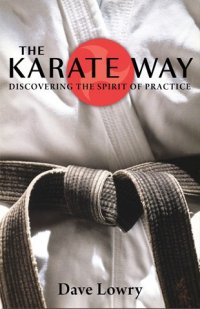
Following is a selection from Dave Lowry’s essay collection, The Karate Way.

We have to admit that the popular image of the black belt is inextricably woven into the general perception of these arts we follow. While we may have a more comprehensive view of the belt, we need to see that in the population outside the dojo, in the world at large, it usually means something else. When a black belt is conferred upon a karateka, that has implications in the popular imagination. And we should consider some ramifications that perception and those implications have upon what people think about karate-do. [Read more →]
Excerpted from The Report From Iron Mountain.
Lasting peace, while not theoretically impossible, is probably unattainable; even if it could be achieved, it would almost certainly not be in the best interests of a stable society to achieve it.
That is the gist of The Report from Iron Mountain. Behind its qualified academic language runs this general argument: War fills certain functions essential to the stability of our society; until other ways of filling them are developed, the war system must be maintained—and improved in effectiveness.
The authors choose not to justify their work to “the lay reader, unexposed to the exigencies of higher political or military responsibility.” The Report was addressed, deliberately, to unnamed government administrators of high rank; it assumed considerable political sophistication from this select audience.
To the general reader, therefore, the substance of the document may be even more unsettling than its conclusions. [Read more →]

Excerpted from Chris Thompson’s Black Belt Karate:
Karate kata (formal exercises) was the only way karate was taught up until the 1930s. In the kata, all the elements of correct karate practice are stored. The vast majority of kata that are practiced in the dojo today and used on the tournament circuit can be traced right back to China or Okinawa.
They appear to be dance-like drills, constantly repeated by students, yet hidden in these movements are hundreds of kakushi waza (secret techniques). These appear to be one form of technique, but in fact may be doing something completely different. [Read more →]