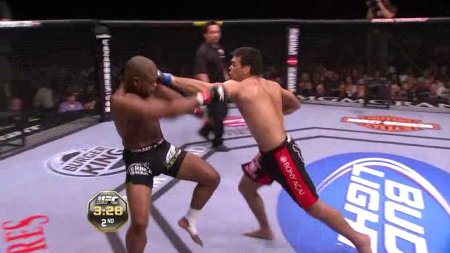
After Karate expert Lyoto Machida’s recent win in UFC 98, fans immediately started talking about a comeback for traditional martial arts. Prior to Machida’s victory, the couch potato consensus had written off traditional training methods as superstitious and ineffective. How quickly perceptions change.
Two short weeks later, Brazilian featherweight Jose Aldo won a truly stunning victory against Cub Swanson in WEC 41. Total match time: 5 seconds. Winning technique: crane kick. [Read more →]
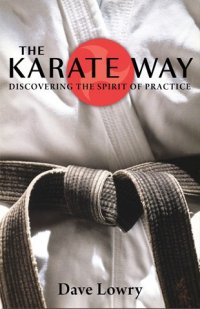
Following is a selection from Dave Lowry’s essay collection, The Karate Way.
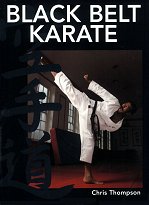
We have to admit that the popular image of the black belt is inextricably woven into the general perception of these arts we follow. While we may have a more comprehensive view of the belt, we need to see that in the population outside the dojo, in the world at large, it usually means something else. When a black belt is conferred upon a karateka, that has implications in the popular imagination. And we should consider some ramifications that perception and those implications have upon what people think about karate-do. [Read more →]
Ikken Hissatsu, the popular Japanese Karate maxim, is usually translated as “one punch, one kill”. And although you won’t see it in the sporting ring, it does happen in real life. As reported in the Seattle Times,
The July 9 confrontation began while James Paroline was watering plants in the traffic circle, where he set cones on the street to protect his watering hose. Instead of driving around the cones, a group of girls got out of a car and two of them yelled at Paroline.
One of the girls summoned Brian Keith Brown, who was driven to the scene. He hit Paroline once and walked away…
Hans Aschenbach, a friend of Paroline’s for 20 years, said the [cellphone video evidence] proved Brown deserved a long sentence. “The video is shocking and was really an execution with a fist.”
Now, I’m not going to ask whether, with all your Karate training, you could have stopped someone like Brian Brown. That is too easy. [Read more →]
When I hear a professional martial arts instructor advising their students to be more natural, I cannot help but feel contempt. Could any help be less helpful?
What is the most natural method for safely evading a knife thrust, while simultaneously positioning oneself for an effortless disarm and throw? How does one naturally reverse a guillotine choke? People who know the answer to these questions don’t need an instructor or a class; for the rest of us, more detailed guidance is appropriate.
With that said, I am a strong advocate of “natural breathing” for martial applications, in contrast to the more exotic approaches advanced in some dojos. [Read more →]
For how long should we continue to practice our kata? Many senseis would simply answer: forever. Personally, I do not have forever to spare. Neither do you, I’d guess.
What do you have? A long list of responsibilities and interests, including but certainly not limited to karate (or other martial arts). You have a desire to maximize the benefits of your practice, while minimizing the costs. And you want to know when, if ever, you should quit your kata.
Simply put, you can justifiably quit when the costs of practice exceed the benefits. Here are a few of the potential, proposed and actual benefits of kata training.
Benefits of Kata Practice
Kata as a Memory Aid
The most frequently cited justification of kata is as a mnemonic device. The kata serves as a living dictionary of fighting techniques and sequences. [Read more →]
Karate kata (formal exercises) was the only way karate was taught up until the 1930s. In the kata, all the elements of correct karate practice are stored. The vast majority of kata that are practiced in the dojo today and used on the tournament circuit can be traced right back to China or Okinawa.
They appear to be dance-like drills, constantly repeated by students, yet hidden in these movements are hundreds of kakushi waza (secret techniques). These appear to be one form of technique, but in fact may be doing something completely different. [Read more →]
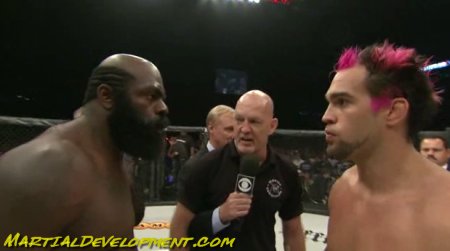
On October 4, 2008, Kevin “Kimbo Slice” Ferguson accepted a last-minute unscheduled fight with a relative unknown. Kimbo entered the match with advantages in strength, weight, and reach. His opponent, Seth “Silverback” Petruzelli, held the advantage of greater experience.
In a shocking outcome that should inspire martial artists everywhere, experience won. [Read more →]
In thousands of halls across our great nation, an archaic manuscript hangs on the wall. Written many decades ago, in a time and place quite foreign to our own, this inscrutable document anchors us to a primitive culture that we would do well to forget. I submit to you that it holds no value to us today; as rational men and women, we should put our sentiments aside and discard this anachronism immediately. Our traditions must not be allowed to stand in the way of progress.
What makes this document so odious? Simply put, it is subjective. Instead of identifying specific behaviors for its reader to follow, it describes general principles and leaves each reader to interpret them as they see fit. These statements are so vague and meaningless that they could conceivably be used to justify anything.
Who decides what this document really means? [Read more →]