Single combat is a wicked problem. It is a problem that resists a straightforward explanation. It can only be understood after it is solved, and only to the extent that it has been solved.
We tame a wicked problem by defining it clearly. Thus, in the field of software development, we often plan to “build one (solution) to throw away.” The product of this effort is not intended to be a final solution, but a restatement of the original problem in more concrete terms.
The benefit of such throwaway prototypes is that we do not become too invested in refining the right solution to the wrong problem. Solving the correct problem is the difference between a successful engineering project and a piece of abstract art.
To my eyes, The Deadliest Warrior TV series is a work of art [Read more →]
Science is what we understand well enough to explain to a computer. Art is everything else we do.
~ Donald Knuth

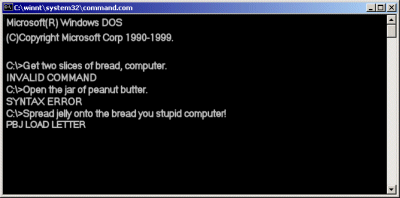
You’ll never appreciate the true complexity of a mundane, everyday task, until you’ve tried explaining it to a computer.
Contrary to popular perception, computers are not smart. Actually, they are stone dumb. Given a lengthy set of precise instructions, your computer can follow them well enough, most of the time, but when asked to exhibit the tiniest bit of reasoning or creativity, your cutting-edge laptop PC is helpless and hopeless. Ditto for the Mac. Sorry, Linux won’t help either.
Consider the simple act of making a peanut butter and jelly sandwich. You can teach the average six year-old child this skill in a few minutes; writing the equivalent instructions for a general-purpose computer could literally take weeks or months of effort.

Knowing all this, I was amazed by the concept and promise of Spike TV’s new show, Deadliest Warrior:
In Los Angeles, CA, we’ve created a high-tech fight club, with scientists, martial arts experts, and lots and lots of weapons. It’s all here to create a virtual battle between two legendary warriors. We’ll test their weapons and fighting techniques on high-tech dummies—stand-ins for human victims. Based on this data, a battle simulation program will stage a true-to-life fight to the death. The winner will be The Deadliest Warrior.
Could it possibly be true? Would the endless debates over the ultimate fighting style finally be put to rest, by indisputable scientific evidence? [Read more →]

How do you think Google established their complete dominance of Web search? Superior engineering? Nope. Shrewd business strategy? Guess again. They have a secret weapon…
Chuck Norris built Google’s first data center from a roll of barbed wire, a pallet of lumber, and a side of raw beef. The barbed wire was just for snacking.

A recent Google Health survey has identified the three most common medical diagnoses in the United States: Chuck Norris’ Right Leg, Chuck Norris’ Left Leg, and Other. [Read more →]

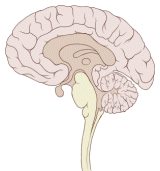
Wetware
(Credit: Patrick J. Lynch)
As a professional software developer, I often ponder the similarities and correspondences between programming and martial arts. A style of martial arts is ultimately just an algorithm—executed in wetware rather than with integrated computer circuits—and there are many interesting correlations to be found between these two outwardly distinct disciplines.
Within both fields, the need for testing is widely acknowledged. [Read more →]
December 26th, 2006 · 2 Comments
This is a continuation of Give Thanks to Your Blogging Inspirations.

From the All Marketers Are Liars Blog
Until recently, I had no interest in marketing. Like so many other scientists and engineers, I considered marketing a necessary evil, unworthy of my own efforts.
[Read more →]
Version History
Kung Fu version 1.0 was released at the dawn of human history, and it was truly a killer app. Though it contained only two basic features—kill people and kill animals—it was useful in solving the problems of the prehistoric age.
Kung Fu 1.0 provided end-users with critical advantages in the constant struggle for food, and an opportunity to reproduce. By leveraging bleeding-edge innovations in Rock and Stick technology, early adopters were able to live to the ripe old age of 30 years, and perhaps even become grandparents. [Read more →]