Rewriting History, Wiki Style
Martial arts are systems of codified practices and traditions of training for combat. While they maybe studied for various reasons, martial arts share a single objective: to defeat a person physically or to defend oneself from physical threat.
~ Wikipedia
Wikipedia’s simplistic definition begs the question: martial arts are martial arts. The statement itself is neither true nor untrue—it is a game rule—but it does reflect an ignorance of, or perhaps a malevolence towards historical facts. Taken at face value, it encourages a dismissive, one-dimensional analysis of the arts’ tremendous potential.
To avoid limiting our achievement in the martial arts, we should begin with an honest and dispassionate accounting of the past. What was the real original purpose of various “martial arts”?
The first clues may be found in our forefathers’ own speech and writings. The Japanese “martial arts” of Aikido and Karate were both systematized less than one hundred years ago, and there is relatively little controversy over their origins.
Morihei Ueshiba left no room for ambiguity when he described his vision of Aikido:
There is no enemy in Aikido. It is wrong to think that having an opponent or an enemy, or trying to be stronger than him and trying to overpower him is true budo. True Budo has no opponent, True Budo has no enemy. True Budo is to become one with the universe. The purpose of Aikido practice is not to become strong, nor is it to fell an opponent. Rather, it is necessary to have one’s heart at the center of the universe, then as little as it may be, help maintain peace among the peoples of the earth. Aikido is both like a compass that enables each person to realize his own individual destiny, as well as a way of unity and love.
Conclusion: Aikido, by Wikipedia’s definition, is no martial art.
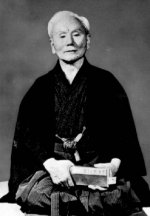
Gichin Funakoshi
Not everyone in the Karate world appreciates Gichin Funakoshi’s assertion that “the ultimate aim of Karate lies not in victory nor defeat, but in the perfection of the character of its participants,” but they do acknowledge he said it. Apparently, Shotokan Karate is no martial art either.
While the historical origins and inventors of older “martial arts” styles are more widely disputed, the practices themselves discredit the martial arts classification—unless you believe Taiji (the metaphysical model) was created to justify Taiji Boxing, or that Ving Tsun’s most fundamental training method was conceived as a fighting stance, or that a bunch of genuine Buddhist Shaolin monks were obsessed with hand-to-hand combat.
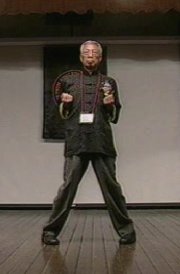
Siu Nim Tau
Basic training of Ving Tsun Kuen
And we can look beyond China and Japan, to the so-called “martial arts” of other cultures. Capoeiristas are expected to sing and play musical instruments during practice. How exactly does this further the objective of “defeating a person physically, or defending oneself from physical threat”?
The historical data support one rational conclusion: martial arts are not martial arts, they are merely used as martial arts. The distinction is critical for its consequence: everything is potentially a martial art, and therefore every time and every place presents an opportunity for study.
Interesting article. I can agree that the definition you are rejecting is flawed, but I can see and agree with what the writer of that definition was attempting to say. Personally, I think that development of real, applicable martial skill is a fundamental characteristic of martial arts, whether or not those skills are ever used.
While soldiers may never fire their weapons in the line of duty, they train to do so understanding that if the situation arises where it is necessary, they will be able to. There are attempts on the part of their trainers to simulate as closely as possible the stress, anxiety and conditions of combat so that if the time comes, they will be as prepared as possible. The military also develops character, integrity and discipline. However, regardless of how disciplined or honest a person is, a soldier who can’t fight isn’t a soldier.
If one trains in a “martial art” that focuses on so many other things, such as character development, flexibility, flashy technique/style or whatever, to the detriment of martial ability, then personally I wouldn’t consider it a martial art.
“Martial” is something that has to do with war. War is bloody violence. If you think of a military tattoo or a ceremonial guard, they can do all kinds of elaborate movements in formation, and you may see soldiers twirling their rifles and passing them to each other through the air, etc. This can be really impressive and entertaining, but it has nothing to do with soldiering, manouvering or fighting with weapons. It’s art, but it has nothing to do with war – it’s not martial.
I don’t think of capoeira as a martial art, I see it as dancing, acrobatics and music. It’s probably good fun, but no one in their right mind would bring it to a war. Now, every language is incomplete in some way. In Swedish, my language, the usual term is “kampsport” which translates to “fight sports” – but not all martial arts are sports! “Martial art” now means anything you do ritually, athletically or artistically that in some way resembles fighting, but in my mind most of it is not at all martial. (Though it may be art.)
Becoming one with the universe? Sounds nice. But isn’t tantric sex, japanese flower arrangements and transcendental meditation also about becoming one with the universe? I’m more into developing my fighting skills, and that’s neither fight sports or martial arts. I guess some things are beyond language.
In theory, Wikipedia content is supposed to reflect a neutral point of view, rather than to serve as a catalogue of hidden agendas and personal preferences. In practice, human beings are not very good at neutrality, and this entry (like so many others in Wikipedia) has instead been filled with weasel words to obscure the authors’ biases.
By labeling these activities as “martial arts”, when these activities do not meet the aforementioned limited criteria of martial arts (and intentionally so!), what do you think Wikipedia is really implying?
Steve, that is exactly the point. A martial art that isn’t a martial art is nothing but rubbish.
Judging these activities by criteria that weren’t meant to apply, as the Wikipedia article implies we should, is an act of passive-aggression. It is analogous to changing the rules in the middle of the game, just because your favorite team is losing.
A martial art is a training method. Training for what? Well, that’s a much larger and elusive question.
Rick, your recent post makes a good addendum:
It seems that Judo is yet another “failed martial art”! 😉
The Wikipedia entry is flawed, yes. However, the concept of “martial art” itself is personal to everyone that considers themselves as practitioners. Some people want fitness, some want enlightenment, some want combat effectiveness. I think that the beauty of this study is that it offers all three, and that we can (or at least should) practice for our own desires without blocking those of anyone else.
How would YOU define martial arts?
Martial arts are movement practices which demonstrate prowess and communicate values.
Would somebody stick that in the wikipedia for me?
Thomas,
From IEEE 1016, a source of inspiration for this article:
“Martial art” is a design view! No architect would confuse a blueprint with a bridge, yet martial artists are always making this mistake.
Scott,
Wisdom borne from decades of diligent study constitutes “original research” and is unwelcome in Wikipedia, whereas quotations from Black Belt Magazine have a “reliable published source“. Embrace the void! 😀
I would think of martial arts as a collection of blueprints, so that you can make bridges, buildings, and all sorts of other things. Some people just want to build a barbeque, others wanna build the Le Tour d’Effiel, there’s something for everyone.
I’m not sure what you mean by confusing a blueprint with a bridge, though. Do you mean that some people confuse sparring with real fighting? I do see that a lot, but I think there are a good deal of people who know they’re just building models rather than actual buildings.
I offer the blueprint as a two-dimensional and incomplete representation of a 3D object, the bridge.
So, I do not claim that the Wikipedia definition is wrong per se, but it is something like confusing an elephant with a wall…then endorsing the extermination of live elephants, for their dissimilarity to the Platonic ideal of a wall!
These martial art techniques, in my own opinion, are actually forms of “art”, and art encompasses a very broad spectrum of both subjective and objective areas of the human nature which we all use to express our innermost passion, feelings, and desires.
Some may train for martial arts to enhance their warrior skills and learn effective combat strategies. While some others, like myself, would choose to believe that these training sessions are one way to improve one’s mental and spiritual being and achieve harmony with oneself and with the universe. Eventually, it will lead to a more balanced and happy life as we learn to empty our senses of the negative factors that surround us and fill our minds and hearts with peace – something which martial arts have always caused – regardless or our own personal reasons for engaging in the training.
Martial of or pertaining to the god of war, aka Mars.
That is the western meaning.
The eastern meaning translates as to “stop spear”.
Two very different meanings and very different approaches.
Wikipedia says,
How ironic that Wikipedia should observe the continual rewriting of (religious) history to serve political ends.
Aikido is Budo, which translates perfectly into “martial arts”
Capoeira is a martial art that slaves in Brazil disguised as a dance
Any excercise is a meditation that heals the body and all sports have a code of conduct. Martial artists are athletes, yet are different in many ways.
Martial arts are fighting strategies, seperated into distinctive systems. Each martial art form is generally recognized by its movements, wich require an initial position to be performed from. Practitioners condition themselves to respond with these movements in combat. Many martial arts incorporate moral lessons and award colored belts to mark progress.
Modern comparisons of the martial arts, with an emphasis on competition, allow practicioners to take from what works best of each style and create mixed martial arts, removing part or all of the traditional identification. Jeet Kune Do was an early establishment of this ideology, though this has not put an end to the creation of new martial art programs. Mixed martial arts can be seen as an evolution, preserving various pieces of each traditional martial art.
cprt.pm8139
As one of those who helped come up with that wording, you seem to have deliberately missed the point. The first line is a broad definition aimed at telling people they are in the right article to read about what they wanted to know.
As to “an ignorance of, or perhaps a malevolence towards historical facts” which ones?
The first paragraph goes on to say that martial arts may have auxiliary benefits, but the key part is based around combat training. Even if there is no intent to use that training for combat or the training is ineffective the concept is still there.
Systematization does not mean ‘Static’ or unchanging : Aikido was Founded around 60 years ago, and was primarily derived from Daitō-ryū Aiki-jūjutsu, i.e. a school of jujutsu that taught a selection of techniques.
Aikido in later years focused less and less on combat an more on spirituality, this is not common to all martial arts, one example does not make a rule!
How long does something need to be around to be ‘systematized’? The Marine Core Martial Arts Program (MCMAP) is less than ten years old but is a highly systematised set of techniques.
Modern Karate is recent but the tradition is reasonably easily traced back to China via Okwinawa in the 14 century! Again much has changed but really small parts at a time with clear continuity
The point being that neither saying “Martial arts should be ‘old’ if they are systematised ” or “these are martial arts and they are ‘new'” holds water leaving a gaping hole in the rest of your argument
What you are saying is that “Martial arts are a Philosophy” and dismissing any that are not philosophically based as not martial arts. Philosophy is closely associated with some eastern martial arts, but saying that a name meaning “arts of war” actually should be defined as “Philosophy” is just dumb
Total Samurai: it translates to “war way” do = way art = jujtsu, the difference is sometimes negligible (especially in the modern world) other times it indicates motivation which is key in this context
Nate, the purpose of citing historically recent examples, is to avoid claims that their “true intent” was lost ages ago–and that their “true intent” matched…whatever you like.
A design view is not a philosophy, and for a few hundred dollars the IEEE will happily explain the difference. I don’t believe they honor demands for free “evidence,” so you’ll get what you pay for.
A design view is something you lay out before hand, not something you apply retrospectively – that’s a definition, you don’t build a see an olympic swimming pool then complain that it isn’t a real pool because it doesn’t have a wave machine like the ones you grew up seeing on TV…
Please read what people write rather than skim, I never said you were using a philosophy i said you defined martial arts as a Philosophy.
The intent in a martial art will vary between who is using/learning/teaching it, but to be a martial art it must have some element of preparation for combat, even if that is no longer the primary application and the preparation is now highly stylized.
Some schools of Aikido do not emphasise the spiritual aspects, these are generally ones descended form those who learnt from Morihei Ueshiba earlier on as he didn’t emphasise it then. Aikido is not a homogeneous lump.
Then it is your turn to read rather than skim.
I responded to you original post not the comment thread, also this still implies it is a prerequisite not a subsequent thing.
I just stumbled on this, I agree with the view expressed in the post, and I edited the Wikipedia article to address the problem. You are most welcome to come to the article talkpage and provide further input.
As you can well imagine, it is an endless and thankless task to clean all sorts of bullshido from Wikipedia.
To the people who presented the “soldiers train to win wars” simile, you are confusing martial arts with self-defense. Self-defense is a subset, not a synonym of martial arts. Soldiers train shooting to win wars. But other people may train to shoot for all kinds of reasons, e.g. to participate in target shooting competitions, out of antiquarian interest (collectors of historical firearms), or just for the hell of it. You need to understand that “martial arts” is a term in its own right, it is more than the sum of “martial” plus “art”, and etymological definitions are futile. In fact, “martial arts” is in origin a translation of “bujutsu”. It is not opportune to exclude Taijiquan from the term just because it not applicable for self-defense: it is very clearly a discipline within the larger field of Chinese martial arts. Of course there will always be borderline cases such as Capoeira. This means that they should be discussed *as* borderline cases, not that a “true” definition should be aimed for which settles the question apodictically.
A refreshing change of pace from trendy views on martial philosophy. I like it.
So can I call the art of sitting in front of a computer and arguing over the internet, martial arts?
Joke aside, if we consider a soldier a martial professional, and a dancer an artist, then what would a martial artist be? It’s also worth to note that neither soldier nor dancer must necessarily be a martial artist, even though they represent both extremities of martial art, one of practice, and one of creativity.
Maybe the problem isn’t the meaning of martial arts, but the abusive use of “arts”
What is art?
Feel free to correct me, please.
martial meaning military or martial philosophy being yin and yang in relationship with martial art. In more American terms possibly both aspect’s in or out of contrast. martial art encompassing the further aspects of martial philosophy (abstracting to further exploration or development of potential’s in student’s or practitioner as art exploration) as a discipline of purely physical effort with little philosophic idealism. Or as a mode of more abstract expression (perhaps a dance or something else entirely at its depth), warfare. or are not the drawing’s painting’s and other creation’s constructed by student’s included as well. As a necessity or a way of seeking enhancement in personnel, personnel development. Or to as seeking a cure cite rgate, and the malady’s of civilization. Art / artist . art only exists because of the artist, here the artist is the work and its painter.
A word for Capoeira as a Martial Art. There is a theory that tells the martial training slaves were doing had to be desguised as a dance, hence the music. Also, if you wach them, many movements use the hands together (as in being cuffed or tied). I think maybe a soldier training is a luxury a slave can’t have but I find really “martial” to keep practicing to preserve your culture and to be ready if the ocation presents itself.
Capoeira can be totally effective in the ring, btw. There are a few examples of effective capoeria style kicks in the UFC and Anderson Silva uses capoeria footwork to enter on opponents, when he does actually enter.
When you practice for long enough, and train with real masters you’ll see the patterns of martial arts repeated in every area of life. Even sitting at a computer arguing. This is because all martial arts, in their point of origin, have one commonality: achieve a goal as effortlessly as possible. This is why martial arts change shape in different contexts, as the goal shifts so to do does the art. And this is the same way everything else works. From defence against violent attackers, to point fighting, to use in MMA, to kata performance, karate looks very different. In each area there is something to be gained and lost. To humble the self and keep searching endlessly for the most effective path is martial arts.
I myself compete in amateur MMA and practice Muay Thai and BJJ. I was privileged enough to learn Qigong under a master in China and, though it may seem odd, Qigong aided my fighting more than continuing to drill my MT and BJJ would have by, simply, improving body mechanics and thereby the transfer of power as well as allowing me to better empty my mind in combat. Now, it didn’t HAVE to be Qigong (Yoga, other mobility practices or other mindfulness practices would’ve had the same effect) but Qigong certainly served that end. I now do tea drinking rituals and qigong daily, and both have really aided my fighting. Similarly, I have recently been privileged to study under an 8th dan Shotokan blackbelt who also served in the military for 20 years and now trains military/police/security in close quarters combat. His traditional art has completed revamped my weight shift on punches and we’ve been working on conditioning my wrists and bare knuckles which has also greatly increased punching power by instilling more confidence.
What may not seem like fighting can aid fighting and fighting can aid what doesn’t seem like fighting. If the perspective of the martial arts is adopted, to attain an end as efficiently as possible, then once can have the confidence to take on a thousand foes. And I mean that literally (Using my martial arts prowess, knowing that I’m outmatched, I would run away and hide!)