In the past few years, mixed martial arts has enjoyed remarkable commercial success. Some fans imagine that its popularity is a result of its vast technical superiority over traditional martial arts styles. But neither MMA techniques nor training methods are particularly innovative; much of what you see in the competition ring was pioneered decades or even centuries ago.
The recent success of the MMA product is best explained with a sociological model, not a technical one; and this model predicts an inevitable fall from grace. MMA will decay, like every style before it, into a traditional martial art.
MMA and the Product Lifecycle
MMA is more than a martial art, or combination of arts; it is a multi-million dollar industry. It is a product sold on pay-per-view television and in training halls across the United States and the world. And like any other object of commerce, it is subject to the product lifecycle.
Credit: Nate Bailey

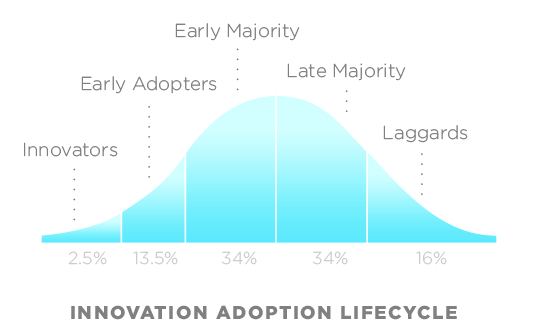
The lifecycle model defines the different stages that all products travel through on their journey from birth to death. These life stages are marked by shifts in market awareness, profitability, and competition; and most importantly, by a migration in the psychology of the consumer.
Philosophically speaking, today’s MMA is an expression of heterodoxy, a rejection of traditions gone stale. As such, this modern style has attracted many of the best and brightest fighters: men and women who, in an earlier age, might have practiced a purer form of Judo or Taekwondo. In the language of business, these people are known as innovators and early adopters.
The vanguard of every product adoption curve is composed of such consumers. Statistically, these individuals are younger, richer, and more risk-tolerant than the marketplace as a whole. They prove a product’s potential, escorting it from obscurity to commercial success.
MMA: A Tradition in the Making


Pokemon and Digimon
Entering the this stage of rapid product growth, competition floods the marketplace. Producers introduce variations on the product, to target the mainstream and low-end consumer, with the goal of maximizing income. After Pokemon, we got Digimon; similarly, the UFC concept has been extended to dozens of televised MMA competitions and reality shows.
As the novelty and quality associated with the art starts to fade, early adopters will be the first to abandon it. Transitioning out of the growth stage into maturity (market saturation), MMA will be directed by a very different psychology.
Late adopters of any product are by definition conservative and risk-averse. They reject change, and embrace the familiar. These are the consumers of “traditional” martial arts products, and MMA producers will adapt to suit their tastes. To do anything less would be bad business.
So, industry marketing teams will re-discover the values of “discipline, respect and honor”—as profitable euphemisms for non-threatening social stability. Unpredictable elements of the authentic traditional practice, such as free sparring, will be de-emphasized. After-school “kiddie MMA” will rise to prominence.
Big business will choke the vitality out of modern mixed martial art, but we should not shed a tear for its demise. This is the circle of life, and hasn’t every decrepit traditional art we recognize today followed the same course?
I suppose that the death of MMA, as with all things, will be inevitable. However, the question lies in when and for what purpose. Right now, I’d say we’re still in the Early Adopters phase, maybe barely into the Early Majority phase. Boxing, by comparison, I feel has reached the Late Majority or Laggards phase, and has taken about two hundred years to get there. So how long will it take for MMA to reach the same state? Due to the unparalleled complexity of the game (I doubt any other sport is so free-form), I imagine we may be well into the twenty-third or twenty-fourth century before it starts to fade away.
Is boxing dead? By our modern standards, no–but those 18th and 19th century boxers who never knew the Marquess of Queensberry rules might have a different opinion.
I don’t think the technical complexity of MMA will lengthen its mainstream lifecycle, because as I tried to explain above, this is not a technical issue. Society is changing faster than ever before, and attention spans are shrinking.
Well, I suppose the question is just how long do you think MMA’s mainstream lifespan will be? Society is changing faster than ever, and it can be argued that the free-form and unpredictable nature of MMA matches suit the current niche for combat sports. The biggest demographics for MMA are males in the early 20s, which leads me to believe that it will continue to grow and develop, sticking around for quite some time.
Side-note about martial arts lifespans: Do we consider traditional martial arts dead as well? It is inevitable that things will change, as you explained with boxing. The real training methods and environment for traditional gong-fu, karate, and taekwondo have all disappeared, and real qigong has all but vanished. Traditional art forms will never last forever, no matter how hard we try to keep them alive, because they’ll always change as time goes by.
do a bit of research and you will find that MMA is actually the oldest traceable martial art in the world originally known as pankration.
and yet you say it will become a “traditional martial art” what a joke MMA already has a firmer base in tradition than any other martial art that we know of other than boxing and wrestling
648 B.C till 2008 A.D thats 2656yrs and still going strong.
but maybe one day it will reach the “late majority” stage
proponitis G, this article is based on a distinction between Mixed Martial Arts techniques and the MMA commercial offering. As you noted–and so did I in the very first paragraph–MMA techniques are centuries-old. Why then is MMA marketed as an alternative to “traditional martial arts”?
Do a bit of research on psychology and market segmentation, and you will find the answer.
Ultimate fights expand to include kids (March 27 2008, Associated Press)
I think society molds the martial arts to be what it is, where as in Canada, USA have different training methods compared to South East Asia like Cambodia where head spiking and neck twists are still being practiced as culture. I think now that the western world is taking in all types of martial arts and putting in a melting pot you get a product that isn’t true to its form, just as jiu jitsu from judo and muay thai coming from pradal serey. The old form is lost and you have a new product which will become mainstream and then watered down cause of what society views it, just what I see now in some MMA schools. MMA will become a mainstream sport and martial arts will be a fitness training routine and killing arts like traditional pradal serey which is meant for killing in the battle field will only be taught to keep the tradition alive and never become a sport.
From In the Guard MMA News:
I believe MMA is noted as a TMA alternative due to it being most likely that any long term traditional martial artist would easily be able to implement a portion of their previous studies to the MMA art, dependant upon the style practiced. I guess this is encouraging to martial artists that have been training some time and don’t want to learn an entire new skillset.
The evolution of MMA isn’t mentioned at all in this article either; MMA has evolved incredibly over the last 10 years. Started out with grapplers being at the top of the food chain, then ground n pounders (wrestlers with striking) then turned into strikers preventing being taken to the ground. These days if most fighters don’t look after and train in all ‘ranges of fighting’ ie. striking, clinching and ground fighting then they don’t have a well laid out skillset and will most likely lose to someone that does. I guess this leads to the question of if this ‘martial art’ is due to die out like some kind of marketed product then what will follow it in the martial art/sport fighting world? In my mind I can’t see a predecessof MMA unless we evolve to have extra limbs or we take on aliens of different body structures 😛 as I’m sorry to say it but time and again it’s been proven to be the most effective and efficient sport fighting as it encompasses all ranges and scenarios of a 1 on 1 fight within a ring, hmmm unless they re-introduced biting or eye gouging or something.
I don’t believe MMA will die out quickly at all…extreme sports aren’t very old but they appeal to a certain demographic, I don’t think a up and coming sport (it’s not even up and coming anymore) should be looked at the same way as a marketed product.
Robdog,
If you’ve ever seen an aboriginal hunter chase his dinner for miles, barefoot, across the open savanna, then you know that “extreme sports” activities have existed for thousands of years. So what is new? The marketing, commercial sponsorship, and other corporate trappings. What was once an small-scale, life-or-death endeavor is now largely a mass profit-making exercise. This is an interesting analogy for mixed martial arts.
On the topic of evolution, consider the Dodo bird. It was extremely well-suited to an extremely restricted environment: the island of Mauritius. After predators started to violate island’s natural boundaries, that bird didn’t last much longer. What are the boundaries of modern MMA?
There are even risk-adverse people inside of Tai Chi, with the Tai Chi set doing part of the physical-training. The body is also trained with push-hands, which will reveal stiff-spots and limp spots. I’ve fallen during practice, which only revealed my need to address stiff muscles.
The people which want the largest quantity of students, will need to modify all of the items to the lowest risk possible. That largest group size possible, will have a portion of people which will intentionally injure other people. This liability-level caused by a large crowd of students, will cause such a heavy-restriction on techniques, ’twill cause Tai Chi to appear as more-brutal.
Quick Point to clarify the model displayed talks about rate of adoption, not total market size, that talking off you are discussing is tailing of of NEW interest. The early adopters and others leaving is a completely different concept.
sorry guys to disagree but the only thing i am impressed by with mma ufc and the others would happen to be the training unfortunatley that rarely translates to fight time say what you want about boxing but is is the science meaning thetraining is theory and the fight is application get it? not taking anything away from tthese gentlemen but one question why is it when the fight goes to the ground we now call what used to be just mount and pummel to ground and pound somehow validating what is just street fighting you know the same thing we did in grammar school jump on top of the kid and beat them down i dont remember needing an instuctor for that.. none the less it just proves a couple things most want to see this human form of cock fighting and as i have noticed at the gyms i check out from time to time everyone wants to be a tough guy !! but the funny thing is the tough guys i speak of cant take a shot just wither after a punch in the face say what you want about boxing ,but you train to take a punch it is an eventuality, simple plan train eat sleep then apply your training in real time like the fight.
Now almost 3 years later, this article was spot on. The adoption curve has many uses besides economics, and we have already seen a change in how MMA is headed.
Why don’t you apply the “product life cycle theory” to aviation, electronics and publishing? When will jets, microchips and word processors go out of style (end their “product life cycle”) and be replaced with propeller airplanes, vacuum tubes and typewriters.
Sorry, but MMA has obsoleted and replaced the bullshit that preceded it, as jets, microchips and wordprocessors have replaced and obsoleted propeller airplanes, vacuum tubes and typewriters.
There are clear metrics to measure the speed of an aircraft or a computational device just as there are clear metrics to measure the effectiveness of a fighting system. In the early 90s, no rules, and near no rules, competetions became popular and the hybrid system comprising Muay Thai, wrestling, boxing, BJJ and Judo, which is called “MMA” has been shown to be the most proven to be the most effective fighting system so far discovered.
People have been fighting since the beginning of time. Its apart of human nature. The Romans were the first to implicate competition style technique to “MMA”. But really fighting is apart of culture. eastern cultures have several including jujitsu, karate, tae kwon doe all of these are rooted in deep within there traditions. all martial arts were invented as combat techniques used in war hence the word “martial” which means war. which was used ever since the organization of society. every martial art had its own style and moves some useful some useless in a modern fight. bruce lee father of MMA created jeet kune doe mixing martial arts keeping the useful and discarding the useless for a street fight style of fighting. which is essentially what MMA is supposed to do. when the UFC 1 took place in 1993 its purpose was to find which martial art was most effective in a street fight which was royce gracie from jujitsu but the style of jujitsu was made to adapt to the different styles of fighting ,but his family had been in other MMA tournaments before this in brazil from the 80s. thus the UFC was born the following tournaments focused more on cross trained fighters then trying to find the best martial arts. right now the UFC is the forefront of the commercialization of the sport of MMA. so the sport of MMA has been around since we had a reason to fight each other and is a tradition past down through generations. so its not a product. the commercialized version of it is but even that has been around since 600 AD with the Romans. so the product cycle ending for MMA not in the recent future or at all seeing that right now is the sports all time high but we’ve barley scratched the surface of its potential. we would more likely see American football baseball or basketball end before MMA ends
This “life cycle” of sports is a joke lol what are you basing this on? what other sports can you use this life cycle to? saying this cycle exists means you have already witnessed the rise and fall of great sports which must take centuries… you sir are a moron.
http://www.martialdevelopment.com/blog/the-end-of-mixed-martial-arts/#comment-5491
Leo is correct in the fact that people have been fighting and warring since the beginning of time. Cain killed Abel, second generation man, and we’ve been at it ever since (pseudo historical/religious joke there). However, there were sparring competitions well before the Romans walked the earth in centurion formation. And the various militaries developed systematized styles of fighting, to include formational tactics and individual combat. Like any good combatant, they evolved their fighting to include new techniques and what worked. Look at the Marine Corps facility MACE. They are studying and breaking down hand to hand combat to improve their training techniques.
TMA was combat, and is combat when practiced properly. This concept that Bruce Lee developed a street effective style of fighting is cute, but rather nonsense. He developed a system that would be easy to teach to individuals who didn’t grow up learning it. All traditional martial arts that are worth their salt are effective in street situations. And the UFC style of fighting isn’t as effective in street situations as it is in sport. (Flame away if you disagree – I believe MMA and UFC styles fighters are becoming some of the best athletes in their training and fighting regime – but getting into an awkward cuddle and rolling on the deck while my opponent’s buddies pound on me isn’t an effective tactic for street situations). Perhaps in one-on-one it might work exceptionally, but when numbers get involved it changes the tide of battle.
To the original topic, I think like most sports and even arts, MMA may have peaked it its fanatical stage, and now may be becoming much like boxing or football, with a steady following of the sport. It will probably last for decades if not longer as a sport until the next evolution occurs and combat chess takes the stage. Or perhaps High-Stakes Go. I see the dojos and schools for MMA being much like the dojos of the 70s – filling with students. Some of those dojos are still open today, but not with the same numbers they had in the 70s, when Bruce Lee was the rage and Chuck Norris was just starting out. (Perhaps we’ll start having Little League MMA teams as MMA becomes normal sport.)
As for GK saying that “MMA has obsoleted and replaced the bs that proceeded it” – what BS are you refering to? The BS that was the foundation for what you consider MMA. That’s like saying you’ve replaced your father and your grandfather and that they were BS. MMA may just be the next generation, or it may just be a juvenile that past generations don’t consider worthy to address yet. MMA came from those past arts, so maybe you can pay a little respect (not to some of the pathetic schools that teach watered down stuff but to the foundational arts). MMA has been “tested” in an arena and those “no rules” events did have rules. They simply were billed as “no rules” – marketing. Some of these self-claimed MMA arts that were tested on the streets were between two athletes who weren’t out to kill each other. Many of the past traditional arts were tested on the street and in battle to the death. And at times the victor walked home maimed and or dying. Foolishness if you don’t have to prove anything. But, as men (generically speaking) we always do feel we have something to prove. In the past few generations, we have thankfully pulled away from the street fights to the degree they had been, but in doing so many traditional martial artists have ceased practicing to the level where they are effective. I see the MMA athletes pouring their hearts into their sport, and its paying off in their abilities in the ring. I wish I trained with the same intensity that I see those young athletes training. It is inspiring.
Just my thoughts. I hope you have a good day.
I believe the word “Martial” is a fairly modern term and was put in front of the word “art” by Europeans probably to differentiate between other more common arts such as dancing. The traditional styles were just that, an art not solely focused on fighting people but self defence orientated and as a way of life, a way of improving ones self through self control and the many other benefits these arts can bring to a practitioner. I think that MMA and UFC fighting mostly appeals to the younger generations and consequently since the traditional arts have become known in the western world they have become misunderstood and to some extent used and discarded. What young man today looks at traditional systems, he is not interested in becoming a better person through learning the traditional philosophies behind a self defence system or concentrating on the basic forms that are the foundations of the techniques he will learn, he only wants to be a good fighter and beat his opponent. Many people however are still choosing to attend or send their children to martial arts classes for one benefit or another and for this reason the modern version of the traditional martial arts clubs will survive. As everything is so commercialised these days it would be very difficult to find the type of clubs that existed in the days before Bruce Lee, however I understand it is called progress and everything must adapt to the times in order to survive.
actually,mma is perhaps,the very best thing that has happened in the world of combat.It is really not as ineffective in a street situation as it is often made ot to be.I honestly dont think an mma fighter would use a bjj move in a street situation.Many “traditional” fighting styles claim to be streetwise (eg: they claim they use eye gouges,groin shots etc) but when do they ever practice them ?? Unless,you are habituated to something,how will you use it ?? And there is no need to abhor mma or dismiss it as violence.There are many other seemingly innocent practices in the world that are way more dangerous.Best example is religion.It has caused (still causes) more wars,more innocent people across the world have been killed in the name of religion.Not to mention that in the age of science,religion has also became obsolete ie believing in a fictional entity named god…but all that being said,you wouldn’t ban religion ,would you ???