A Simple Guide In Plain English
Introduction
- Chi (qi) is an ancient Chinese term, which can be translated as energy. Like energy, the word chi is used in both abstract and concrete terms, and applied to both general concepts and specific phenomena. In other words, chi is ambiguous. (People who use the term often have a specific meaning in mind.)
- In the broadest sense of the word, chi is generally understood to be pervasive, present in everyone and everything, but it is not uniformly distributed.
- Chi moves freely around the universe, assuming various forms along the way. Disciplines such as Chi Kung (Qigong) and Feng Shui purport to observe and manipulate chi, for the specific benefit of human life.
[Read more →]

Although Tai Chi is an effective treatment for stiffness and lower back pain, the complexity of its forms discourages some from learning the practice.
Fortunately for back pain sufferers, not all Tai Chi forms are long and elaborate. While some traditional forms contain more than one hundred movements, others contain less than a dozen. The short forms are easier to learn and faster to complete, but no less beneficial to the practitioner’s health.
Among the short forms, Tai Chi Ruler is the easiest to learn. The ruler, or chih, is a simple wooden dowel, approximately one inch thick and one foot long. Fundamental ruler practices consist of a single movement, repeated a few dozen or few hundred times.
Many of the Tai Chi Ruler movements do not actually require a ruler, and can be performed just as well without it. Here I will describe one such exercise, which is suitable for any age and fitness level. [Read more →]
October 19th, 2007 · 7 Comments
An Exercise to Build Flexibility and Coordination
This Pigua Tongbei warm-up exercise is an old favorite of Mike Martello—Director of the Wu Tang Association of Belgium—and a new favorite of mine. It will loosen and strengthen your core: waist, back, shoulders and hips.
[Read more →]
Last week, I attempted to describe one of my favorite lower body warm-up exercises. Online and offline feedback since then indicate that my description wasn’t as clear as I intended.
The particular choreography of this kicking exercise isn’t so important. I recommended it for its general characteristics. To explore those qualities, let’s contrast the exercise with a more common kicking drill: [Read more →]
February 26th, 2007 · 8 Comments

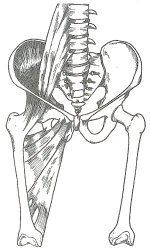
Kwa (Iliopsoas)
The best warm-up exercises do more than increase your heart rate. They build flexibility, strength, balance and coordination, in a way that is relevant and beneficial to your martial art.
Here is one of my favorite exercises for loosening the kwa, or hip region. Tim Cartmell demonstrated it at a recent seminar in Seattle. [Read more →]
January 23rd, 2007 · 4 Comments

Happiness does not happen to us, it happens by us. That is, by our specific intentions.
The Secret Smile is a simple and powerful meditative technique for cultivating happiness, to improve your health, your work, your relationships and your outlook on life. To practice the Secret Smile, follow these steps:
- Sit quietly and relax, until you have reached an emotionally neutral state. [Read more →]