
Shield and spear
To the ancient Romans, the concept of a non-violent martial art would be nonsensical. Their literal definition of martial was “belonging to Mars”, the god of war. Modern usage of the term martial arts, however, is hardly related to military strategy and tactics.
Today, most popular martial arts are practiced without arms. Considering this shift in focus, from immediate and practical skills to more abstract and long-term benefits, it is reasonable to ask whether violent destructive potential is still necessary at all.
Is a non-violent martial art worthy of study?
Before we can attempt to answer this question, we should first clarify the definition. There are two distinct categories of non-violent martial arts.
The first category is exemplified by Aikido, which can be translated as The Way of Peace, or The Way of Harmony. Under mainline Aikido philosophy, starting a fight is impermissible, but ending it is compulsory. Destroying one’s attacker is not ideal; yet this is recognized, in some circumstances, as a practical necessity.
Members of the second category of non-combative martial arts are not necessarily pacifist in disposition, but inadvertently harmless due to their complete lack of non-cooperative practice. In the absence of testing, formerly proven attack and defense techniques decay into empty symbolism. Dahnmudo apparently belongs to this second category, as do those schools of taiji that omit tui shou and san shou from their curriculum.
No Conflicts, No Resolutions
[The need for conflict resolution skills] is based on the premise that poorly handled conflicts lie at the core of emotional distress. With more effective conflict resolution patterns, individuals, couples, and families and distress can move toward resolution of their underlying difficulties and resume emotionally healthy living.
Business people, lawyers, political leaders, parents and children—in fact, all of us—deal with conflicts daily. Few of us want altercations to disrupt the smooth flow of our lives. We want what we want, but without loss of a cooperative atmosphere in our homes and at our workplaces.
Source: Skills and Strategies for Individual, Couple, and Family Therapy
In life, interpersonal and intrapersonal strife are inevitable; effective conflict resolution skills are not. Freestyle sparring is one way to develop these worthwhile skills.
This is not to say that all personal conflicts can be resolved with lightning-fast punches, brutal kicks and excruciating joint locks. It doesn’t mean that you beat up your boss after being asked to work overtime. The refined martial skill set contains far more subtlety and depth.
Relevant conflict resolution skills, summarized in a recent article by Drs. Jeanne Segal and Jaelline Jaffe, include:
- the ability to recognize and read nonverbal cues
- the capacity to remain relaxed and focused in tense situations
- the ability to experience intense emotions and recognize what matters most to you
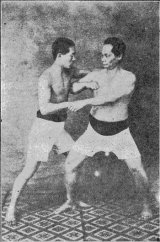
These qualities are a natural byproduct of jiyu kumite. They are not passed down from master to student via verbal instruction; they are inculcated by the rigors of the practice itself. Competent conflict management is not learned so much as earned.
Dojo, or Day Spa?
Freestyle sparring is perceived as excessively dangerous by those without experience: resulting in hard feelings at best, serious physical injury at worst. In reality, these risks are minimal with proper supervision and guidance.
Students of non-competitive martial arts shoulder a far greater risk, that of failed investment; that, after spending much time and money in an artificially stress-free environment, they are no better equipped to cope with trial and tribulation.
Persuing short-term comfort and control at the expense of challenge and growth, these students have missed an important lesson. When the challenges inside the dojo exceed those outside of it, life itself may become an oasis.
I’m not so sure anout non competitive martial arts.
Though I did sparring in IMA for more than 10 years, I stopped with 40 and the last 8 years did nothing in terms of serious fighting.
All in all, I never had reason to see and try my stuff in real application, thanks god! But as I get older my emphasis is more and more on inner training, neigong, qigong and form training.
I would like to distinguish between the free sparring I recommended above, and “serious fighting”.
Free sparring (in my opinion) does not require you to hit hard, or submit your partner. The goal is simply to gain and maintain a superior position, against someone who is trying their best to stop you.
I spend about 10% of my time in non-cooperative training. That is enough to ensure I keep moving in the right direction, during solo practice.
Featured in the January 2008 Carnival of Martial Arts.
The competitive approach …. both free sparring in a dojo or competing in a tournament … declares the most vital areas as off limits. In the lightest form it is a game of tag, maybe with some benefits. Perhaps full body gear could be the answer, but the limitations in movement would hinder effect execution of techniques. Like Hermann, I haven’t sparred in years …. uh, decades (unless you count the play sparring I do with my 12 year old). I loved it when I was younger, but I’m 52 now and find katas and basic drills works just fine for me. Is there really anything wrong with approaching it just as an art and for overall health?
When the great trumpeter Miles Davis took the stage in his later years, fans would sometimes ask him to play his most popular works from decades past. His frequent response was, “I ain’t playin that old sh*t!”
Do your katas and drills really approach the level of art? Or are they just comfortable repetition? There is nothing wrong with comfort, except that it is antithetical to growth.
As Confucius said, “The one who would be in constant happiness must frequently change”, and freestyle practice teaches poise in the face of change.
I can appreciate this. It sounds a lot like Bruce Lee and the philosophy he derived from the teachings of J.Krishnamurti.
MY katas may not approach the “level of art” …… but some certainly do …..
My forms don’t come close to the level of this 16 year old girl (you have to admit she’s pretty awesome). I also draw and paint, but I’m no Picaso ….. should I give that up too. Is art also repetition? The performance of katas change as I become more proficient …. and I should grow with every experience … if I’m mindful.
Peace.
Ramji
Hi….is anyone still watching this blog? For the past couple of years I have been developing what I consider to be a truly nonviolent physical method of conflict resolution. I hesitate to call it a martial art, because the whole intention and environment is significantly different. The interesting thing is that the techniques that my training partners and I are refining are very effective in realistic situations without causing physical harm or damage. The system is a true extension of Hatha Yoga, and adheres to the philosophy and practices of Hatha Yoga very faithfully. I am an experienced martial artist and teacher, as well as a certified and active Hatha Yoga teacher. Is anyone out there interested in discussing and learning more about what I have to offer?
Michael, we are listening.
Hi Chris. The name of my art is Satyara, or The Art of Truthful Expression. Like every substantial martial art, Satyara is founded on a solid philosphy. This philosophy is one of non violence which is inspired by the yogic concept of “ahimsa”, or abstention from violence. This abstention is at every level; mental, verbal, physical, and energetic. The purpose of Satyara is to provide a path to personal fulfillment through the direct experience of one’s true nature, which is the same for every human being – a nature of peace and harmony. The student begins with a study and practice of meditation and Hatha Yoga asana, or postures. This is the method of achieving the direct experience of personal peace and harmony, through which the student resolves internal conflict, again at every level; mental, verbal, physical, and energetic. The next stage of training introduces the cooperative, or what I refer to as the interactive techniques. These techniques are used to direct the peace within oneself outward, into one’s environment with the intention or neutralizing whatever imbalance or conflict the student comes into contact with. The concept here is that one cannot share with others that which is not theirs. If one does not have the experience of inner harmony and peace to some degree, it is not possible to share that with others. While on the surface this does not seem very different from the philosophy of other arts that are out there, the major differences are found in the details of the training, and the intention by which the training and practice are guided. A couple major differences between Satyara and other “nonviolent” arts are; (1) Unlike systems like Dahn Mu Do there are effective interactive techniques which honor our concept of ahimsa at every level, and (2) There are no exceptions to the adherence to nonviolence. No one is hurt and there are no lethal techniques used – ever. There is never an intention to cause damage under any circumstances. If one truly follows the way of true peace, causing harm is not acceptable, or even possible. The techniques are designed to immobilize without carrying the intention of doing harm. It is also the experience of the Satyara practitioner that if one truly moves in harmony with the energy of one’s environment (the Universe), then one cannot be harmed. The quality of the result of any technique is a function of the level of internal and physical clarity on the part of the practitioner, and the strength of the practitioner’s intention to extend compassion, understanding, love, and healing to the aggressor.
As funky as this sounds, it works. My training partner and I have used these techniques to successfully deal with attacks that would have resulted in significant injury in the traditional Aikido classes that we used to attend. My partner was recently invited to attend an Aikido seminar sponsored by our old dojo. To make a long story short, 2nd and 3rd dan black belts found it very difficult, and at times impossible, to take him to the mat. He was able to neutralize their techniques in many cases by applying some of the energy channeling and physical alignment concepts of Satyara.
The point of the story is not to brag, but to illustrate that we have had a glimpse of what is possible. I believe with all of my being that the idea of a high level, functional, completely non violent martial art that is effective at many levels is viable. I think that we are well on our way to experiencing it.
What do you think so far?
Quoting Nancy Vedder-Shults, Ph.D.,
Non-violence is nice, Yoga is nice; but is Yoga really non-violent?
Do you have some videos that showcase the distinctive characteristics of your practice? If so, I’ll consider posting them on the front page to stimulate further discussion.
The cycle of action, reaction, birth, life and death as described in the many texts associated with Hinduism and Yoga is an attempt at getting the mind around the overall flow of Life throughout the Universe over all time.
The reference to “destroying” or “destruction” in your above quote does not refer to the act of willfully imposing one’s will on another or causing the untimely demise or suffering of another. The cycle of birth, life, and death is a basic outline of the natural cycle of creation. That is a more accurate interpretation of the Hindu and Vedic messaging. There is no violence involved in that process according to our definition of the word.
Ahimsa is considered by the Yogic sages throughout time as one of the two most important guidelines of personal being taught in the system of Yoga. So is yoga really non-violent? The answer is unequivocally yes. That is why it forms the perfect basis for a healthy interactive process of conflict resolution.
As far as videos of Satyara technique, I have not created any yet, but I will do so. I’ll probably post them on YouTube and send you the link once it’s done. I appreciate your offer to make them available here as well.
Thanks for the opportunity to share with you and everyone else, and I hope we can keep the discussion going.
Keep practising your kata and drills ramji.
All aspects of training have their advantages,
whilst free sparring keeps the reflexes tuned, and gives the artist a chance to see what techniques can work or be applied to relevant situations. Katas are the key to any martial art, the goal is not comfortability, but muscle memory,
which can only come from repetition.
Muscle memory is when the body reacts without the mind thinking, when in a street fight situation you do not have time to think.
If you can achieve mastery of a pattern and get away from the mere kick punch aspect, then you will find that there is much more to a pattern/kata than what you first thought. many artists think of kata as just a thing you must do to get the next belt, and just going through the movements without ever really learning the kata
Self-defense can take many different forms.
We many times confuse dominance-contest and self-defense for each other.
Self-defense requires about a third of the energy required to win a contest.
Non-violent self-defense forms and non-sparring “martial arts” have their place.
Martial arts do not promote peace. Animals fight because they have to (for food) no other choice. There are plenty of ways to compete if you wish -play tennis soccer american football and so on all good forms of energy (no one really gets hurt). But martial arts are still hitting someone and that is that. You cannot dress it up. Who says the orient has all the answers towards being spiritual. And so what if you are the strongest man on earth. Big deal!
Compare this strength to an animal its puny. So i am not impressed. Flex the muscles. YAWN compared to an animals power!
“Animals fight because they have to (for food) no other choice.”
Where do you think animal food comes from? And where does human food come from?
“There are plenty of ways to compete if you wish -play tennis soccer american football and so on all good forms of energy (no one really gets hurt).”
Have you actually checked the injury rate statistics in different sports and martial arts?
“But martial arts are still hitting someone and that is that. You cannot dress it up. Who says the orient has all the answers towards being spiritual.”
Nobody has, at least not here.
“And so what if you are the strongest man on earth. Big deal!”
So what?
I know old, but hopefully this message gets to Michael Please contact me Mail@nathanhollis.com I would like to discuss your Satyara technique.
Michael
Where do you think animal food comes from? And where does human food come from?
Answer the supermarket. And while you mention that I have never seen two octagon opponents eat each other after their PLAY fight.
Don’t compare real animal violence Which is not violence its survival to human play fights. That is like comparing a water pistol to a machine gun.
Lets face it a man unarmed is not really strong if he was so strong why did he have to make weapons to survive?
Have you actually checked the injury rate statistics in different sports and martial arts?
2 Yes I have and all were unintentional the injuries in martial arts they are intentional and what is the purpose of these injuries?
To eat your opponent in a ring for food ? Strange diet.
Oriental spiritualism has as many flaws as any other religion .
But Its seems all other religions are open season and deemed silly.
As for the strongest man on earth
All just puberty fantasises about Tarzan who wrestles teddy bears.
Thus The only real martial arts is weaponry like a gun.
That’s the sad reality sorry for shattering he-man for you.
Micheal,
no offense but your satyara technique sounds like what O’sensei was doing. He called it aiki, Aikikai and most modern mainstream aikido schools (95%) teach a variant of jujitsu masquerading as aikido). i call it jujitsu with peaceful slogans like “train with the spirit of harmony). No internal power, lousy body sructure, no energy play. Aiki arts with no application of aiki. Kisshomaru and the other doshu really let aikido’s standard slip. Either that or they are playing the ‘long con’. The essence of aikido like judo, was lost some time back.These days people like saotome, ikeda, ledyard, gleason are trying to bring it back.