Mastery is efficiency. A master of their art simultaneously exerts less effort, and achieves greater results than others. Wouldn’t it would be wonderful if attaining mastery was as easy as defining it?
It is that easy, and that difficult.
Defining mastery is the same as understanding mastery, is the same as embodying mastery. An accurate definition guides productive study and practice, which leads to greater skill and understanding; this in turn provides the foundation for a clearer definition. It is a continuous upward spiral of feedback and refinement.
Without this clarification, no amount of effort can lead to improvement. The spiral flattens out, and the student runs in circles. There is movement, but no progress.
Unfortunately, most students do not recognize the importance of a clear definition as a destination, or acknowledge the fact that it will change over time. With no destination, and no way to measure their progress towards it, they can only imitate their instructor and hope for the best. This is not the road to mastery, but to mediocrity. Even supposing their witless imitation is a faithful one, it will be ill-fitted to their unique body and temperament. Furthermore, the student will emulate their instructors’ bad habits and personal quirks. After a few generations of such dilution, the original skills are inevitably lost.
The great kung fu masters of the past did not acquire their exceptional skills through rote imitation. Nobody taught Aikido to Morihei Ueshiba, or Yang Tai Chi to Yang Luchan, or Yiquan to Wang Xiangzhai, to name a few examples; their respective arts did not exist until they created them. Though these arts were certainly influenced by the traditions of the ancestors, they were perfected through direct observation of universal law.
According to Morihei Ueshiba himself:
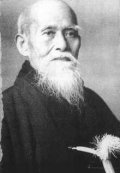
Morihei Ueshiba
Founder of Aikido
All techniques, every one, must be in line with the Truth of the Universe. Technique which is not will surely rebound and cause the destruction of one’s own body. Any martial activity which is not tied to the universe in harmony is not to be called the art of Takemusu.
This raises a few questions, among them:
- How is martial arts study an investigation of universal law?
- What should a student be doing in class, if not imitating the instructor?
This reminds me of the following quote by an unknown author:
“The key to giving one’s life meaning is to take on something and master it! To go for less is poor.
As someone once said, we should not seek to be like the masters of old, but to seek what they sought.”
Great thoughts on imitation leading to mediocrity!
Great masters always tell their shining students that they will be greater than the master. I think that’s because students who really immerse themselves in a teaching come to a greater understanding of it. It’s like the master passes on the torch.
Mimicry is needed to get the mechanics and technical aspect of it, but you have to come to your own understanding, have your own experience, have it seep into your being. No one can show you how to do it.
BTW, I don’t do martial arts, but I am deepening my understanding of Spirit. This has been my experience.
In Spirit,
Nneka
There is a strong relationship between spirituality and high-level martial arts, as you might surmise from the Ueshiba quote above. But even at the most basic level, martial arts are concerned with what we might politely term “reincarnation assistance”.
Authenticity is the word that comes to my mind when discussing mastery. What is a student supposed to do in a class if not imitating the instructor? As long as the instructor is capable of igniting the sparks of curiosity and promoting experimentation, rather than mimicry, the student’s task is to explore and experience as much as possible in regards to the topic of the class.
For instance, my favorite living Aikido master is Koichi Tohei, who was the top disciple of O-sensei Ueshiba. Throughout his carer as an Aikido instructor and Hombu Dojo chief instructor at the time of O-sensei’s passing away, he seemed dissatisfied with performing routines of waza – techniques. Unlike most other disciples and instructors of this art, he “wanted Aikido to focus on these principles, using practical exercises to both cultivate and test Ki in the daily Aikido practice,” to quote the Wikipedia article about him.
Similar approaches led many creative people to become authentic masters of their original styles of martial and many other arts. In the West, the most notable representative of such approach is probably Bruce Lee, who defied the norms of loyalty and adherence to the traditional arts to create his Jeet Kune Do. Never mind that most of his teachings and sayings are a compendium of Zen phrases and Confucian proverbial wisdom, he certainly was an embodiment of the methods he was researching and promoting. As in the case of numerous other pioneers, he paid the highest price for his bold exploits – his own life.
Now, as to the question of investigation of universal law through the studies of martial arts, I believe that these arts allow to test in real time and convincingly prove or disprove one’s ability to be in harmony with the “flow of things,” or the Tao. Hence I currently concentrate on working mostly with those who wish to experience this sense of oneness and enjoy the effortless power it brings about, rather than try to beat their opponents by kicking and punching or hurt them by any means possible. The one who is “in the flow” does not need to be protective, for one can rely on the power much greater than one’s personal power that nobody can withstand. The flow of things, the Tao, is irresistible and invincible. Identifying with it requires letting go of ego with all its superficial defenses and hangups. This approach to the arts may not for everyone, but for me it is the greatest game in the universe.