The drama triangle is a model of dysfunctional social interaction, created by psychotherapist Stephen Karpman. Each point on the triangle represents a common and ineffective response to conflict, one more likely to prolong disharmony than to end it.
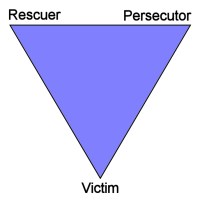
The Drama Triangle
Participants in a drama triangle create misery for themselves and others. By applying the physical principles of martial arts to the psychological realm, you can transform this lose-lose situation and create a more positive outcome for everyone.
Each player in this particular mind game begins by assuming one of three archetypical roles: Victim, Rescuer, or Persecutor.
- Victims are helpless and hopeless. They deny responsibility for their negative circumstances, and deny possession of the power to change them.
- Rescuers are constantly applying short-term repairs to a Victim’s problems, while neglecting their own needs.
- Persecutors blame the Victims and criticize the enabling behavior of Rescuers, without providing guidance, assistance or a solution to the underlying problem.
Players sometimes alternate roles during the course of a game. For example, a Rescuer pushed too far by a Persecutor will switch to the role of Victim or counter-Persecutor.
Similar to the cycles of Five Element theory, each corner of the drama triangle supports and moderates the other two. Victims depend on a savior, Rescuers yearn for a basket case and Persecutors need a scapegoat.
While a healthy person will perform in each of these roles occasionally, pathological role-players actively avoid leaving the familiar and comfortable environment of the game. Thus, if no recent misfortune has befallen them or their loved ones, they will often create one. Victims suffer a series of “accidents” and Rescuers engage in noble self-sacrifice, while Persecutors are just “keeping it real“.
In each case, the drama triangle is an instrument of destruction.
Avoid the Corners
The emotional co-dependence exhibited by the three roles of the drama triangle has a physical analogue in martial arts practice. In both cases, the solution is simply to refuse support to your attacker, forcing them to choose between retreat and collapse.
The strategy can be summarized as follows:
- Move into the center. Resist the temptation to play an exaggerated and complementary role to a Victim, Rescuer or Persecutor. You do not want to stabilize an unpleasant situation. Instead, find and hold the center position, thereby marginalizing your adversary and eliminating their power base.
The center of the drama triangle contains elements of each corner. It is a combination of sensitivity, compassion, and responsibility. - Refuse to accept your opponent’s force. Do not struggle with them, or yield to them; instead, allow your opponent to move into an indefensible position.
If you have successfully taken the center, your adversary will halt their attacks, rather than risk unmasking themselves and exposing the game.
Although the drama triangle is a form of passive aggression, you may nevertheless object to casting a loved one as your opponent. Instead, take their bad habits and unskillful means as your enemy, and destroy them with awareness and enlightened action.
This article is featured in the Carnival of Conflict.
how? How do you not be a victim? how do you “take the center”? it doesn’t make sense. you have said the same thing that everyone else says but there are no answers on how to do it. what do you think about how to control the victim inside. what if your a vitim of ignorance and dont understand what your doing to make people say you act like a victim then what do you do? go to a theripist? What?
Megan, the answers to your questions can be found in any good martial arts school–though I do not recommend martial arts as a substitute for therapy where that is needed.
We have discussed bullying here before. And if you browse around this site, you will find a few instances where hostile commenters have attempted to make a victim out of me, and failed. Learn what you can from those examples.
Through constant criticism I have lost confidence and becom the victim. I hate this feeling and need to get out of the triangle but cannot find the path
The victim needs to recognise their own needs and start becoming proactive in taking care of their own problems. Counselling would be a good place to start.
From personal expereince I can say that the most difficult thing to do is for the victim to acknlowledge that they are actually palying the role of the victim (or abuser). And unless they acknowledge it, they will never be able to break free from the situation and are doomed to continue in the self-destructive pattern they see as ‘normal’.
I often times play the rescue roll. It gets my mind of my own problems and needs, however I feel that I am dis empowering, the ones I rescue, the ones I rescue really want to be rescued. That’s all they know they refuse to learn even though I try to get them to help themselves they play dumb and or have no motivation. I do like helping but not to the point where I neglect my studies and needs.
Any Comments?
To acknowledge our own behavior is the beginning of recovery, awareness, healing and growth. I have placed myself as the victim and have also been the abuser. I have allowed my control to be taken from me and then blame the other in my relationships. I won’t acknolwledge when the other has blamed me wrongfully, however I look at myself and make honest assessements now and focus on what “I” need to change.
In order to move away from this DRAMA triangle, it is necessary for the rescuer to cease rescuing and take on a COACHING mentality. Once this occurs, the VICTIM becomes more of a Learner and the Persecutor (the 3rd party in this) can be viewed more as a Teacher. Similarly, the VICTIM needs to make an effort to cease feeling victimized, and attempt to learn from any interaction. This ‘mentality’ changes the whole dynamics of any interactions.
Hopefully some food for thought!
This is a great article on the drama triangle. Some of the comments asked how to get off the triangle. I liked some of the replies here.
For my own situation and awareness I would like to offer. You can’t get other’s off the triangle. If you are stuck on the triangle and can’t see a way to get off you are exhibiting the nature of the triangle.
Self-esteem, clear problem solving skills, and a willingness to look at and change your own behaviors that lead to your situations are the tools that allow you to move off the triangle.
I love the martial arts metaphors here as well.
Thanks
Hi!
I love the concept behind the Drama Triangle and moving toward the center rather than being forced into a corner. This totally makes sense to me, but then again I am a black belt in Tang Soo Do and this is one of the things that is taught right away in class – try never to get caught in a corner!
I am in a situation where my husband is the persecutor, another person is the victim, and I’m the rescuer. Consequently, the “victim” in this role is anything having to do with my interest in karate. Kinda blows you away doesn’t it?
Recently my husband started picking apart my karate instructor telling me that he feels that he has a “cult-like” following. This is completely untrue. I told my husband that I did not want to argue with him – by coming to the person’s defense. I told him that he was entitled to his own opinion and that I, however,did not agree with his opinion. That was all the further I would allow the conversation to go.
By realizing what my husband, the persecutor, was doing and by taking myself out of the role of rescuer I essentially shut down the conversation. There was no “victim” there for me to rescue, because I refused to let him persecute.
I’ve been noticing a pattern where I am the rescuer in many situations. I place myself in that situation and I realize that I have to move to the center to be more balanced in my approach with everything.
Thanks for the illustrations. They were VERY helpful!
I have had a history of being in a triagle. What are some tools to help me not be any of the three in the triangle. I have the victim possition pretty much under control .
Great drama triangle reference!
I would like to introduce you to author David Emerald. His book, The Power of TED* (*The Empowerment Dynamic), actually offers an alternative to the drama triangle. As a matter of fact, Dr. Stephen Karpman himself said, “The Empowerment Triangle is a highly original and effective escape from the Drama Triangle.”
A description of the book, as well as other resources, can be found at his website http://www.powerofted.com.
I look forward to hearing your impressions.
Creating today,
Kathy
I think taking responsibility for your position, or being self aware in your life and how you can change it takes you out of the victim role. Being empathetic and understanding that you put yourself in the victim role, not others keeps you from the persecutor role and having realistic expectations for another keeps you out of the rescuer role.
I’m afraid, most of tou don’t fully understand the dynamic of the drama triangle, this can be played by as little as two people in multiple roles who move from r-v-p-r-v-p, this is found in co dependent and alcoholic/drug addicted relationships. You really need to read the full article to understand.