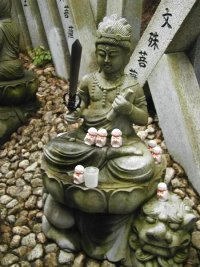

“Tell me, Subhuti,” Buddha inquired, “Can an arhat think to himself: ‘I have attained the realization of an arhat’?”
Subhuti, his disciple, replied, “Of course not. With such a thought, he would be grasping to the illusory notions of an ego, a personality, and an individual self. Any so-called arhat who holds these notions is a fake.”
~Diamond Sutra
The meaning of “investing in loss”, as originally recommended by the late Tai Chi master Cheng Man-Ching, was to neutralize a superior force through the practice of non-contention:
Now when I say, “Learn to invest in loss,” who is willing to do this? To invest in loss is to permit others to use force to attack while you don’t use even the slightest force to defend yourself. On the contrary, you lead an opponent’s force away so that it is useless.
Against genuinely applied force, the method is so difficult to apply that it usually fails; thus, it is called a loss. After becoming familiar with every misapplication of wuwei, the non-contention principle, one can eventually start using it correctly and effectively; thus, it is called an investment.
Investing in loss can be a tiresome and disheartening method, but it is a reliable one. Sadly, the term is often misapplied as a catch-all justification for fruitless endeavors. Not every loss qualifies as an investment.
Buddhists and non-Buddhists, martial artists and pacifists alike should be especially wary of methods designed to strengthen the ego, insofar as illusions of identity hinder one’s ability to adapt to rapidly changing circumstances. In the heat of the moment, there is no time to consider whether one is the “type of person” who makes the right move.
Cheng’s Cult of Submission
Each style of martial arts is prone to its own flavor of illusion. When Tai Chi goes wrong, it typically does so by confusing non-contention with submission in the mind of the student.
The internal dialogue sounds something like this:
“I don’t use force, I do not resist others, and this makes me a good person. If I remain good for long enough, Tai Chi skill may eventually be bestowed upon me by the master. In the meantime, although I am physically helpless against aggression, I know that I am spiritually superior to my aggressors. This is my ‘investment in loss.’”
Whether one prefers the Diamond Sutra or the Tai Chi Classics, such neurosis breaks every rule in the book. Tai Chi ability cannot be doled out as a reward for loyalty, much less passive counter-aggression; it is earned, through patient listening and a willingness to abandon limiting conceptions of the Self. (And of course, a mere willingness to be pushed out is no spiritual attainment at all.)
Internalized notions of “an ego, and personality and an individual self” ultimately determine when the Tai Chi student chooses to “follow the curve”, and when they elect to attempt “completion of the circle,” disabling an attacker. And the correctness of these notions—the degree of genuine self-knowledge—determines their likelihood of success.
Ironically, the penchant for submission reveals a distaste for risk, which is a fundamental characteristic of investment. Giving up guarantees the outcome, simultaneously protecting the illusion of the tragic victim.
The hero’s journey starts with self-reinforcement, passes through acceptance and internal quietude, to arrive at listening, learning and perhaps, ultimately, transcendence. This is the common path of spirituality and martial arts. To win, one must first be sincerely willing to lose more than just their footing.
I’ve been investing in loss for so many years that it became a second nature ;-).
Good topic and well thought out. I guess you could also compare this to someone believing they will be skilled at tai chi application by doing nothing more than forms.
You do have to invest in yourself and be willing to take risks. Keep up the good work.
the analysis above is very helpful. Ego satisfaction interferes with my daily Tai Chi practice. Thank you for your insights.
I believe there is SO much more to the concept Invest in Loss then what can be applied to the martial aspects of tai chi and other such arts. From what I know of Professor Cheng he always related the principals of tai chi to everyday life and social interaction. It is here where I think Invest in Loss has its true foundation and application. Investing in the loss of controlling any given situation. Investing in the loss of ego and power, selfishness and investing in humility and generosity, the concepts that involve giving of oneself, thus the loss. Yielding both physically but more importantly mentally or spiritually; this IMO is what separates the amateurs from the players.
Many ask me to explain and at times it can be difficult. I use the analogy of when one is walking on the beach. The surf is coming in wave by wave. Not every wave has the power to reach your ankles. The first wave is a small one and only reaches so far and then recedes back into the ocean, the second wave does the same, receding back into the ocean, however the third wave comes in much larger and flows over your ankles because the energy from the first two smaller waves fed into the third larger wave. We must be like the first two waves by yielding to a given situation in the moment when emotions run high and investing in the loss and by the time the natural consequences play out the person truly learns their lesson and the situation is made better without the risk of you making it worse by reacting and not investing in loss. Does any of this make sense? 🙂