The old Kung Fu master touched his assailant, with no apparent effect. Days later, the assailant died a sudden and mysterious death. He was a victim of the legendary dim mak, the touch of death.
 dim |
 mak |
Dim mak is a popular discussion topic among martial arts enthusiasts. Some instructors claim to have the skill, or believe that it was used to kill Bruce Lee. Others insist that dim mak instructors are frauds and the skill itself is a complete fantasy. Is there any evidence to support the existence of dim mak? Could it possibly work?
Dim Mak Does Not Equal Death Touch
The Cantonese term dim mak does not translate to “death touch”. I have heard that a less dramatic, but more accurate translation would be “press artery”.
With that clarification, it should be obvious that the skill of dim mak does exist; anyone can press an artery, right? For more useful answers, we should ask more specific questions….
Can dim mak be performed on a skilled, resisting opponent?
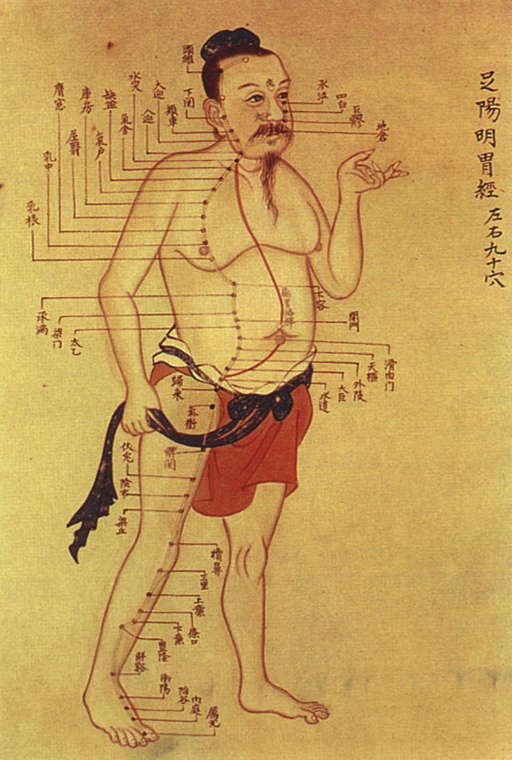
There are pressure points on the body, which can be manipulated to cause immediate and excruciating pain. And there are vital areas, which can be damaged with a relatively small amount of force. Martial artists protect these points and areas. But all this has little to do with dim mak.
By definition, dim mak operates on arteries, which are continuous and span the entire body. Yes, some pressure points happen to be located along these arteries. No, this does not make dim mak synonymous with pressure point striking or grappling.
According to TCM theory and practice as manifest in acupuncture, the body is covered with these arteries, also known as meridians. If you are touching an opponent’s arm or leg, you are probably touching a meridian.
In other words, if your opponent can touch you, they can probably perform dim mak.
Can dim mak injure an opponent?
Simply touching an opponent’s meridian is unlikely to hurt them, much less kill them. Dim mak cannot be haphazard pressing and grabbing, any more than acupuncture is random poking about with a needle.
The connections between acupuncture/acupressure points and organ function are supported by thousands of years of practical experience, and by experiments with modern biomedical technology. If acupressure can be used to cure sickness, it can obviously be used to cause sickness.
Can dim mak cause a delayed death?
If dim mak can influence organ function, then it absolutely can cause a delayed death, in a matter of days, weeks or months. Consider these two concrete examples:
- Symptoms of liver failure include yellow skin, itching, and swelling. Without treatment, liver failure is fatal.
- Symptoms of kidney failure include shallow breathing, lethargy, and an inability to urinate. Without treatment, kidney failure is fatal.
Chris Crudelli and Duan Bao Hua demonstrate dim mak (dian xue)
It seems to me that the legendary skill of dim mak is no more implausible than the more common skill of acupuncture, and it should be given a similar degree of respect and consideration.
It was helpful…but a concrete verdict from the author would’ve been nice.
From the article: “…it should be obvious that the skill of dim mak does exist…”
What questions have gone unanswered?
By this same logic since jumping is a means by which humans may influence their distance from the earth, then surely the ability to fly is no more improbable than the ability to jump one meter.
Puhlease.
It is rather like saying that if you can jump to the left, you should be able to jump to the right.
Dim mak is real , My deceased grandfather (trained by a shaolin master) was good at it and even tried to pass down the training method and technique but the new generation (us) sure prefer TV or computer over those ancient deadly and boring martial arts.
He could poke a hole in the botol and he knew at which spot and time(say 12Pm) one should strike at to be fully effective . But all thess knowledges are gone under the new generation. The time has changed .
Dim Mak as a valid martial arts form is a load of old cobblers, I’m afraid.
Sure, getting pressed, poked or jabbed in certain parts of the body can be very painful. But basing your system of self defence, or basing your combat skill, around this is just asking to lose every fight you are in.
I can punch you in the jaw quicker than you can locate pressure point 17e at midnight on a Tuesday (if I have eaten brunch, if not–Wednesday)and grip it with your left fingernail whilst simultanously touching pressure point 12.5b under my left toenail.
Dim Mak isn’t a soft tap, its a blunt strike to a spot on the chest that causes 2 inches of chest compression, broken ribs, and heart failure.
Dim Mak is a legitimate subset of the chinese martial styles. Essentially, it is preceision striking, which takes advantage of anatomical weaknesses of the human physiology. Historically, It took ten years of hard study and practice in order to weild correctly. It was anything but easy.
One of the many problems which exists today is the martial arts public has been innundated with less than authoritative material on this subject. This continues to lead to a number of repeated misconceptions on what is and is not Dim Mak.
Arguably the first published reference in English occured in 1958, when James Yimm Lee published his books on Iron Hand training. Bruce Lee also made brief mention of it in his 1963 book on Gung Fu. And Ark Wong wrote a considerable amount on the topic in 1963 and 1968, in his books on Kung Fu. Since the 1970’s, there have been countless magazine articles and books on the subject… particularly in the late 1980’s and early 1990’s. With all things in the media, some of this material was accurate, and some was not.
From a research historian perspective, the subject appears in several original chinese works, which were published in the late 1800’s (particularly the book by Master Huo Tuo in 1878, and the book by GrandMaster Li Shi Zhe in 1881). The three proper sets of Dim Mak (aka, Dim Mak, Dim Hseuh and Dim Ching) also appear prominently in the Shorin Ryu Bubishi (circa the late 1700’s), which was published in the 1930s. Funakosh also mentions the subject in his published work in the 1920’s and 1930’s, and so did Motobu in his books of the same time period.
Very Respectfully,
R. Bauer
co-author of THE ANCIENT ART OF LIFE AND DEATH: THE BOOK OF DIM MAK
Richard, thank you for the historical info.
Chris,
Your welcome. The Seattle area is where I grew up, so I am always happy to help folks back home. 🙂
All the best from the Gulf of Arabia,
Rick
With all due respect to mmabjj, he is wrong.
First of all, Dim Mak (or Kyusho-jutsu in the Okinawan version) is not only effective, but is much more effective as a defensive/offensive technique than a random punch to the jaw. Sure, if you are strong enough, you can knock an opponent out with a strike to the jaw… maybe. Obviously boxers, oriental martial artists and shoot fighters hit and get hit in the jaw all the time, but knockouts are actually pretty rare. Sure it could happen, but not all that often, and not reliably enough to end the fight with a single strike. However, with the pressure-point techniques of Dim Mak/Chin Na/Kyusho Jutsu, a knockout, or at least an end to the fight, is virtually guaranteed… every time… if the technique is executed properly.
The idea behind pressure point fighting is that a strike to a single pressure point causes pain and a weakening of a limb or joint. A strike to two points causes the pain to be multiplied as well as to be referred to another spot on the body. Striking three points causes a knockout or extreme weakness, disorientation and inability to defend oneself from a follow-up strike (effectively ending the fight). Four points causes organ failure unless revitalization techniques are used to reverse the effect. Five points (and it has to be the correct five points in the correct order) causes death.
Now, you are probably thinking: “How can I hit three different points reliably to cause a knockout faster than the opponent can counter me with a single blow?” The answer lies in the anatomy of the human body. For instance, the pressure points known as Lung 7, 8 & 9 are within an inch of each other, on the thumb side of the inner wrist. A single strike can activate all three pressure points, causing a drop in heart rate, blood pressure and overall dizzyness and disorientation… effectively a TKO, and a move that ends the opponent’s ability to attack you (which is the real goal, after all). A friend of mine actually did this by accident a few years back during a practice in which he caught his opponent’s L7, 8 & 9 during a deflection of an incoming punch. It wasn’t even intended as a strike, just a deflection.
Another example is a cupped-hand strike over the eye. Properly executed, this can activate as many as 8 different pressure points (ST 1 & 2, LI 20, SI 18, UB 1 & 2, GB 1 & 14). There’s a video of this type of knockout being performed by David Rhodes available here: http://www.kyusho.com/davidrhodesKO1.wmv.
“But isn’t this too hard for the average person to learn quickly” is the next obvious question. The answer is yes and no. The fact is that most martial artists are already learning these techniques… they just don’t know it. As George Dillman explains, the techniques are already in the regular kata and bunkai performed by every martial artist from child to adult. They just haven’t been taught to recognize it as such. They are taught that the movements of kata have meanings that are simplistic at best, and downright rediculous and ineffective at worst. But when taught in the context of pressure-point fighting, they make perfect sense.
For instance, why would anyone use the weakest part of the arm to block a kick, as is commonly taught in every martial arts school as the “lower block”. Chances are that your arm will break before you can stop a full-powered kick. But if the same “lower block” movement is used to attack pressure points on an opponent’s attacking arm, such as Lung 5 or Heart 3, the movement begins to make sense and become effective. Taught in that context, it is clear that every moderately capable martial artist has the movements down pat. What he needs to learn is the real meaning behind the movements he was taught. This means an entirely new way of thinking about the movements of your fighting style. But the locations and directions of the major striking points aren’t that hard to learn… I picked up quite a bit of it in a few weeks, enough to make it an effective system for using what I already knew in real combat situations. It is no slower and often faster than the punch to the jaw that is advocated by mmabjj, and ALWAYS more effective.
It is truly a shame that a viable martial art subset has been cast aside by modern society as voo-doo. I have performed several strikes explained and demonstrated to me by my fathers ishin-ryu sensei. Not only are they incredibly effective but they are relatively easy to learn and execute. It is my understanding that the necessity of time of day and other such restrictions (minus angle and force) were essentially mental exercises. These lessons were intended to bring a greater level of discipline to students in dim mak. I have performed the same strikes at various times of day with ultimately the exact same results. Too often people cast aside what they do not understand or do not wish to understand as nonsense. Someday you may be forced into a fight with someone not afraid to learn these techniques and when you are on the ground wondering what happened maybe you will make an attempt to understand rather than put down a very effective fighting style.
Also, Ken, I mean no disrespect to you or your grandfather but poking a hole in a bottle does not necessarily mean he was practicing dim mak. I was capable of doing the same thing through training in qigong. It is commonly known as iron palm, fist, grip, etc.
To mmabjj. I suggest checking your sources and rather than focusing on time of day etc., focus on picking one combination of points you can easily locate. Practice being able to find those points and then use them on a training partner. Be sure to learn the counter measures to reverse the effects of your strike before doing so. If that doesn’t change your mind then I guess you are on your own.
Hello, I know about these facts and it’s 100% basic. In the structure of the human body we have points to where the tissue goes in, leaving points in the body fresh open to attaries. When you strike a pressure point it closes it and causes the pressure to counter back into there body. When they counter back into your body it allows effecting nerves to your brain from the blood flow to effect the whole part of the area. It can cause your muscles to be stunned, knockout, or death. If your a big fan of martial art movies, you hear about the “5 Points of Death”. In Dim Mak there is certain skills you can learn to target the nerve in the heart, the kidney, the bladder, liver and brain to cause a delayed death by the amount of pressure on the body. It takes years of studying the points and years to learn how to do it.
Any questions add [email protected]
funny how none of this has been used in any kind of UFC tournament. let me guess, its too deadly! but as ETwolverine pointed out, you could use just 3 points for a TKO rather than 5 for a kill… hmm.
let me share the secret of the ninja death touch with all of you. even though the ninja clans will hunt me down and kill me, i will add my 2 cents to shed some realistic light on the matter. tiny poisoned needles attached to fingernails!! oh my god it all makes sense now! slow acting poison for delayed death touch! anaesthetic for a knockout or limb numbing!
apply occams razor here guys… what makes more sense- poisoned needles or an esoteric chi/meridian system. FYI acupuncture has never been shown to work in any scientific controlled double blind study. yes there is tons of empirical evidence and users who swear by it. i leave it at that.
Back in the 1960s and 1970s, certain infamous comic book and pulp fiction versions of Dim Mak were produced and sold in the North American and European mass-market, which purported to teach “Dim Mak – The Death Touch.” These over-hyped versions were not factually accurate, and were designed to sensationalize and sell. In my humble opinion, this marketing trend… which was part of the pop culture phenomena of the times, helped turn the subject of Dim Mak into a morass. It was akin to learning Karate or Kung Fu from a tabloid.
Dim Mak, as a legitimate historical subject, was an outgrowth of Chinese medicine and Chinese Gong Fu. The ancient doctors of the period witnessed the outcome of fights and battles, and thru empirical observation, recorded what they believed was the cause and effect outcomes of specific, focused trauma, applied to sensitive areas of the human body. As a matter of medical physiology and biomechanics, the body is not uniformly strong. It has areas which are more vulnerable to damage.
The way in which trauma can be inflicted on a person’s body can vary significantly, and is directly dependent on the manner in which they are hit. The Old Chinese Masters, thru centuries of cause-and-effect observation, determined a specific number of ways of inflicting certain types of trauma to specific parts of the body. They divided this information into three distinct subsets… the most viscous of which they referred to as Dim Mak strikes.
Biologically, the human body runs on regulated cycles. For example, the circulatory system was of particular interest to the Old Chinese Masters, as it followed a consistent, rhythmic pattern. This gave the Old Masters a timing mechanism, of sorts. For certain types of strikes targeting blood gates, they charted out the length of time it took from the moment of impact, when the arterial wall was severely traumatized, to when it ruptured. The Old Maters made records of these cause-and-effect patterns, originally to understand how to heal the condition. They then spent a considerable amount of research on the health and restoration techniques (such as herbology), which were necessary to heal the trauma. Feudal China was plagued with massive wars, and fighting was almost a routine part of life. Originally, the Old Chinese Masters begin the study of Dim Mak to understand how to try and heal a person, in the event a person in their care was struck and hurt in a fight, battle, war, etc.
When the subject of Dim Mak begin to appear in Western literature in the late 1950’s and early 1960’s, most of the cause and effect descriptions were very limited, and cloaked with eastern imagery (such as “Hit here, and the person will fall down like frightened chicken”)… which fueled pessimism in the West, and comparisons to Voodoo. Then a number of less-than-authoritative information was published, claiming to be “Dim-Mak.” It wasn’t. It was pure fiction. It wasn’t authoritative. It was not based on legitimate training or records. It was cattle manure. But in the swirl of concepts and pop culture, it became part of the urban legend. Regrettably, the legacy of that period of bad information continues to live with us, along with the gross misconceptions.
Hope the above helps.
Very Respectfully,
Rick Bauer
After reading thru the discussion thread, there are a couple of areas in Chris’ original article which I would respectfully offer some thoughts and comments:
“The Cantonese term dim mak does not translate to death touch… “
Linguistically, this is correct. But it is also fair to say that over the past 200+ years, the term “Death Touch” has become associated with the Asian practice of hitting vital points on the body.
“I have heard that a less dramatic, but more accurate translation would be “press artery… ”
“By definition, dim mak operates on arteries… “
For the subset of Dim Mak strikes which target blood gates (Dim Hsueh), I would partially agree. But as a general statement, I would respectfully disagree. The subject of dim mak is much more complex than this. Dim Mak is not limited to just attacking arteries or blood gates. In the same way, it is much more complex than just attacking nerve centers or branches… which is another common theory. As a process, it would be better to characterize it as a systematized method of attacking anatomical weak centers of the body. And these attacks are all done with high precision and skill.
Chinese lexemes can sometimes be very difficult to translate into English, and often times refer to a concept, image or process, and not an actual thing. In addition, their exact meaning is influenced by the order in which the brush-stroke characters appear in the sentence.
Dim (Dian) (Tian) can translate by itself to: dot, speck, spot, point or degree
Mak (Muk) (Mai) (Hsueh) can translate by itself to: blood vessels, veins or arteries
The Mandarin term Xue can translate by itself to: cave, den, or hole
In the simplist of translations, dim mak (dian xue) can refer to “spotting points” or “spotting acupoints”
In the Chinese martial arts, the process of studying Dim Mak is often referred to in Mandarin as Dian Xue Shu: or the skill / art of spotting (striking / attacking / pressing) acupoints / vital points.
On the recent translation of the Shao-lin Dim Mak book, Dian Xue Shu, which was originally published in China in 1934, the translators noted: “[This book is about the] method of acting on acupoints and their practical application in Martial Arts. DIAN XUE SHU… literally means “The Art of Touching Acupoints” [and is more commonly known] in the West as DIM MAK (“Blows to the Arteries” in Cantonese dialect) or “Death Touch.” It should be noted that the last two names do not fully reflect the essence of this method.”
I would respectfully agree with the above assessment. The full concept of Dim Mak includes attacking arteries, but it is not limited to it. The old Masters always taught Dim Mak using references to traditional Chinese vital points / acupoints as targets. That is why you will often see teachers refer to the subject of Dim Mak as: “The skill in striking Vital Points” or “The Art of Attacking Acupoints” or “Acupoint / Meridian Pressing”… just to name a few.
“According to TCM theory and practice as manifest in acupuncture, the body is covered with these arteries, also known as meridians… “
I would respectfully disagree with this statement. The circulatory system plays a critical role in Chinese meridian theory, but arteries are not meridians. The Chinese Classics of Medicine are fond of saying “where the blood goes, chi flows…” but they always make a clear distinction between the circulatory system and the meridian / collateral system. They are different conceptual processes. Meridian theory is much more complex than this.
Just my humble opinion.
Very Respectfully,
Rick Bauer
I did indeed use “artery” to describe both blood arteries and chi “arteries”; I did not mean to imply they are the same and I apologize for any confusion. The points I intended to communicate are:
1) Dim mak is not merely punching really hard to break bones and tear flesh.
2) To accept acupuncture while dismissing dim mak is hypocritical.
mmabjj, that was a little outrageous, you obviously don’t even comprehend the power this has to offer
It’s very simple.
I am correct.
If you believe this stuff, deadly death touches, 5-point death knockouts, 3 point TKOs, you are delusional, in love with the idea of the martial arts (mysticism, ninjas, death touch, etc.) rather than the reality of martial arts (punches, kicks, submissions, and a lot of hard training.)
ETWOlverine is clearly delusional. Apparently, pressure point TKOs are MUCH MORE EFFECTIVE than a punch to the jaw. This is despite the huge pile of empirical evidence to the contrary (people in boxing matches, MMA fights, and street fights are getting KO’d every minute of every day around the world), and the fact that the mysterious death touch mysteriously doesnt work when a master of said technique tries it on someone who is not from his school.
You people are bullshido, the worst kind of delusional martial artist, with no real idea of what it means to be able to fight or to study martial arts.
There’s a video of a volunteer offering to be “dim-makked” by someone giving a seminar. Surprise surprise, it didn’t work. They were not his students.
Here’s another video where the technique doesn’t work on someone who is not pre-brainwashed.
Best of all, here is a master of not only the death touch, but no touch knockouts, entering a real, limited rules fight. And getting his nose smashed and giving up by one of those punches that Mr. Wolverine dismisses as ineffective.
People, for the love of humanity, wake up.
You are free to discuss the technical merits of dim mak, or its lack of merits, in a civil fashion. No ad hominem attacks are allowed in my forum.
Ric,
First of all, it HAS been used in UFC tournaments. Remember how many UFC fighters have been choked out? Those chokes are as much a part of pressure point fighting as what I have been talking about.
Second of all, Ninja didn’t use dim mak. They used poisions. So you are right on that count. That doesn’t mean that OTHERS didn’t use dim mak. Each has its place in the martial sciences.
Third, you said, “FYI acupuncture has never been shown to work in any scientific controlled double blind study. ” Hate to tell you this (no I don’t), but you are wrong. In a double blind study, the Chochrane Group found the following: “Thirty-five RCTs covering 2861 patients were included in this systematic review. There is insufficient evidence to make any recommendations about acupuncture or dry-needling for acute low-back pain. For chronic low-back pain, results show that acupuncture is more effective for pain relief than no treatment or sham treatment, in measurements taken up to three months. The results also show that for chronic low-back pain, acupuncture is more effective for improving function than no treatment, in the short-term. Acupuncture is not more effective than other conventional and “alternative” treatments. When acupuncture is added to other conventional therapies, it relieves pain and improves function better than the conventional therapies alone. However, effects are only small. Dry-needling appears to be a useful adjunct to other therapies for chronic low-back pain.” — The Cochrane Database of Systematic Reviews October 30. 2004
A review by Manheimer et al. in Annals of Internal Medicine (2005) reached conclusions similar to Cochrane’s review on low back pain.
For headache, Cochrane concluded (2006) that “(o)verall, the existing evidence supports the value of acupuncture for the treatment of idiopathic headaches.
The Cochrane review (2006) on the use of the P6 acupoint for the reduction of post-operative nausea and vomiting concluded that “compared with anti emetic prophylaxis, P6 acupoint stimulation seems to reduce the risk of nausea but not vomiting”
Bandolier said “P6 acupressure in two studies showed 52% of patients with control having a success, compared with 75% with P6 acupressure”(1999) and that one in five adults, but not children showed reduction in early postoperative nausea(2000).
According to the National Institutes of Health: Preclinical studies have documented acupuncture’s effects, but they have not been able to fully explain how acupuncture works within the framework of the Western system of medicine that is commonly practiced in the United States.
The NIH further stated: there is clear evidence that needle acupuncture is efficacious for adult postoperative and chemotherapy nausea and vomiting and probably for the nausea of pregnancy… There is reasonable evidence of efficacy for postoperative dental pain… reasonable studies (although sometimes only single studies) showing relief of pain with acupuncture on diverse pain conditions such as menstrual cramps, tennis elbow, and fibromyalgia…
Central Nervous Pathway for Acupuncture Stimulation: Localization of Processing with Functional MR Imaging of the Brain—Preliminary Experience: Ming-Ting Wu, MD, Jen-Chuen Hsieh, MD, PhD, Jing Xiong, MD, Chien-Fang Yang, MD, Huay-Ban Pan, MD, Yin-Ching Iris Chen, PhD, Guochuan Tsai, MD, PhD, Bruce R. Rosen, MD, PhD and Kenneth K. Kwong, PhD. “Acupuncture at LI.4 and ST.36 resulted in significantly higher scores for De-Qi and in substantial bradycardia. Acupuncture at both acupoints resulted in activation of the hypothalamus and nucleus accumbens and deactivation of the rostral part of the anterior cingulate cortex, amygdala formation, and hippocampal complex; control stimulations did not result in such activations and deactivations.”
There is ample clinical evidence that SOMETHING biological is happening when accupuncture is used, whether we understand the mechanism of it or not.
mmabjj,
How many MMA fights end up going absolutely nowhere with no KOs, no submissions and time running out? How many boxing matches? How many UFC fights? What is the percentage of actual KOs to fights without KOs?
I’ve seen these kyusho-jutsu techniques used. I’ve been on the receiving end of them… before I believed in them. I was a practitioner of the old “punching and kicking” type of martial arts that you are pushing, and I don’t deny their efficacy. I’m a brawler myself, when it comes down to it. But that doesn’t mean that the kyusho techniques don’t work.
I can’t view the youtube videos you posted on my computer due to technical difficulties, so I can’t see what went wrong. But I cannot believe that a properly executed pressure-point attack had absolutely no effect whatsoever on the subject. Even a smack in the face or a finger jab in the ribs has an effect. So… what effect did it have?
As for an MMA style fight, I’d love for you to see an MMA fighter try to “shoot” for the legs of a good kyusho practitioner, and see what happens. I’ve actually seen it. It was quite an interesting fight… all six seconds of it. Here’s a hint: CV 24, GV 24 & 25, GV 15, TW 15. Two strikes, he was out.
Finally, what makes your disagreement with pressure-point fighting any different from the disagreement with any style of martial arts that used to exist in this country (and still does in some circles). Remember how street fighers and boxers used to look at Karate and Gung-Fu as mystic BS that could never work in real life? But it does work. What makes you think that THIS is any different? Sure it’s more complicated than what you are used to. But does that mean that it’s ineffective?
And if someone is saying that there is a technique that is more effective than a punch in the jaw for producing klnockouts, don’t you think its worth a bit of direct investigation before you dismiss it out of hand based on your belief that it could never work? Why not try it before you deny it?
Such hostility over techniques that are probably older than whatever you practice, and that obviously work for SOMEONE. Based on the fact that you have HEARD that it doesn’t work, without having checked it out for yourself.
mmabjj,
I should make one more point.
The Kyusho Jutsu techniques include a “punch to the jaw”. Kyusho just happens to teach the exact method, including direction, angle, and power with which to punch the opponent in the jaw for greatest effect. TW 17 is on the corner of the jaw, just behind the bone ridge and below the ear. TW 18-22 are around the ear. TW 23 is at the temple. CV 24 is in the center of the lower jaw. GV 26 is on the upper lip just below the nose. GV 25 is on the tip of the nose. LI 19 and LI 20 are at the corner of the mouth and the ridge of the cheekbone respectively. These are all the same spots that a “brawler” who just punches and kicks tries to aim for anyway.
So basically, all those punch-to-the-jaw knockouts that you are so enamoured with all are associated with pressure-point attacks. The difference is that for you, they were an accident, just blind luck. You might have gotten a KO or you might not. For a Kyusho practitioner, they are done on purpose, with intent and proper technique, and thus more likely to result in a KO with more frequency.
Elliot
This is ridiculous. He chopped the guy in the ribs. Notice he didnt “touch” him. He hit him with some force. Any strike to the body cavity can be felt on the opposite side. Plus, the guy didnt fall over like the guys in white. Why not?
Have a friend strike you in the ribs like that. I guarantee, you will feel it on the other side of your body.
The best way to interrupt “chi flow” is to wrap your arms around their neck and squeeze. Its called a Rear Nake Choke. Works everytime. Doesnt matter what time of day, waht season, if they have their toungue in the top or bottom of their mouths. They are going to sleep.
I leave you with these words of wisdom…
Chi doesnt exist, Ninjas dont rule the night, and an elbow to the back is not the anti-grapple.
“But I cannot believe that a properly executed pressure-point attack had absolutely no effect whatsoever on the subject.”
That would be exactly what happened – I’d recommend you find some way to view them before continuing the argument. Though I’m guessing your response may well be that the representatives in those videos were somehow inadequately skilled, and therefore incapable of giving dim mak a fair showing.
Having said that, I’d be very interested to see some evidence of this:
“As for an MMA style fight, I’d love for you to see an MMA fighter try to “shoot” for the legs of a good kyusho practitioner, and see what happens. I’ve actually seen it. It was quite an interesting fight… all six seconds of it. Here’s a hint: CV 24, GV 24 & 25, GV 15, TW 15. Two strikes, he was out.”
Do you have the name of the MMA fighter and some corroborating accounts of the incident?
Who has claimed that dim mak was merely touching the opponent? In every post I have made here I mentioned “striking” the target points. Different points respond best to different types of strikes, presses or rubs. TW12 is best activated by rubbing. H6 is best activated by pressing and torquing/twisting. L5 responds best to a hard, sharp strike. SI17 should be struck with a heavy blow. TW17 requires a strike at a 45 degree angle from back to front to work properly.
I haven’t seen any accupoint that is simply “touched” for effect. If someone was claiming to simply be able to touch an opponent and knock him out, he was full of crap. It doesn’t exist.
Furthermore, if you ever look at an accupuncture point chart, you will notice that the accupoints are exactly the same points that a typical puncher/kicker aims for anyway. The difference is that a kyusho fighter’s aim and angle of attack is better.
I wish I could give you the name of the MMA fighter, but I don’t have it. The corroboration could come from some friends of mine who were there at the time, including a Kyusho instructor named Eric Lerner. But since he’s a Kyusho guy, his coroboration would be suspect.
Finally, are you aware of the fact that a rear neck choke is a pressure-point technique? Not a strike, but a “press”. But a pressure-point technique, nonetheless. Please read again what I wrote above: “The fact is that most martial artists are already learning these techniques… they just don’t know it. As George Dillman explains, the techniques are already in the regular kata and bunkai performed by every martial artist from child to adult. They just haven’t been taught to recognize it as such. They are taught that the movements of kata have meanings that are simplistic at best, and downright rediculous and ineffective at worst. But when taught in the context of pressure-point fighting, they make perfect sense.” In other words, every martial artist worth his salt is already a pressure-point fighter… he just doesn’t know it yet.
One last point:
In UFC 2, Keith Kackney defeated sumo Emanuel Yarborough, He did it with strikes to the head of Yarborough. And in doing so, Hackney broke his own hand. It was certainly a triumph of technique over size. But what good is a punch to the head if in doing so you break your own hand, and are unable to continue the fight against other opponents?.
The guys posting here that push the idea of a punch to the jaw don’t know anatomy very well. Why in the hell would anyone deliberately attack some of the hardest and most dense bones in the human body, the bones of the skull and jaw, with some of the weakest and most easily broken bones of the body, the metacarpals of the hand and metatarsals of the foot? Do you really think that these millenia old martial arts styles couldn’t find a better way to fight than to slam the softest parts of your body into the hardest parts of your opponent’s body and hope he falls unconscious faster than your hand breaks?
Kyusho answers that problem. The strikes are just as hard, but they are aimed better, so that the effect is greater for your opponent and less painful for you. Does nobody here see the value of what that sort of fighting technique might have to offer in terms of efficacy?
One does’nt kick with the foot, one kicks with the SHINBONE. Wich you should know, what whith your “superior angles” and all.
Why attack the jaw? Because it jars the brain, causing concussion. It’s been proven so many times it’s not funny. While all you have is hearsay, and bad interpretation. Last of all, George Dillman is a fraud. Proven fraud. Big time fraud. And so is Dim Mak.
“As George Dillman explains, the techniques are already in the regular kata and bunkai performed by every martial artist from child to adult.”
Again, I strongly urge you to watch the actual documented evidence that has been posted up to support the case against dim mak. Please tell me you don’t think Dillman is making a credible excuse at the end of this video:
“Does nobody here see the value of what that sort of fighting technique might have to offer in terms of efficacy?”
Not until we see some proof. Considering that in this thread alone four videos have been posted up in which dim mak failed miserably in terms of efficacy, I think our position is more reasonable than yours.
To recap:
Hi Everyone,
I have read thru the recent string of posts, and respectfully would add the following thoughts:
One of the biggest problems with the subject of Dim-Mak is credibility. When folks started to write about this topic in English 40 years ago, it was often described as “one of the greatest plateaus” within the arts. And it was shrouded in mystique. In reality, the subject was originally the study of medicine (from the old Asian perspective), and it was all about understanding how people became injured in fights, and what needed to be done to treat the injuries.
The old Dim-Mak material from China and Okinawa, dating prior to 1900, was usually presented in the following manner:
(a) On the top of the page – there would always be a description of the type of injury being discussed. The descriptions were usually brief, but were always specific as to the place on the body being hit (usually defined by the acupoint and meridian areas being affected). If the strike was causing a serious level of trauma, this was also discussed – using the Asian medical imagery of the time.
(b) On the bottom of the page – there was a description of the herbal formula needed to treat the injury, along with acupuncture notes.
Prior to 1900, the Asian approach to medicine in China was simply termed “Dim-Mak.” It was all about healing people. But in order to understand how to treat trauma, the old Chinese Martial Arts Masters (who were considered doctors from the temple orders) also studied how it was inflicted. And so they kept notes on both. That was the original genesis of this subject. And it took lots and lots of skill and practice to learn correctly. It was hard and rigorous training. It was NOT a shortcut. It was not systematized around simple point sequences. It always required physical skill and action.
The problem with the subject of Dim-Mak today is it has become heavily distorted, over sensationalized, and is awash with incorrect material.
In the 1960’s and 1970’s, a wave of bad information was sold to the public. To my knowledge, this started around 1963. The first may have been a well-known judo instructor in LA, who sold booklets via comic book ads, under the name “Honorable Master Kung Fu.” This material purported to teach the “secrets of Dim-Mak… and the fabled “No Touch Knockouts.” In reality, it was a well-illustrated booklet of judo techniques! It was NOT Dim-Mak. Beginning in the late 1960’s, another martial artist in Chicago did a similar thing… selling booklets thru comic book ads, also purporting to teach “Dim-mak” and the fabled “Death Touch.” Again, this material was not based on any credible source material or training. At best, it was akin to streetfighting techniques. But the author called it “Dim-mak” – and many people accepted that.
During the 1980’s and 1990’s, a new wave of material came out. In my humble opinion, some was good; a lot was bad. In internet forums, when the lineage or credibility of certain techniques was brought up, some of these instructors would simply allude to un-named “old Shao-lin poems” which they claimed “proved” any martial use of acupoints was really Dim-Mak… and therefore, what they were teaching was “100% authentic”… no mater what it was. This was all highly incorrect. The legitimate source records which specifically reference Dim-Mak (such as the Bubishi), are very specific on what is and is not Dim-Mak.
In reality, a large number of these these types of instructors were never classically trained in this subject. In certain cases, they had, at best, developed their own approach to the topic, thru trial-and-error, or personal research trying to reverse engineer concepts. Or they used techniques from an existing style which they did know (like judo or chin-na), and simply modified it and called it the same as “Dim-Mak.”
Very Respectfully,
Rick Bauer
Out of interest, what’s your opinion on the videos, Rick?
Also, do you have a view on George Dillman? I notice he hasn’t cropped up in your posts yet.
Finally, on the topic of suspicious adverts purporting to teach ‘dim mak’ back in the 70s, here’s a flashback for you:
http://www.bullshido.net/gallery/data/557/medium/SSOC_007_August_1975_p56.jpg
Dear slideyfoot,
In reference to the videos, poor technique is poor technique. And improper technique never works, under any conditions.
In Okinawa, prior to 1945, they had an old practice called “Jutsu.” It was somewhat akin to a wild-west shoot-out. Two martial artists would cross paths. A challenge would often be made, and a close-quarter duel would often ensue. Thus, a martial artists’ skill was often put to the test, and at times were critical to their survival. Obviously, in today’s polite society, we do not have the same training environ. Which in certain ways has led to a lot of untried and unproven claims.
There are lots of folks in today’s world claiming to be martial arts masters. But what did they have to go thru to earn that? It is extremely rare to find anyone who was properly taught the Old Way, by a qualified Bujin master. The difference in quality instruction can be considerable. Unfortunately, the general public continues to see a black belt from any style as being fairly equal in skill base to eachother. This is further ascerbated by the regretable paradigm, in which skill is equated by plastic trophys and cinema time.
Yes, I am very familiar with Mr. Dillman. He has been active in martial arts circles since the early 1960’, and made quite a name for himself in the 70’s and 80’s doing ice breaks. In the early 90’s, he started self-publishing material on pressure points, after experimenting with submission techniques he had seen demonstrated by Seiyu Oyata and Hohen Soken. Over the past 15+ years, he and his students have attempted to research pressure points by a wide variety of methods. Mr. Dillman’s books and tapes lay out the concepts of “the Dillman theory of pressure point fighting,” which he says is dim mak. I respectfully do not agree with all aspects of that claim.
In reference to the Count Dante flashback… yes, that was one of the many sources of opinions on dim mak which swirled around in the 1970’s. Mr. Dante managed to sell quite a few of those booklets, and received quite a bit of press coverage – until a tragic series of deaths at his Chicago dojo effectively discredited him and his system.
Just my humble opinion!
Very Respectfully,
Rick
Thanks for the response, Rick.
“Obviously, in today’s polite society, we do not have the same training environ. Which in certain ways has led to a lot of untried and unproven claims.”
In a sense, we do, in the form of MMA competition (UFC, Pride etc). Its not quite the same, as there are doctors on hand and a referree, so generally not “critical to their survival”, but it DOES provide an excellent training environ in which to test unproven claims. This was even more true in the early UFC, when the rules were very limited (no eye-gouging or biting), and even then breaking those rules would merely result in a fine rather than disqualification.
Not to mention that the concept of the UFC wasn’t new in 1993, predated by various organisations in Japan, and even earlier by competitions in Brazil. I’ve also heard there was something vaguely similar in Asia (might have been Hong Kong or Thailand), but I haven’t yet seen documented evidence. Well, unless something like this counts:
http://www.bullshido.net/gallery/data/557/tournament_held_in_Shanghai_.JPG
“I respectfully do not agree with all aspects of that claim.”
Would you mind going into further detail? I wouldn’t agree with Dillman’s claims either, particularly going by the videos which would appear to disprove them. I’m assuming that in addition, you would have a more theoretically grounded objection?
Hi slidefoot,
In reference to the UFC and similar types of matches… yes, they do help validate certain types of techniques, to a point. And yes, the required training and development of fighters in these types of no-holds matches can be extensive, hard and rigorous. But there still are certain levels of difference which can exist. A hypothetical example, of sorts, would be comparing two boxers of relative equal standing. Both trained in similar ways. But one of the two fighters served two tours in the special forces, in which they legally had to use their martial skills to survive. And in that combat environment, the had to take it to the highest level. The other hypothetical fighter did not, and only trained in the gym, and participated in organized matches. That is the difference I am referring to. There is an intensity in warfare-earned, combat proven skills in which lives are fully at risk. This type of proving ground is absent from other training settings – no matter how hard. This is the training intensity that used to exist in Asia, and were often mployed fully in life and death encounters. Gogen Yamaguchi and Mas Oyama often noted this same disctinction to their students during the 1960’s and 1970’s.
Very Respectfully,
Rick
As I mentioned, I can see that there is a difference between testing your skills in a ring with doctors and a ref as opposed to a genuinely life or death situation. However, I still feel that in terms of the point you made regarding “a lot of untried and unproven claims,” the MMA format is an ideal environment in which to rectify that situation.
It isn’t life or death, but it IS an arena in which your opponent is doing their best to knock you out: in other words, a fully resisting partner. If a technique can work in this environment, then that would strongly imply it is a viable technique.
Interestingly enough, the US military has recently moved towards a BJJ-influenced curriculum for its hand-to-hand training. BJJ was arguably the starting point for MMA in the US, and could now legitimately be called a ‘battlefield art’, as in it has been utilised on a battlefield, in a life-or-death situation.
E.g., see this thread:
http://www.bullshido.net/forums/showthread.php?p=1279786
Slideyfoot,
You are pulling that string of words in the wrong direction. My comment was specific to the central issue being asked… are certain techniques being taught and labelled by certain instructors as “dim mak” actually dim mak, or are they something else?
I find it interesting when certain folks claim to be “masters” on this subject… yet they have never “walked the path” required to know this subject correctly and fully – nor did they study under someone who also “walked the path” in the Old Way. So it can lead to a credibility question, as to how the person “fully learned” these techniques?
For example, certain folks have claimed they “fully understand” the lethal death strike aspect of this subject… but they never served in any capacity (i.e., military, law enforcement, etc.), in which they were forced by circumstances to legally take this subject to its hitghest outcome level. So how do they fully know them?
Credible arts produce credible fighters. All martial arts styles have strengths and weaknesses. To become proficient in any martial art requires lots and lots of hard practice, and this includes sparring and matches and so forth. This has never been at issue.
I am quite aware of the military martial arts training programs. Very respectfully, I have taught some classes myself at a few bases during my career.
BJJ is one of many martial arts under contract to the military, and studied by the men and women in uniform. For example, where I am currently at, they also actively teaching classes in Goju-Ryu, Kempo, JKD, and TKD. Plus a few others. During Vietnam, Judo and TKD were in vogue, and were heavily used and effective. There are many fine martial arts training programs that have been taught and used. Warefare, like well-organized sparring matches and so forth, have a way of weeding out bad technique.
About four years ago, we had Billy Blnks out here in the Gulf of Arabia teaching Tae Bo. The marines were all out in the sand, doing Tae Bo moves with Billy. His classes were very popular, that he taught hundreds of folks out here for several weeks. They also filmed everything for a DVD series he was making. Many of the participants walked away, commenting that they thought they could use some of those nifty Tae Bo moves in a real fight. So could it also legitimately be a “battlefield art?”
Just my humble opinion.
I wish you the very best on your training.
Rick
Thanks for the response, Rick.
I think you may have missed the point I was making, however. BJJ is not simply taught on a seminar basis, it is now an integral part of the Modern Army Combatives program. In other words, this is not a case of external instructors from some style or other popping along to a military base and saying “hey, want to see some tae-bo?”. It’s an actual part of required military curriculum.
Perhaps I should have linked the article which crops up in that thread:
http://www.moderncombatives.org/index.html
leading to
http://www.moderncombatives.org/training.html
“In this same way the concept of dominant body position from Brazilian Jiu-Jitsu is the base for Modern Combatives. The dominant positions are the spine that connects all of the techniques. ”
Also here:
http://www.moderncombatives.org/history.html
“The Chief of Staff of the Army has recognized Combatives as one the blocks of the modern Soldier and formal instruction in the program is included in all Non-Commisioned Officer Education System and Officer Education System courses as well as being a requirment for graduationg Initial Entry Training and being included inthe Warrior Tasks List, required knowledge for every Soldier.”
Hi Slideyfoot,
In reference to your post, in which you mentioned:
“I think you may have missed the point I was making, however. BJJ is not simply taught on a seminar basis, it is now an integral part of the Modern Army Combatives program. ”
No, I fully understood your post. I am quite familiar with the martial arts training program you are referencing, along with the others. And I am fully aware of how they are being used in the field. I am in the Gulf of Arabia right now, and I have been since shortly after 9/11.
BJJ is one of several martial styles currently under contract for long-term training of the uniform military services. There are a number of such programs that exist. BJJ is a excellent art. But it is not the only one being actively utilized.
Anyway, I have spent enought time on this subject. I wish you the very best on your continued training.
All the best from the Gulf of Arabia,
Rick
For the most part, I agree with Mr Bauer, but I posit that he may be perhaps too polite. If you go to youtube and start looking at videos of old asian masters there is always some UFC fan there calling these old guys names.Saying that a 94 year old practicing QiGong is a fairy and that he should jump in the ring is just disrespectful. Unless you are a soldier, a cop or a professional athlete martial arts is about one thing: self improvement. Judging by what I’ve seen BJJ/MMA are about as effective in this regard as watching Hulk Hogan bash Andre the Giant with a folding chair. Self improvement includes respect. These dogmatic BJJ nazis remind me of creationists. It doesn’t matter how well you explain things, they won’t listen. I agree that if Dillmans technique were real he probably could win a UFC, but thats no reason to sneer at the average non-professional trying to improve the quality of life. Yes, if I got into the ring with a Gracie I would get my a$$ handed to me, but I’m skinny and over 40. I say rolling around on the ground in a dark alley playing grab-a$$ with a mugger when broken bottles and used hypodermic needles are all over is about as smart as going to a Dillman seminar.
In reference to ambulocetus’ post, in which he said (in part)…
“[In reference to Rick’s e-mail]…I posit that he may be perhaps too polite. ”
Thank you. You are a true martial artist.
Very respectfully,
Rick
Mr. Bauer, have you ever trained with Amulocetus? Then how can you know if he is a true martial artists?
Aye, there’s the rub.
We have different ideas about what a martial artist is.
Mine? That you know how to fight.
Yours? (apparently) That you can speak with feigned honour.
Much as you all like to talk about honour, respect, tradition, all that gubbins, let’s not lose sight of what the martial arts were created for.
To teach people how to fight.
All the rest is secondary, no?
mmabjj,
I respect your opinions, but I do not agree with you. I am sorry that you do not respect mine.
I wish you the very best in your training.
R
I agree with you on all your points Rick. I respectfully do not believe there are a lot of talented or enlightened martial artists with knowledge of DM participating in UFC etc. I can say that I know for a fact that pressure points are real. Boxers know there is a point to the lower jaw on the side of the chin that when hit with the correct angle will result in a knockout. [basic] Cavity press, sleeper holds, etc. are not as refined as DM but very real and very obvious. I believe that those who have knowledge of acupuncture understand DM better than most martial artists. A blow with correct angle to the side of the neck causes an immediate drop in blood pressure and respiration no matter what time of day or night its done. If you have 12 hours a day to perfect DM then I believe it is possible to obtain the full measure of this art. I believe there are better techniques, to improve and advance a martial artist and benefit your entire being. I also believe there are even more deadly and esoteric arts than DM but lets not go there. This has turned into the same old; “what works and what does not work discussion”
this may offer a better explanation as to how and why it works, uses anatomical explanations rather than the mystic chi energy one.
http://www.taiji.net/old_yang.html
In reference to the post from “the snare,” I have attached an old article I wrote about 10 years ago, which hopefully will provide some additional and relevant information.
Very Respectfully,
Rick Bauer
A PRIMER ON PRESSURE POINTS
Is choking really similar to dim mak? Choking is interrupting the flow of breath, not pressure points.
It would depend on what you call a choke. My understanding of what a, sleeper hold would be, “Compression of the Arteries” on the sides of the neck
[What is sometimes called; “Sealing the Vein”] Of course crushing someones windpipe with a choke, [or with a blow that would cause the neck muscles to contract and block the flow of air] would not be Dim Mak as most people understand it. There are however different levels in the art that are frequently misunderstood. There are also levels that combine, “Sealing the breath” with “Sealing the Vein” as they are sometimes called. There is also
a level that was practiced with striking rice paper with the fingers for penetration. This was referred to as; “Poison Hand” and no, they did not use poison in their fingernails or anything like that. [IMHO] This was the Dim Mak that I believe most people have trouble understanding. It had to do with certain strikes, [and combinations] performed at certain times of day or night that would correspond to certain vital points and organs of the body as practiced in Traditional Chinese Medicine. With all due respect to George and the other proponents of the art, I don’t believe it is something you can learn in a seminar, or without much thought, practice, and meditation. Is it hidden in different forms, and positions of martial arts? I believe to some extent it is, but that is not unusual given the limitless number of forms in combat. Because I don’t practice Dim Mak, I can only offer my opinions. I am a semi retired martial artist and musician. In no way am I a master of the subject. As soon as I have time I will check the website postings again, but for now I have too much practicing to do. Good Luck!
One thought I would like to add to my last comments are that some of the arts like DM are not practical to our way of life today. We are not monks with nothing but time on our hands, [we have jobs] we wear more restrictive clothing for the most part and the world has changed. [The only constant] The arrival of gunpowder, and the Boxer Rebellion, changed Martial Arts, Combat, and History forever. They are still however, “Arts” and sometimes, “very effective”
You are all off your rockers. This is a bunch of non-sense
I think every opinion is useful, even yours! I believe Bruce said to take whats useful and discard the rest. [Good Advise!] I think there are a lot of good opinions, and useful information here. Richard, and Ricks comments make a lot of sense and answer a lot of questions to those who take the time to read them. Hats off to those that have given the subject some thought whatever your opinion is!
The body has many locations where a sufficient strike will cause a specific level of trauma. Because the body functions along certain physical laws, the ancient Chinese were able to experiment with applied trauma patterns, and figure out many types of strikes that could consistently produce a very predictable outcome. The problem is, some modern authors (as well as some martial arts instructors) do not understand all this. Not all the material that has been published on this subject is well researched, accurate, or ground in fact.
The traditional dim-mak attack patterns handed down by the Old Masters targeted specific acupoint centers along the 12 main Chi meridians and the 2 midline collaterals. Within the Okinawan Bubishi, a number of these strike patterns are described. 36 of these strike patterns were considered the highest order (dim mak), and 72 were considered lower order strike patterns (dim hseuh and dim ching)… for a total of 108 patterns. There is some slight variation in the composition of these lists between the various schools of thought.
As an academic example, there are a number of strike patterns that have been medically shown, through modern clinical study, to have a specific cause-and-effect relationships to specific outcomes. If done correctly, these patterns are VERY regular and VERY consistent. Some of these strikes are very straight forward, and some are very complex. But it should also be noted that many also have certain dangers associated with them. Because of the risks of certain injury associated with practicing any type of martial arts program, I would strongly encourage anyone out there to seek out a highly qualified teacher, and learn these types of techniques through properly supervised study.
There is no clear historical records of how the superstitions swirling around Dim Mak started, or the exact date. It is probable that they started as rumors, as rival clans in Asia competed for martial techniques which would give them an edge in a fight. And as part of that bravado, many claims also emerged… not all of which were true. By the boxer rebellion period (1899-1900), there were a number of commonly held Dim-Mak myths within the MA community… such as people could train in Gung-Fu to the point that they could kill people with just the slightest touch (or without any touch), and deflect bullets with their internal Chi energy, etc. These fables, unfortunately, continue to persist, and cloud and detract the public perception of this subject.
Thanks for the clarification and information. Because healing, and Traditional Chinese Medicine are also a part of the learning curve, I think its important to learn how to bring someone out of a knockout at the same time or before pursuing this. Organ failure, etc. requires knowledge on how to reverse the damage. I only know of 2-3 masters who still have this knowledge. [perhaps there are more, I don’t know] One source and good authority would be, Erle Montaigue at; http://www.taijiworld.com Richard already put it as well as I have heard it. Its difficult to pin down all the sets and subsets and modifications that are part of the nature of Chinese Martial Arts. As such, I think I understand why there is so much I don’t understand, if that makes any sense. DM is a good example. There are probably equal parts myth and fact.
Hi Geemann,
I agree with the obseravtions you have made, regarding the traditional health aspects / roots of dim-mak.
In addition to what you wrote, I would respectfully add the following thoughts and observations:
To humbly paraphrase my teacher, Dim Mak was originally the entire method of medical instruction for Chinese Doctors; their traditional philosophy being one of Yin and Yang, in that one must understand the healing aspect in order to understand the destructive aspect.
The traditional Asian approach to medicine permeates the full curriculum of classical dim-mak theory and practice. It is one of the reasons why GrandMaster Walker and I chose the title “The Art of Life and Death” for our book on this subject. In China, a master instructor was required to show proficiency in both areas.
Very Respectfully,
Rick Bauer
Thanks for the excellant information and historical context. Fascinating.
(PS. You can prevent spam in your blog using session variables hidden in the background, it’s cleaner than asking the user for the answers to formulae)
Also, people have said “If this works, why do we never see it in UFC/Pride/MMA?” small joint manipulations are banned in UFC, and according to wikipedia (though it doesn’t say so in the fouls section on the UFC website) pressure point strikes were banned in UFC 15, though there were previously both allowed.
Though I do think some more solid evidence is required, if mmabj and slideyfoot submit to pressure point strike from Duan Bao Hua and absolutely nothing happens, I’ll be totally convinced on their side of the argument. Yes, poor technique is poor technique, but on someone who has demonstrated it successfully on someone who doesn’t believe in it at all like them, then that will prove our side of the argument.
Everyone is different! some folks are very visual in wanting evidence, some are not. We all respond differently. I will acknowledge that there can be a, Carnival, TV Evangelist, approach to Chi Gong demonstrations but the same could apply to some of the UFC fights I have witnessed. What ever happened to the element of surprise? If you know it is coming does it change the outcome? Speaking for myself, I have only used my very limited knowledge of pressure points for two things. First for pain relief, and once to assist a fellow worker who was suffering a seizure on the job. As Richard pointed out, Traditional Chinese Medicine is deeply rooted and integrated in the DM art. For me this is enough evidence without having visual evidence that some others demand. An interesting thought has come to me. Imagine that we were investigating Acupuncture instead of Dim Mak. I would be willing to bet that the same folks, with the same temperaments, and same opinions, would have the same or similar viewpoints that they do on Dim Mak LOL! BTW, I have not seen the video yet. I can understand some of the frustration, thesnare and others feel in their view for evidence. It really comes down to what you believe and what you don’t. These viewpoints will likely continue to repeat themselves long after this website is gone. I hope we all learn something from it.
Well, true, but we all have the same anatomy, the same pressure points, the same nerves and arteries, sometimes they can be anomalies, a person is born with six fingers or more, and some women CAN grow a beard, and of course everyone is unique unless they are an identical twin, but we all have the same DNA that makes us human and builds us the same way, either male or female from the point the egg becomes fertilized, so we should all have the exact same weak points.
Also, something that’s objective doesn’t require belief, you’ll still fall if you don’t believe in gravity, and still get burned if you don’t believe in fire.
Anyway, personally I hope this art is true, it seems like it could be useful, for self defense, perhaps even stunningly so. I took chin na, of which dim mak was a part of, never got that far up where were taught it, we mostly focused on joint and bone locks.
Thats an interesting comment you make. Its not what I meant by, “different” however. I was trying to make the point that we all process information differently. [including what we consider evidence] Some for example might be, “analytical”, some may process information more on a, “auditory” level. And finally there are a lot of people who will only accept, “hard visual evidence” only. Did the joint locks you learned with Chin Na work? By the way you are absolutely correct to connect Chin Na with Dim Mak. Both are usually part of a larger system like, Northern Shaolin and a few others. I just believe that if the locks work, the techniques work, acupuncture works, [at least I believe it does] Then why would I doubt that Dim Mak would not work? I believe its a very, “dated art” but I would never dismiss it outright, or worse yet refer to it as, fake or nonsense! Everyone says, lets test it, but it is always on someone else’s terms! What would be gained? Is it that important for the individuals with doubts, or is it more important for the art to survive? My own question is on, how long does it take to really learn it along with Chinese Medicine? I have no doubt it will knock you out.
I could go to a George Dillman seminar and see a knockout! Are they all brainwashed students that have already made up their minds before dropping under nausea? possibly? but I am not volunteering to find out. Another thing I would like to point out is that most of the real masters of this art are getting along in their years. Does anyone really expect one of these guys to suit up and jump in the ring with the Gracie’s? [when they don’t have a point to prove in the first place?]
Yes, the locks in Chin na did work, I could definitely feel some pain when someone used it on me. My classes were with Dr Yang-Jwing Ming, you may have heard of him. He was Black Belt magazine’s artist of the year once, in Kung-fu
http://www.yangsmartialarts.com
However, the mechanism for those locks is well known, as he explains, your twisting the bone or tendon in an unnatural way, a way it’s not supposed to or designed to go, sending pain sensations to the brain, doing damage. It should be noted that he is also a PhD in mechanical engineering, so he definitely knows how to view things with a scientific mindset. There’s a breakdown of how exactly each subset of chin na works, here:
http://www.yangsandover.com/programs.shtml?page=categories
All of them seem to have sensible, reasonable explanations, except the one with the mystical chi energy, Dian Mai. If something works, it works, if it can be observed, and isn’t being faked, but this seems to be just a semi-religious explanation, like how before we knew what made people sick we had the 4 humors of the body explanation.
I’m just taking into consideration that stuff that’s been posted in this thread and being objective here. George Dillman was also mentioned here as being a fraud, and there’s a link in this thread with him explaining as to why one of his dim mak moves didn’t work. I’m leaning towards that he is a not a credible source of information, it seems. If Dim-mak is real, he at least isn’t a qualified practitioner.
I think it would be useful to have a session where it was used on UFC fighter, either a demonstration, or where the fighter is fully resisting and trying to hit the person. In Fact, I may wear pads and have someone really try to hit me while doing chin na joint locks, so I know I could do it in a real situation.
Thanks for the links, I was trying to remember Dr. Ming earlier and have read many of his books, vids etc. He is one of the leading authorities on the subject and an awesome instructor! What bothers me is the trend of a lot of people and martial artists to refer to Chi as being, “mystical”. Some instructors seem to have the same take without really understanding what it is, and how it functions. There are probably as many misconceptions about it as there is with Dim Mak. William Chen went to some lengths to explain Tai Chi as, “Body Mechanics” some years ago. Sometimes I think
terms like, leverage, balance, weight, etc would better be understood if it were left in Chinese terms. Sometimes translations to english do not have a suitable equivalent that really explain it correctly. If you think of Chi, or Dim Mak as being, ” mystical” you set yourself up for misinformation right away. [in my opinion] I am very much in agreement with you, and I think it is a good thing to question your training, and even, “test” it. It keeps Martial Arts healthy and weeds out some of the scams. Having said that, I disagree with the brothers who show disrespect and issue blatant challenges to others with an air of arrogance. Believe it or not, both sides of the fence need one another. Sportsmanship, and respect is where it all should start. If you want to test Dim Mak in a resisting environment, I see nothing wrong with that concept.
You should probably keep it real and skip the pads though. [unless you were to wear them all the time] It would be rather difficult to apply the technique with an extremely limited target area I would think. I agree that a fully resisting opponent is much different than, 1-2 step sparring! No rocket science there! As for George Dillman, I have not been aware of what the controversy was. I am just getting back to classes after a long layoff. I am hoping to get together with some UW students this quarter and get back to a training practice schedule. I would urge you, and any others who are interested in Chi, [or don’t understand it] to check out all of the top notch Tai Chi, Bagua, instructors we have in the Seattle, and Eastside areas. There are so many great Chi Gong
teachers it would not be fair to name one. You cant go wrong!
We are very fortunate to have them! They could explain much better than I could, the Chi concept. Good Luck with your training and quest!
It’s actually Dr Yang, (there’s someone named Kathy Yang, who is on his site, and probably his daughter) usually in Chinese and Japanese Families, the family name comes first. Then, when they come over here, where our last names come last, they switch it, to be more compatible with Western Society.
Maybe I will ask Dr Yang sometime about if he does Dim Mak demonstrations, and he could do a minor one on me.
What you mention about respect and sportsmanship is something I’ve thought about at length. Sports like boxing and UFC, which can be considered both martial arts, don’t have the same element that something karate and aikido do. Dr Yang’s classes were small, and very, very informal, there were no belts, uniforms, or salutes of any kind. It seems that was reserved for the Kung-Fu classes he taught (the Kung Fu guys who also took Chin Na would have to salute at the end of class) but, I’ve been to others such as when I took karate at around 7 years old (just a few classes) we had to call the teacher sensei, salute, and respect rules. As well as this Aikido school I saw in which they said their salutes at the beginning and endof class in traditional Japanese style, wore gaea’s, etc. Boxing and UFC don’t have this element of respect it seems.
In martial arts movies, there needs to be some kind of conflict between good and evil. So, they create some kind of evil martial arts practitioners, like in the Karate Kid movies, that movie Showdown with Billy Blanks, an 80’s movie called “No Retreat, No surrender” (Van Damme’s first movie- he was the bad guy)
But, just how common are these evil martial arts schools and teachers in real life? Remember in The Karate Kid 1, Mr Miyagi says that there’s no such thing as a bad student, only a bad teacher, then how did the teacher become bad? Somewhere along the line, the student must have betrayed a good teacher (see Dragonheart, for example) and passed it on to his students. But, I just wondered if there are any schools, where the teacher doesn’t care if his students abuse his teachings. There was one Karate school around here where the teacher went looking at some kids at recess to make sure they weren’t abusing his teachings, trying to intimidate and bully kids with his art. Now, that’s a good teacher!
Thank you all for your comments. In an effort to keep this related to Dim Mak, I will remind you that these other topics have been discussed elsewhere:
What Every Martial Artist Should Know About Chi and TCM
Do You Have a Comprehensive Testing Plan?
Scarcity and Abundance in Martial Arts Instruction
thesnare, I hope that last comment about the Karate teacher was sarcasm!
I stand corrected, and in no way intended disrespect to Dr. Yang
I wish I would have had the opportunity to meet him. He is in fact someone I would consider an authority for the subject of Dim Mak. Most traditional teachers teach the way they were taught. I just thought that if you have a problem with his explanation, perhaps another instructor could explain it better.
[Some of his books on Yang style are very different than others]
They are packed with a lot of knowledge and presented with his own particular style. I am not sure where you were going with all the movie quotes. Maybe you need a Dim Mak demonstration to convince you, I think you are sincere! For myself, there are a few things I wont do. Crab fish in Alaska, Jump out of a plane, hang from a peak with my knuckles, or set myself up as a, “Dim Mak Dummy” You have an opportunity to learn what a lot of us would like to know about
the subject through your instructor. If I were you I would take advantage of it. Sometimes you have to study for years, [through advanced fighting sets] before you can, “test it” Hang with it! questions will be answered and good things will happen. I also need to reach some of those goals!
No, it wasn’t sarcasm, he was just making sure that they weren’t abusing what he was teaching him, which I think is good, you don’t? Wish I could have e-mailed this to you however.
Unless we can find someone who has mastered Dim Mak to weigh in, I think we have just about exhausted this subject. There are a lot of good links, and information but any more discussion might stray from the topic. I am ready to move on.
Thanks for the discussion!
thesnare, anyone can email me from the About link at the top of the page. I don’t think that a Karate teacher who watches other people’s children on the playground is doing his job.
i hear dim mak is very deadly. i have 2 questions though
1. how long would it take to learn it
2. is there anything basic that can be taught?
Hi #9,
In reference to your post, I would respectfully offer the following:
In terms of your first question, in which you asked “How long would it take to learn [Dim Mak]”… in many ways, this is dependent on the student, and their willingness to learn, and the quality and skill of their teacher.
VIEWPOINT #1: To properly learn Dim Mak the old traditional way, it would take years and years of hard work, practice and study, directly under a qualified master instructor. The whole curriculum was originally based on the 36-chamber sequence (such as in Shaolin, prior to the Boxer Rebellion period), and usually took ten full years of hard study… 12+ hours a day, 6 days a week. It was very, very difficult.
VIEWPOINT #2: Some modern teachers allege that they have reverse-engineered Dim-Mak through research and experimentation, and claim that they have perfected a number of training sequences and methods, which will cut thru all the “chaffe,” and can teach you everything you need to know about Dim Mak in about one year. In the late 90’s, there was one American teacher who was quoted in a British Martial Arts magazine, stating that modern students don’t have the time to spend in training like they did in Asia prior to World War II. He claimed to devise modern teaching methods, that purport to teach students advanced and complicated techniques, such as Dim Mak, through a series of one-hour seminars.
In terms of your second question, in which you asked “Is there anything basic that can be taught [about Dim Mak]?”… yes. But the value of what you will learn and receive is highly dependent on how you are studying / training, and so forth.
A Martial Art, at its most central tenant, is about fighting and self-defense. If you study a subject incorrectly, it can limit what you are able to respond with in a real threat situation. The old masters always stressed learning the basics of self defense first, and then building up from there. I would strongly encourage you to study under a qualified teacher, and practice, practice, practice.
Very Respectfully,
Rick
well it would be hard to find some one who would teach me dim mak but id be willing to learn.right now im in tacoma were everyone uses knifes or guns and what not. i don’t have either. i do know and somewhat rememberbasic blocking from when i was in karate a while back but that was a while back. if i could learn dim mak i could defend myself over here a bit better. ill try to look for a teacher though, i think i might have the time to learn. the jobs im applying for don’t have postition and the my lady is in germany so i rarely talk to her. so learning dim mak would be a good way to learn to defend my self and kill time.
Hi #9,
I know the Tacoma area very well. I grew up in the Pacific Northwest, and went to college down in Parkland.
Some self-styled teachers of “Dim Mak” purport that it can be learned through a series of short cut, of sorts, to training, and can be employed quickly and effectively in simple, easy steps. There are also modern claims that it is simply about hitting accupoints… so anyone can rapidly learn it, and in doing so, “increase their power 10x.” I do not agree with this position. In my humble opinion, these types of views are contrary to proper training, are wholy incorrect, misleading, and irresponsible.
Based on your follow-up post, I would strongly recommend that you find a really good instructor in the Tacoma area, in a martial style you like, and work on learning the basics of self defense first. This will require lots of hard work and hard practice, and probably several years of study.
Dim Mak is all about precision striking. It should not be viewed as the starting point of a martial arts training program. It is the refinement and further advancement of skill, and should only be done after a student has reached a certain proficiency in their training. In Asia, advanced concepts like Dim Mak were only taught after the student had fully demonstrated the necessary prerequisite skill base. This consisted (in part) of lots and lots of free sparring training, hard workouts and practice, and so forth. In the old schools, the proper study of Dim Mak was never rushed, and it was never partially taught. The training only began after the student had reached the necessary proficiency in the basic skill sets of fighting; such as blocking, striking, etc., as determined by their instructor. This could only be reaced after seveal years of serious study and practice, and lots of hard work and dedication. Otherwise, the student was not properly skilled enough to employ it effectively, correctly, or wisely.
Very Respectfully,
Rick
I just stumbled upon this site in search of Dim Mak material, because I experienced Dim Mak a few years back. A good friend of my uncle’s introduced me to it, because I was being a typical eighteen-year-old who thought of himself as invincible. After knocking both of my arms out of commision, I realized I should have kept my mouth shut. Now, I’m trying to find a few training materials for my own study, since he will not train someone who has not already achieved a black belt, and then he tests them himself. I have experience in several martial arts already (Tae Kwon Do, Kendo, Tai Chi, and Goju-Ryu). Do you have any recommendations on books/DVDs? Thanks for your time.
Hi to all it is a very interesting subject, I do belive in the soft fist tech and the Dim Mak, but until I can “feel” the 3 points your out tech I will have 100% aceptance in it until then only 80% much of that is because I have been in fight of masses (more than 20 guys were you dont know whos friend or foe) and some guys do have pressure point tech training but could not use it becaus of X manner and end up in the hospital with 4 broken ribs and crying, while the just kick that motha ****er end up “winning” im sure the techs work but only in people that can think under pressure of were and how to anyone can learn but if at the point of practice you dont recall what you lear it dosent work…. Im currently learning general taijitsu…. will stick to swords till I get it…. there will always be a stick pipe or X to use as a sword…. NOTE: I do belive the thing is not 100% till I experience it first hand in “combat” just sparing will do it ^_^
Despite everything, I think that everyone’s culture should be treated with respect. I mean- and this does sound weird- they’re not hurting anyone, are they?
Besides, it’s one thing to scoff at a load of martial artists when you watch them practice on YouTube, but I bet that not one of us would even consider going two rounds with them.
Viva la differance
i have trained in wing chun for 4 years and boxing 6 years. i have experiance fighting in a ring and on the street. we are taught to protect the arm pit in bieu jue becaus this is a dim mok presure point. the autery ther goes right to the hart if you are hit with a full force strike there it will kill you! our wooden dummy set contains dim mok seqences. a chi strike is a internal strike when aplied to a dim mak point its fatel. theas masters train there mind and body behind closed doors developing unherd of skills. look at what we have seen showlin monks doing even now. no teacher is going to teach you this with a concence its like handing out a loaded gun registerd to the teacher! dim mak is not for sporting events its to save your life. the fienix fist has no mecy.
one touch one kill now or later i have seen it.
Good Day Richard C. Bauer I had buy your book and is on the way! Any way before i read the wonderful book i wonder one thing! Do you had read the books of Master , Dr Pier Tsui-Po ? If yes Did you get good inspirations on his books? I wonder because I read somewhere that Dr Pier Tsui-Po said that many of the books out there didn’t mention the points of Dim Mak right, or something like that!?
Any way any comments of Dr Pier Tsui-Po books it would be nice! And do you have plan on read them ( if you have not) before writing another Dim Mak book?
http://www.goldenlion.com.au/home/dim_mak.htm
Thank you and have a nice day!
PS. I had been done a interesting thread in the Shen Men Tao Forum http://www.shenmentao.com/forum/viewtopic.php?t=427
Dear Mr. Mila,
Thank you for your post, and for your kind words concerning my humble little book.
Regarding Dr. Pier Tsui-Po… he has written a few articles on Dim-Mak, which appeared in INSIDE KUNG FU magazine (1999, 2000 and 2006). Very Respectfully, I have seen his website, and read the four articles mentioned above, but I have never read any of his books.
Over the years, there have been a large number of authors (25+) who have written books and magazine articles on Dim-Mak. To my knowledge, BLACK BELT magazine, etc., started running items on Dim-Mak as far back as 1965. But the subject really started to see heavy interest in print during the 1970’s, 1980’s and early 1990’s. Some of the folks who have written on this subject include (in no particular order) the following:
• Bruce Lee
• Ark Y. Wong
• Bruce Tegner
• Massad Ayoob
• Doo Wai
• Seiya Oyata
• John Painter
• Ed Parker
• Erle Montaigue
• Mike Kelly
• Harry Cook
• Dave Lowry
• Patrick McCarthy
• Brian Gray
• George Dillman
• Chris Thomas
• Doc Fai-Wong
• Rick Moneymaker
• Tom Muncy
• Rick Clark
• William Cheung
• Jim Lacy
• Evan Pantazi
• Jaime Clavo
• Michael DePasquale, Sr.
• Michael DePasquale, Jr.
• Rick Osborne
• H. Chris Schaefer
• Scott Shaw
• Stephen A. Skiver
• Linda Woodward
• William Durbin
• George Alexander
• Jane Hallander
• Plus many, many more…
This is only a partial list of folks I am aware of. There are many others. The above list is simply a representative sampling of modern authors, and should not be taken as an endorsement of any particular artist. In my humble opinion, some of the material was worth reading – other material was not. In that aspect, I do agree with Dr. Tsui-Po. 🙂
Hope the above helps,
Rick
Thank you so much Rick for a fast and good answer! You are very kind!
I wonder if you have plans on reading Dr. Tsui-Po books?
God Bless you my friend Rick from the heart a humble Hugo.
Hi Hugo,
I have an extensive collection of material on Dim-Mak… including a number of original chinese source books from the 1800’s. Of the material currently in print, I would strongly recommend Erle Montaigue’s 2-volume Encyclopedia of Dim Mak. In my humble opinion, it is excellent.
All the best,
Rick
Thank you Rick I had buy that book long time ago, in fact my first book about Dim Mak but I found it that it have just to much points so I give the book to the library, so I and poeple can read it when they want!
Honest of all the books about Dim Mak in English that I know I belive you book is the best one in the world, I get the book today or tomorrow then I write the good comments, the other book That is also on my mind sometimes to times is ISBN-10: 0646404814 but well I belive I buy all Dr. Pier Tsui-Po books next year!
PS. Rick I wonder if your book The Ancient Art of Life and Death: The Complete Book of Dim-Mak going to be in Spanish in the future? I would be very much happy because I was born in Cuba and was there until 13 year old (before I came to Sweden) so I can speak Spanish and love more to read in Spanish, it would be great and I sure going to have your book then whit my other best spanish books: La puerta del dragón by Chen Kaiguo and El mago de Java by Kosta Danaos! And also my brother that speak spanish and are 12 year old and have train shotokan karate will sure love the book(if published in spanish) and I am sure many people would love and buy it!
PS. a good homepage (of the many)of Spanish Martial Art Books is: http://www.indicalibros.com/buscar.asp?idi=ES&Author=Fern%E1ndez+de+Castro%2C+Angel&idAlmacen=ESP&stroption=on&buscar.x=22&buscar.y=13
Hi Hugo,
Thank you for the kind reference to Grandmaster Walker and my book. In all fairness, all modern books owe everything to the old masters. It is their genius that is deserving of such high praise. As Patrick McCarthy once described, “[Within the Martial Arts,] we are all standing on the shoulders of giants…” in reference to the men and women of genius who originally devised these types of advanced techniques centuries ago. I was just very fortunate to co-write a humble little book with my Teacher. It is our sincere hope that it provides some measure of benefit to the martial arts community.
Regretably, my publisher (Paladin) has no plans to translate the book into other languages. But perhaps one day… 🙂 There are some wonderful books out there which I would love to see translated too.
All the best,
Rick
then mmabjj why the army, military ,FBI, teach it. some things r not meant to teach just to any one. plus u need to be responable about it. also ufc is a sport thing u can just use dim mak and walk away if u kill or really hurt someone to the point they can’t walk. cmon really it show u got alot to learn. and about why the army,etc teach it(and not just anyone,need to be a sgt etc) is bc ur life depends on it ,not like ufc that if u lose u got a second chance, and the ones that use it in ufc r careful.but its good that people think like that it keeps the art to those who know to who to pass it. plus they r different level of understanding it.
Do all the chinese kung fu styles had Dim Mak before? or is this just a rumor?
Thanks Rick for your answer here and in private that we had have whit good heart , have a nice day ~
Hugo Olivares Milá
Hi Hugo,
No. In the developmental history of the martial arts, not all Chinese Kung Fu styles had Dim Mak as part of their training.
All the best,
Rick
Thank you Rick
I know that Eagle Claw are good at Dim Mak!
Please Rick can you tell me what is Empty Force the same as Dim Mak?
http://www.answers.com/topic/empty-force?cat=entertainment
I have hear in the book Opening the Dragon Gate: The Making of a Modern Taoist Wizard by Kaiguo Chen about the tiger roar that came from sounds created by the body and that sound can kill, how can this be connected to Dim Mak when you don’t need to touch or point at some points on your body, i also hear that Voodoo Doctors or other witches can kill you whit the power of the spirits or whit the power of the mind! please Rick have you any commends to this invisible force that have different sources around the world?
David “Shen” Verdesi’s website: http://www.traditionaltao.com/index.html/html/site-section/ID/1
Thanks
~
Hugo Olivares Milá
[Added explanation for links. -Ed.]
Hi Hugo,
I am aware of both of the methods you are referring to. In my opinion, the subjects of empty force strikes and sound projection strikes belong in a different category than Dim Mak.
Both subjects are highly controversial, and generate a lot of debate within the martial and scientific communities.
All the best,
Rick
Thank you Rick that is the best answer!
~
Regards
~
Hugo Olivares Mila
Hello once again Rick ( sorry if there is something wrong in my English, as a Cuban guy living in Sweden is hard to know so good so many languages)
Now I understand and belive when you say that:
empty force strikes …. belong in a different category than Dim Mak.
So I just wonder how is that connected whit the answer I get from my ex-, former Teacher, Master Wong Kire Kit!?
He Said to me in Question 7:
http://wongkk.com/answers/ans05b/jul05-2.html
A One-Finger Zen master can “dot” the energy points of an opponent from a distance of 36 steps
Is not this Dim Mak? I mean here we read: energy points and “dot”
Regards
~
And Thank you so much for al the time!
~
Hugo.
Hi Hugo,
In reference to question No. 7, via the hyperlink:
“… of all the techniques that exist in martial art is the most powerful or the highest?”
To which Master Wong replied:
[Quote]
In kungfu circles, there are what is called “the three ultimate arts”. They are:
(i) One-Finger Zen,
(ii) Strike-Across-Space Palm, and
(iii) Marvelous Fist.
All these three are Shaolin arts.
A One-Finger Zen master can “dot” the energy points of an opponent from a distance of 36 steps.
A Strike-Across-Space Palm master can strike an opponent from a distance of 72 steps.
A Marvelous Fist master can strike an opponent from a distance of 108 steps.
Strictly speaking it is not the technique that is important; it is the master’s internal force.
Notwithstanding this, in our school what we consider the highest technique or skill is Sitting Meditation. We consider meditation a martial art technique or skill because it is taught in our Shaolin Kungfu and Wahnam Taijiquan. It is the highest because it leads to the greatest achievement any being can ever attained, i.e. Englightenment.
[Unquote]
In traditional Asian arts, dim mak is not the only method using or targeting acupoints. There are several. Master Wong is describing some of them. They follow the concept of Empty Force strikes.
In my humble opinion, the highest level of the arts was best expressed by Sun Tzu 2,500 years ago:
百戰百勝非善之善者
不戰而屈人之兵善之善者
BAI ZHAN BAI SHENG FEI SHAN ZHI SHAN ZHE
BU ZHAN ER QU REN ZHI BING SHAN ZHI SHAN ZHE
“…To win one hundred victories in one hundred battles is not the [highest level] of skill. To subdue the enemy without fighting is the [highest level] of skill.” (Griffith, p 77)
Again… just my humble opinion. I am sure others may have differing views.
All the best with your studies,
Rick
Hi there Rick…
Now when you say:
In traditional Asian arts, dim mak is not the only method using or targeting acupoints. There are several…
I wonder if one of these several are this one?:
Some Masters can do so their Chi run up to the top of the sword or staff so when hitting the enemies the enemies get the shock of Chi making him more weak! Is this Empty Force or Dim Mak?
Another thing I don’t really understand is this:
Some Masters call heal whit Chi coming out of their fingers, so how could this chi at the same time also be use to kill or hurt? I mean must the Master think bad so the energy be bad or what?
Or would that bad energy of the Master hurt some one that is not in a bad energy state? I wonder because a Teacher of Yellow Bamboo here in Sweden told me sometime ago, that the energy of Empty Force could not harm you if you don’t have bad thoughts, so maybe this is the same in Dim Mak?
Thank you!
~
Adios
Dear Rick I had get some answer about some part of my question on private E-mail after putting the question here! So you don’t need to answer that, but if you want you are welcome!
PS. here is a beautiful photo I belive of Dim Mak:
http://www.dim-mak.de/bild02.gif
Rick I Thank you and I, am Glad about your comments that you had been send me on e-mail about Dr. Pier Tsui-Po’s book, “THE TWO DRAGONS OF DIM MAK,” that you had went out and bought it and looked at it this weekend.
So after seen careful the contents of the book, and all that I had been learn from you Rick in this Homepage and on private E-mails, I had decide to not buy Dr. Pier Tsui-Po books!
I remember the answer i get in the Shen Men Tao forum by Doc Stier there he said, ( someting like) that is not wise to learn Dim Mak from a book, but that a book should be just for information! That what i had said and say for the last time: How Much I would like a book call something like ” Introduction to Dim Mak wonders” There you learn the history, philosophy, healing art of Dim Mak ther you don’t need to know the ingredients of the formula or were the points are ( some chart of the front or back of the body of the most dangerous points of Healing or Hurt point would be good but is not so much necessary in my opinion, for those who wants they can read your book Rick!)
Rick have you any plans or comments about teaching Dim Mak online? Just like some Masters do! for example:
Dr Pier TSUI-PO
http://www.dimmakworld.com/?Online-lessons&pageContentId=14
Honest I feel Dim Mak is to sacred to teach lessons over the Internet to anyone!
PS. here are videos of Dr Pier TSUI-PO
Hi Hugo,
In reference to your recent posts, I respectfully would offer the following thoughts and observations:
Different systems and styles have different terms for different techniques. Some are the same – they are just called by different names. But also understand Hugo that some of these “methods” are more mythical than fact. I personally would not include the methods being described as dim mak. In the classic training sequences, the Old Master’s always stressed that some measure of physical action and physical contact was always required in dim mak.
** Some Masters can do so their Chi run up to the top
** of the sword or staff so when hitting the enemies the
** enemies get the shock of Chi making him more weak!
** Is this Empty Force or Dim Mak?
Based on the old classics, this is another method of using Chi, Hugo. It is not Empty Force, and it is not really dim mak. I would consider this a Chi augmentation strike. Again, this is just my opinion.
** Some Masters call heal whit Chi coming out of their
** fingers, so how could this chi at the same time also
** be use to kill or hurt? I mean must the Master think
** bad so the energy be bad or what?…
** Or would that bad energy of the Master hurt some one
** that is not in a bad energy state? I wonder because
** [I was told] that the energy of Empty Force could not
** harm you if you don’t have bad thoughts, so maybe this
** is the same in Dim Mak?
The concept of Empty Force consists of striking someone with a projection of Chi energy at a distance, in which no physical contact is made. This is not dim mak. In recent years (as well as in the past), a number of people have come forward, claiming in the Press to be able to strike people with Empty Force. But these same people have not been able to demonstrate this skill in controlled scientific settings. These types of media failures have called into question the legitimacy of these types of techniques, Hugo, and also brought along comparisons to magician tricks. It is one of the reasons why this area is so controversial.
In Dim mak, all strikes are to the points. The acupoints are the access openings for reaching the meridian channels in the body. The healing arts use the same acupoints, but in a different way. The process is slightly different, but the acupoint centers are the same. All points can be used both to heal, and to harm. It is Yin and Yang. But it takes a true Master of the Art to do it correctly and consistently.
In my humble opinion Hugo, energy is energy. It is not bad or good – it simply has a wavelength (like voltage or current) and a polarity (positive charge vs. a negative charge). In the standard classic, the NEI JING, it is the manner in which Chi is used which is significant, as well as the type of energy being used – not what the Master is thinking. Again, this is as the classics describe the conceptual uses. The Old Masters always stressed the role of Chi in dim mak.
Chi, as an entity, though, has not been quantified by Western Scientific standards. A large number of people within the modern martial arts community view it as a myth. It is a very controversial subject in the arts.
** Rick I Thank you and I, am Glad about your comments
** that you had been send me on e-mail about Dr. Pier Tsui-
** Po’s book, “THE TWO DRAGONS OF DIM MAK,” that
** you had went out and bought it and looked at it this
** weekend.
** So after seen careful the contents of the book, and all that
** I had been learn… in this Homepage and on private
** E-mails, I had decide to not buy Dr. Pier Tsui-Po books!
Since you mentioned our private discussion, Hugo, I will respectfully summarize what I told you off-line:
Over the years, I have seen quite a few books on dim mak. All of them discuss point locations, and certain methods of using them. But I am unaware of any book which describes only the history and philosophy of dim mak – which is what my friend Hugo is most interested in finding. In order to help Hugo, I went out and bought THE TWO DRAGONS OF DIM MAK, and looked at it this past weekend. In Dr. Pier Tsui-Po’s book, he discusses the history of dim mak briefly (pp. 9-10); tying the development to Shaolin and Chang Shen-feng. This is a very common approach, I should note. Regrettably, the book does not have the extensive discussion of the history and lineage of dim mak, which Hugo is interested in seeing.
In regards to the developmental history of the martial arts in asia, the subject is very complex, and very few records exist prior to 1900. In part, this was due to the oral tradition and record keeping practices. Not much was written down. In addition, three events happened in the past 100+ years which had devastating consequences on the martial arts: (i) The Boxer Rebellion (1899-1900), (ii) World War II in Asia (1937-1945), and (iii) Mao’s “Cultural Revolution” in China (1960’s).
Prior to the Boxer Rebellion, there were a number of Asian styles that had dim mak. The Boxer Rebellion was a popular uprising against foreigners. Many of the Boxers (Chinese martial artists) believed that they could develop their Chi to the point they could stop bullets. The Boxer leaders convinced the Chinese Empress that they had divine spirit powers, and that China should go to war to wipe out all foreigners and forein influences. The Empress agreed, and threw her support behind the movement. With that Royal edict, martial artists across China rose up against the foreign colonial powers, who had been setting up “treaty ports” within China since the 1840’s. This popular uprising swelled in ranks, and ultimately included almost the entire Shaolin order, and members of almost every martial arts group in the Maritime Provinces. The Boxers united with local militia, and attacked the foreign troops. But their “invulnerability skills” did not seem to protect them, and the Boxer rebels were shot down by the tens of thousands. As the war progressed, the foreign troops hunted down all martial artists – shooting them on sight. They destroyed temples and martial libraries and so forth. Completely unnerved, the Chinese Government fled the capital, and struggled to make peace with the foreign armies. In order to end the war, they offered many concessions. One such concession was helping to hunt down the rebels. The Government placed a bounty on all martial artists (which was so loosely interpreted, it was used indiscriminantly), and thousands of “suspected rebels” were arrested and executed. As a result of the Boxer Rebellion and its aftermath, hundreds of thousands of Chinese martial artists were killed. In fact, some martial arts groups were decimated to the verge of extinction.
During World War II, the Japanese troops also suppressed the study and practice of martial arts. In the occupied areas, martial arts were prohibited. Anyone caught practicing a martial art were arrested, severely punished, and often killed. In the final years of the war, the Allied bombings also heavily contributed to the losses.
The final round of record destruction came during Mao’s “Cultural Revolution.” Mao outlawed many forms of traditional martial arts, calling them subversive. Millions of books were confiscated and burned in huge bonfires. Thousands of martial artists were arrested and sent to re-education camps, and/or shot.
This is one of the reasons why so little exists today Hugo. Much of it has been destroyed. Fortunately, some of the Masters survived the war periods. What we know today largely comes from them.
** I remember the answer i get in the Shen Men Tao forum
** by Doc Stier there he said, (someting like) that is not wise
** to learn Dim Mak from a book, but that a book should be
** just for information!
In my humble opinion, books can be very valuable resources to learning… but there is no substitute for a teacher, and a lot of hard work and training.
** [What is your opinion] …about teaching Dim Mak
** online?…
The internet can be a wonderful source of information, Hugo, just like a book or a DVD. But in my opinion, internet “distance learning” also has its limits. To properly learn a complex and physically demanding subject, such as a martial art, and to learn it correctly, requires a lot of hard work, dedication, and time, as well as an instructor. Then practice, practice, practice.
I hope the above is helpful. It simply reflects my opinion. I will sign out now and leave the discussion for others.
All the best in your training,
Rick
Thank you Rick is a very good answer from you like always, you are really a good heart man and Master!
I going to print out all this conversation so I study more in deep!
** Regrettably, the book does not have the extensive discussion of the history and lineage of dim mak, which Hugo is interested in seeing.
That is truth! You had became to know me very well my Friend Rick and my apologies to mention our conversation on private E-mails, well from now on it be just between us, Rick!
I am just a wondering martial artist that feels good to read “mystery things” like Dim Mak and others stuff, from all the world( but love more Taoism, Daoism “stuff or magic”) of what people call “magic”
**In regards to the developmental history of the martial arts in asia, the subject is very complex, and very few records exist prior to 1900. In part, this was due to the oral tradition and record keeping practices. Not much was written down.
Thank you Rick!
That is why I also don’t found a very good book that explain the old roots of Martial arts history of philosophy, healing etc that were before Tai Chi
It is very sad that many of this books are gone, sure many had Dim Mak information like for example:
What Zhang Wuji said in Shaolin Wahnam forum:
The title is 《国术概论》 by 吴图南
(publisher unknown, date circa 1930 – 1940)
It is said by many to be the last word on the development of Chinese martial arts (no just wushu or kungfu) in China. The author spent years travelling throughout China and visited the various sites of origin, such as Chen village for Taijiquan, Wudang Shan, and I believe Shaolin Temple. Until he passed away at 108, he was known as the greatest living expert on Taijiquan (his grandmaster was Yang Luchan himself).
I would send it to you but it is not even available in my country. I have been looking high and low for it myself.
http://wongkiewkit.com/forum/showthread.php?t=2551
Rick do Master Erle Montaigue get the oral information from his Wudang Grandmaster when he say:
Venerable Enlightened Zhang Sanfeng used to use Dim Mak to kill prisons?
Do the Master of Dim Mak know how to use Dim Mak to any animal like dogs, bears etc?
~
Thank You
~
And please all that read remember to respect Rick, and not write here what it had been said on private e-mails!
~
Hugo
Hello Rick!
Rick please can you give us, some comments about the relationship between Dim Mak and Fa Chin (Explosive Energy) and Nei Kung (Internal Skill)?
Thank you very much!
From my own research Dim Mac does exist. In some Chinese provinces it was considered as the highest skill in martial arts. Hiting your opponent without raising your hand; putting off a candle by projecting your energy towards it ; lining peolpe up and having someone call a number then stricking the first person in the line without hurting him or anybody in the lime but knoking out the person whose number you called in the line. There was a Chinese master from the early 20th century who was so good at it that they used to call him two days. Because all the people who challenged him were dead after two days because of his poison hands. He would pile up bricks and have you pick any under the first one then he would hit the top one and not smash any except the one that was picked. Those were Neigong Grand Masters. To be a Neigong grand Master you had to be able to perform about 120 miraculous acts that only Grand Masters could perform.
Thank you Simon for your comment! I wonder what are the name of that Chinese master from the early 20th century?
Thank you….
To the owner of this website,
Thank you for making this information available.
And to all that have posted comments,
I have enjoyed reading everything you all have written.
To Mr. Richard Bauer,
your replies have been very informative, it’s nice to see an author like yourself take time out to respond back and share his knowledge.
I have some questions for you if you do not mind since you have so much knowledge about martial arts in general.
Author of this site please excuse my off the subject question,
but I didn’t know how else to contact him.
If you would like,
you can contact me personally if that’s possible,
so I don’t take up space for others.
I have been searching for a master in the ancient art of Qigong, and I have found your reference of Chinese History very informative why it has been so hard for me to find an authentic master of that art.
If you have any help or could be of assistance I would appreciate it very much.
I live in Daytona Beach, Florida…
I don’t even know if you know anyone here,
but maybe you know of someone who would.
Thank you for your time,
– Ryan
I realize some people don’t believe in the art of Dim Mak.
But I have seen it with my own eyes and had my legs go
numb with a touch to my forehead A slight touch.
Now i believe in Dim Mak. This art is not for someone
like a loose cannon. You must respect people not to
abuse this art. Also Intent, vibratory sounds, emotions even colors
can be used. My teacher is a Buddist Lama so i’m fortunate
to use this art for self defence only.
Sincerly Mike
Wow Mike!
The Lama Art is really powerful.
But is hard to find information or books about the Dim Mak of Lama Kung Fu so i am glad that you had posted at least your comment!
Here are some good links:
http://www.lamakungfu.org/
PS. i don’t know if this book had information about Dim Mak?:
http://www.ryukyu.com/Merchant2/merchant.mvc?Screen=PROD&Store_Code=RBP&Product_Code=18OKFO817
Thanks
~
Regards,
Hugo
Good Day because we before talk about my ex former Teacher Grand Master Wong Kiew Kit, i belive this could be a interesting video to see! Here Grand Master Wong Kiew Kit, applies a gentle touch of Dim Mak:
http://wongkk.com/video-clips-3/weapons/sword/dim-mark.html
PS. Ryan i found 3 schools, that i belive are the best for you, see here:
http://www.pailum.biz/contact.htm
http://home.cfl.rr.com/whitedragon/index.html
Ryan your coments are welcome, you see i don’t know if White Dragon use Dim Mak, but here is one that sure do, and is near you live, in Ocala Florida:
http://www.sifudavidgarcia.20fr.com/index.html
Regards,
Hugo.
Thanks Rick you are a doing a good job. I have not read all the posts but with the little I have read you are doing a good job. I am rather surprised at your control of emotions which is very good. As for MMABJJ….. What I dont know does not exist is his motto. The other might be he believes his style is better than any other style.
[…]take your eyes off your opponent….point out that dim mak does not actually signify “death touch” ….[…]
Magic people can look at some one and that person will die!
can’t reference to acupuncture and chinese medical theory validates any of this. you can quote studies that say it seems to have an effect, but there are just as many, if not more, that report otherwise.
http://www.skepdic.com/acupunc.html
dim mak translated more literally would be ” pick pulse”
“By definition, dim mak operates on arteries, which are continuous and span the entire body. Yes, some pressure points happen to be located along these arteries. No, this does not make dim mak synonymous with pressure point striking or grappling.”
that would correlate with my translation there isent a pressure point on every arterie but theires a pulse in everyone of them
and as for the validity of of dim mak it is universally accepted in the east (at least thats the way i took it growing up in hong kong ) as a skill that once exsisted just like the skill of jumping from tress i.e. the wonderful flying of “hidden dragon” also known as “hing gong” the “light technique” and other legendary skills i.e. 18 arhats of soalin training and leaving indentations on solid brick ground !! mythological maybe but all myths stem from something …
many skills joe but maybe the highest a dim mak master can do is to stike points whitout touching the person or animal or maybe even the plant or tree?
Regards
As long as people are dumb and believe nonsense the mysterious bullshit techniques exist. They buy books and attend seminaries and pay big pucks for it.
It’s only sad that most of the dumb people are together in martial arts schools where even greater fools, called “masters” teach them fairytale stuff and all the fools are paying lot of money for this crap. When they go home late at night they still get beaten up by the thugs who have never learned any martial arts.
It’s the fighting spirit that is the core of everything.
Ivar I dont believe calling names tackles the question being discussed hear. Every Technique has it counter, that is why there is attack and defense. Those who learn any form of style and get beaten out there by hoodlums who dont know “jack” about any form of style are just not practising what they have been taught. The difference between a Mach 10 and an uzi is the person behind it. Let us not insult other peoples believe. Someone may also not see your believe in the style u practise. We might even argue that if you have defended yourself successfully against any hoodlum who knows nothing about your style, the coincidence may just be that they were as ignorant as those u tend to insult. I have seen Black belts being beaten before just because they dont seem to understand what they have learnt. I trust we all have something to learn form each others style and that is how and why there are all different sort of martial arts out there.
My Friends –
INTELLIGENCE is what is all about it !
~
Regards
~
Hugo
.
I don’t believe in the dim mak but, I do believe strikeing pressure points is effect but, the whole interupting the flow of your chi is alittle far’fetchd what i do think happens is it either scrambles or stops your brain waves to either the area struck or whatever it leads to.
Just throwing my oppinion out there not arguing with anyone.
Also in regards to the UFC fighters, most of them are muscle headed idiots who wouldn’t know a real martial art if it kicked their butt, most of the fights turn into hugging contests laying on the ground.
But some have talent like gracie he knew what he was doing.
hey guys,teach me how to learn “death touch” or “dim mak” because i have many enemies in the Philippines…please,i want to knock them out…
I have several of Earls books as well as a training video and the man is the real deal i have trained with a student of his who was my teacher named David Harris. I also have met Ashida Kim nice guy really easy to talk to but I do practice the dim-mak hand strikes as well as atemi- waza i have a disability were I cannot kick with my legs to well so i must concentrate on hand techniques alone. well it been grand
Searching on http://www.ncbi.nlm.nih.gov/pubmed for documented instances of Commotio Cordis comes up with some interesting results.
Additionally, Pulmonary Contusion has been known to cause a range of effects, including death. Not necessarilly directly upon suffering the injury, either.
We could get into blunt trauma to the head and neck (among others) as well, but I don’t think that’s entirely relevant.
I think we can agree that it /Is Possible/ to kill with a hand strike, whether open palm or a fist.
After hunting around, though, I seem to come up with the same question: “What are we talking about here?”.
Dim Mak has too many different meanings to too many different people to give a straight Yes or No. And apart from the direct translations, exact meanings and so forth, you also have to compete with the fact that we could either be talking about a direct translation or an interpretation of a concept.
I apologise for this one, and to those that this next statement offends I ask that you be patient with me, but it’s much like the Bible. There are those who live the teachings within to the letter, and there are those that believe that it’s meant to be read with more of an imaginative or personal interpretation in mind.
The letter of the law vs. the spirit of the law.
The discussion of Dim Mak is in a similar state.
Do the old masters tell us -exactly- what is happening, or do they give us a more poetic and artistic outline of a physiological happening?
My thoughts are as follows:
* Dim Mak has too many meanings and potential meanings to have it’s existance either confirmed or disproven definatively.
* It is entirely possible to kill with a single hand strike. It is also possible that this death is immediate or delayed. However, the strength required to inflict sufficient injury to result in death is substantial to say the least. Reported deaths caused by Commotio Cordis are often attributed to sporting injuries, where the deceased has been struck with a blunt instrument (baseball bat) or some other fast-moving object (an extremely strong kick to a soccer ball, for example.) Pulmonary Contusion is often attributed to some form of motor vehicle accident. There’s no case, as far as I can find (Please Note: Limited research here) of a person suffering either of these conditions from anything remotely like a light touch.
* Logically, if one were to possess a degree of understanding of the human body and it’s functions, the correct application of force in the correct area could result in the desired “Delayed Death” result. However, your knowledge of the human body and it’s limitations in certain vital areas would need to be nothing less than heroic. Even then, the variations in the human physiology from person to person would result in variations in effect from the same strike from person to person. It can never be precise because you can never know your target’s body that perfectly.
In summary:
It is possible to kill instantly with a hand strike. It is also possible to cause a delayed death from a hand strike. Substantial strength is required in either case. Whether or not this constitutes as “Dim Mak”, I’ll leave to your own interpretation. I’m very much a “spirit of the law” kind of thinker. My vote is a yes.
YOU FOOLS KNOW NOTHING OF THE ANCIENT ART OF COMBAT. I COULD KILL YOU IN THE BLINK OF AN EYE WITH ONE STRIKE TO THE TEMPLE AND YOU WOULDN’T EVEN KNOW IT. THE ONLY WARNING YOU WOULD HAVE IS SUDDENLY SHITTING YOUR PANTS FOLLOWED BY A SIEZURE AND BLEEDING FROM YOUR
EARS , YOU WANT TO KNOW HOW TO FIGHT WITH DIM MAK ASK MY MASTER.
Hello Chris! I wonder who is your Master? Bye bye Chris….
By master you meen the videos you watch off of youtube. I know so many people like you that claim to be black belt or martial artists, but you just watch to many kung-fu movies and you hope people will be afraid of ou if you tell them you have a black belt, POSH.
nowdays kids can have black belt too!
I agree about Earl i have a few of his books hes the best I know of teaches basics and advanced techniques nothing mystical about it just good body mechanics and science
Greetings! (Ha! I just figured out the 10+8 field)
I’m 56 years old. I have studied various martial arts since I was 16… About as long as I have studied computers (and YES, we did have computers back then!) but I am no means to be considered even very skilled practitioner.
I first learned of Dim Mak in 1968 from Count Dante’s publication when another student introduced me to the subject matter. He considered this yet another ‘Silver Bullet’ to add to his arsenal of fighting techniques.
I post today, not to praise Dim Mak or debunk the style but I would ask you if you think this technique doesn’t work, then why waste your time debunking it or if you, like my long ago friend believe in it, why would you wish to learn it?
Ok, I’m done pontificating (hmmm sound like male bovine deficating, dosn’t it?) and I shall give you my opinion…
As my Sensei, Sifu or ‘Kick My Butt Instructor’ would say, technique is like driving. Your milage depends upon your driving habits.
Cheers!
Richi.
Good to have you here Richi, your presence of a adult feels good, like ying!
like ying yang
Who needs to know Dim Mak? Maybe a few of my students who are in Iraq serving our country, the U.S.A., and law enforcement agents that are serving our public and that’s about all I can think of. Is it real? Who wants a to be the recipient of a Dim Mak demonstration? These are the real questions about Dim Mak. I know a few of these techniques but I will not teach them to anyone else unless they can prove to me that they may actually need it. Otherwise, just go buy a gun, it’s way more effective.
hey master Mike…teach me the dim mak please…i have many enemies here in the Philippines..people here are bad guys..they always punch and kick me…please teach me, master Mike…
Whaaaatttt?
I agree a gun is better but the practice of the din mak art could cause some one to learn it just to kill…. I really dont get why people want to learn it…
Dimmak is not only to kill! The genuine Masters use Dim Mak just because they don´t want to kill, if the kill must be the last thing he can do to survive, then he sure use but that is rare,nowdays and even before, of cource the are som Masters that use Dim Mak to kill but this are not “genunine” Dim Mak Masters in my opiniom, Dim Mak Masters were and are more interesting in healing ( Dim Mak can be used and is use almost more to heal, than to harm) In old days Dim Mak Masters were Doctors!
hey yeah i do a lot of reading and i know how to get that ability but i dont have the time or stuff to do that~
hello, to do what?
Hi i completly agree with dim mak as a phisical effect but there are other explanations for the dim mak effects.
the plasibo effect.
when uv had a head ache, have u noticed somthing, its fine its pretty much gone, u dont notice it.
one of ur mates walkes in,
“hey, hows ur head”
immediatly the pains back,
im sure many of u can remember somthing like this happening.
peoples minds are facinating, u can perswade someones body to make them selves ill or even die.
Witch doctors in Afrika. they dance around for a few seconds burn stuff, says stuff. point a stick at a guy say hes going to die tonight. im not joking, if he belives in the witch docter, hes just gonna go into his bed lie down and die.
if any one of u are going to try and arguee that that is becausse of somthing else or he didnt realy die i wanna see proof for your claim.
I have also heard that most people bitten by a nonpoisonous snake fall ill with poisining effects.
id love to put some for mine but ur going to have to take my word for it.
Still the fact remains, a mystic could kill by doing fuck all, the people kill themselves. this has been witnised.
the same princible is applied for sceptics in tia chi, if u think ur stronger, you will be stronger
just to add i have not trained dim mak or poinsons and i know very few leathel strikes. if any one could post a easy technique advice or even a link to a good site with the above i would be very gratefull
best luck to all
Dim Mak isnt a realistic defense system. Any idea of using cavity presses to subdue an opponent will be quickly thrown out the window whey they start kickin your a$$. The only effective cavity press will be used by someone like John Chang. Extreme control of chi
tbh if he can do it anyone whose trained can. plus realistic tends to mean “WTF i dont get it” if u cant see that these strikes will work then think about it harder. no one here is saying they can kill with a feather touch. some are just saying it hurts or it is a more precice and reliable way of knocking someone out. a grunt in a bar fight knows he has to hit the head but someone trained in dim mak knows wich part of the head to hit.
I had a stomach congestion that was troubling my respiration,numbness in my left arm and headaches. My uncle who is a doctor told me it was the stomach channel and that I needed some herbs and acupuncture. When I consumed the herbs, I started feeling much better. I think that the Dim Mak is a secret technique and difficult to apply in real combat.
somthig like that is harder to apply but if u slower someone down it should be easier, plus u can apply ten techniques, if theres a 10% chance u hit each time u should win
Greetings,
People say Dim Mak is a secret technique. Hmmm, it seems a lot of people know about this “Secret” technique. And then some talk about “lethal” strikes while others talk about the healing properties and some others talk about … well it goes on, ad infinitum.
By now, it should be obvious the even the casual practioner that Dim Mak is a Qi (Chi) {Ki} based system based on an understanding of meridians and such (far being beyond my limited abilities to explain) and would take many, many years to fully understand.
Sigh… If you want to kill, use a gun, rock, stick bomb or if you want to heal then go to a good medical school.
Personally, I’d prefer you went to Med School. When I was in the Navy I needed a shot in the butt every time I came back from shore leave. Good Corp Men are hard to find.
I am originally from the UK but have lived in China for the last 5 years. I suffer from a form of painful arthritis, and I have used many different types of pain relief. Accupuncture is indeed a fantastic (and natural) way of combatting the pain. It WORKS period. Dam Mak is just another way in which these points in the body can be manipulated. These and Chinese medicines have worked here for thousands of years. I have actually seen a woman give birth by way of a C-Section, and she was treated using accupuncture and small electric pulses. She smiled througout the whole process without even a whimper.
If Westerners cannot explain something using their own logic they simply dismiss it.
Hi Lee look into bee sting therapy, they use honey bees then
sting themselves in the affected area
mike
To tristan : This is your problem….dim mak is not necessary a art of destruction and attacking it’s more an assasinate art….a story about Bruce Lee’s death is that he been killed by a dim mak old shaolin practicer..I understand that bad guys pissed you off….but you don’t have to kill them:)…
We may never know what killed him but if it was dim mak then the chances are he had a good reason to be killed. highly trained assasins dont just kill people cause they thought there last pic was a little cheesy. i mean its either a very long prison scentence or death so it will be somhing meaning full. plus hed have to be damn stupid not to see a doctor after getting poked by a shaolin. he would have known the risks. he was just to aragont to accept it i reckon.
i rekon it all true az
“These dogmatic BJJ nazis remind me of creationists. It doesn’t matter how well you explain things, they won’t listen.”
Ironic. Because often BJJ nazis are more like the atheists, and the traditional practitioners more like creationists; the Trads back up their statements with philosophical and supernatural ambiguities while the BJJ nazis demand proof.
For instance:
Arguments for chi/qi/dim mak/teh real kung fu:
1. The rules in MMA are too restrictive for our martial art to work.
Return argument from modern martial artists: What rules exactly are causing you grief?
Trads change the argument.
2. Our martial art is not a sport; it is too deadly for the ring, it’s designed for the street/battlefield
Return argument from the Moderns: If it works on the street it should work in the ring under no-holds barred or limited-rules.
Note: having a one-on-one fight empty handed is already an established rule for safety purposes; if rules are thrown out the window, there’s no reason one fighter couldn’t pull out a gun and kill the other, and use that as an argument that the opponent’s martial art was crap.
Note 2: If your martial art will not work in the ring because of the rules, it means that it must be completely made up of small joint manipulation, biting, gouging, strikes to the spine, neck and back of the head. These techniques put together would not equal a street-effective martial art.
STREET VS SPORT
The street vs sport argument is invalid. There are a set of basics which can increase your chances of survival. If you’re not well-versed in the simplest and most high-percentage techniques, you will not have a delivery system for your advanced nerve strikes / dim mak, etc.
GOOD SET OF BASICS vs TECHNIQUE FOR EVERY SITUATION / PREDICTING YOUR OPPONENT’S MOVES
However, once you have those basics down, you won’t need anything fancy. This is what the UFC and MMA in general have shown. The most basic punches, kicks and takedowns can be improved to a level such that you don’t need any kind of fancy, low-sucess-rate techniques.
It’s better to know three techniques and be phenomenally good at them than to know a thousand techniques for every situation. Something I’ve noticed from studying BJJ recently is that even if you know exactly what is coming, if your opponent is more skilled, there’s still nothing you can do about it. You don’t need to catch your opponent by surprise in any way; you just need to be able to control them.
After all, boxers know they’re going to be knocked out by a punch to the face. That knowledge doesn’t automatically mean you can avoid it.
P.S. I laughed when I read the stuff about Dim Mak being a higher-percentage knockout than a punch to the jaw. The stuff that guy (forget his username, can’t be bothered scrolling up) wrote about not punching the jaw because it is hard is ridiculous.
he didnt say that.
he said that a dimmak punch to the jaw was more reliable as it hit the most effective point on the jaw. to be honest there are two types of dim mak. there are the unreliable pressure point attacks that are famous and blown out of proportion. and then there is locating the opposet side of the part of the brain you need to damage for a reliable knock out.
can I add here almost everyone here is writting about what they think. noone has written about what they have done. this probably indicates that the average dim mka practitioner does not piss about on forums and probably is not interested in cage fights. and dont forget noobs of an art always say there masters but then there art doesnt work cause they dont know it and then they end up losing and making there art look shit.
A dim mak punch to the jaw? As opposed to any non-chinese MA properly executed punch to the jaw which accomplishes the same thing?
He didn’t say that a Dim Mak punch to the jaw was better. He said that any Dim Mak punch was better than a punch to the jaw. This comment I have a problem with.
I understand that your art/s works fine. but dim mak is not anything special. other than its reputation of mystic effects (ballshit or over rated id say) the only difference is they focused on a different way of thinking.
have you been told to punch at a point on the jaw and why that part?
and wich person is this i search through and find several comments on punches to jaws?
Dim Mak would be less powerful and practical than just hexing someone
I came across this forum by accident. I am really enjoying all the different comments on Dim Mak. Rather than go threw all the explanations and make comments I am going to give you my story instead.
When I was 8 years old 2 major events happened to me.
1 – My mother taught me the gift of healing hands. The skill of holding or pressing injuries until the pain goes away.
2 – I started getting my but kicked all the time at school because I was chubby and did not fit in socially.
Both of these lead to years of studying martial arts and deep tissue repair. I am now 41 years old and and a Master of
Acupressure. My journey of Martial arts is as follows. Judo 1 year, Wrestling 1-year, Tai-Chi (Traditional fighting style) 25 Years, Chito Ryu-short stance Karate 21 Years, Shotokan-Long stance Karate 19 Years, Med evil hand to hand combat weaponry 31 years, Ninjutsu 5 Years, Boxing 2 years, Iron fist Kung fu 2 years, Dim Mak 9 years, Art of the Snake (Dim Mak in its true form – per my research) 2 years.
The more I studied the human body for martial arts the more I saw the holistic relationship with Acupressure. 4 years ago I was rear ended by an Astro van traveling at 110km, My little Nissan was in neutral, this saved my life. Using my own Acupressure I was back to work in 6 months. I have hundreds of major tears in my body and thousands of micro tears that have all turned into scar tissue. My family Dr had never saw so much soft tissue damage and never saw anyone get back to work so quickly after such an accident. This lead to a ton of interest by other people to use my Acupressure on them. Before this I was working on family and friends all my life. Threw results on myself and others I now have a extremely successful Acupressure business. This is leading to the Dim Mak conversation you folks have been having. I use my fingers, wood, marble and metal Acupressure tools on the human body on a daily basis. I work on meridian points and damaged soft tissue to help the
body heal itself. I have 100% customer satisfaction. I have helped tons of people get there life back when the western
medical doctors and specialists have told my customers there was nothing else they could do for them. I am accredited in body systems. Circulatory, Respiratory, Muscular and Skeletal.
Now that I have blasted you with my credentials and experiences I will explain what Dim Mak means to me.
Dim Mak is the use of a spear hand attack (shuto). No fist, no palm, no elbow, no knee, no choke, no ju-jitsu, no kicks or
grappling.
There are key points on the body not all Meridian. That when stricken will have severe damaging effects.
The shuto strike has to hit with tremendous force and extreme speed. We are talking 35km per hour at 600lbs per square inch.
With all my years of acupressure, martial arts experience and research I have never found a point on the body that can be tapped or lightly stricken that will cause death or paralysis. However with the right speed, lbs of pressure and most important, Accuracy! You can kill immediately, or days later a person will die, you can cause paralysis, you can cause long term damage to internal organs. You make a guy pee blood for years, the list goes on. If you miss then your gonna take damage to your hand or worse your opponent is going to use your mistake as an opportunity to crush you. Dim Mak is very difficult to use during combat. However it can save your life if you are extremely out gunned by weight, youth and reach. I would never personally use Dim Mak on anyone unless I felt my life depended on it. During kumite I have used light Dim mak to non essential parts of the body. Hitting muscles on my opponent causing lots of pain and discomfort. Making it difficult for my opponent to concentrate due to pain. No long term damage just pain. Now this is kumite not mma. I would not play around in an
mma fight this way. There are more rules in kumite that give allowances that you cannot take in an mma fight.
This has been my personal experience and research. I hope it adds some flavor to your martial arts journey.
Sincerely,
George Crosland
Can you teach me anything else please?
if you can thanks very much.
Dear Mr. Crosland,
In reference to your post concerning this topic, you mentioned the following…
“… My journey of Martial arts is as follows:”
“… Dim Mak 9 years, Art of the Snake (Dim Mak in its true form – per my research) 2 years.”
Could you please detail why you consider the Art of the Snake to be Dim Mak in its “true form” – based on your research?
Rick
Dear Mr. Crosland,
Further to your post, I would respectfully add the following comments:
“The more I studied the human body for martial arts the more I saw the holistic relationship with Acupressure. …”
In part, I would concur. Under the classic study of Dim Mak, Acupressure (Tui Na) was recognized and taught as part of the complete curriculum.
“… I will explain what Dim Mak means to me.”
“Dim Mak is the use of a spear hand attack (shuto). No fist, no palm, no elbow, no knee, no choke, no ju-jitsu, no kicks or grappling.”
I would respectfully disagree. The striking patterns used in the full study of Dim Mak are not restricted just to the spear hand (shuto). There are a number of strikes, as well as kicks that are taught and are employed.
“There are key points on the body not all Meridian, [that when struck] will have severe damaging effects…”
Within the modern martial arts apprach to “pressure point” and “vital point” striking, I would agree. There are a number of anatomical weak areas of the body that are not related to acupuncture points, which are included today under the broader concept ional concept of “pressure points.” But this broadening of target areas was not the case in Asian Dim Mak material published and taught prior to the 1930’s. In the classical study of Dim Mak, the old masters would always say “all strikes are to the acupoints.” In fact, this was a Shaolin and Okinawan maxim of the martial aspects of this subject.
“The shuto strike has to hit with tremendous force and extreme speed. We are talking 35km per hour at 600 lbs per square inch.”
Such a strike would inflict a considerable amount of blunt trauma. But sheer kinetic force is not the sole basis of a Dim Mak strike.
“With all my years of acupressure, martial arts experience and research I have never found a point on the body that can be tapped or lightly stricken that will cause death or paralysis. “
In my professional experience, I would respectfully disagree. There are a number of strike patterns in Dim Mak which can be done, which do not require large amounts of contact pressure. These types of precision strikes require master level skill, and take years of hard study and practice to learn correctly.
“However with the right speed, lbs of pressure and most important, [accuracy, you] can kill immediately, or days later a person will die, you can cause paralysis, you can cause long term damage to internal organs…
I would also add that the outcome of a strike is dependent on the precision and skill of the martial artist.
Very Respectfully,
Rick
if you can believe that you can get knocked out by a single punch to the jaw, why is it so difficult to believe there are far more advanced techniques to achieve similar and deadlier results?
Both sides of these arguments have valid points. Although it seems like trying to talk to the MMA/BJJ guys is like talking to a brick wall. No one that has posted here about the merits of Dim Mak has claimed it to be some mystical magical thing. They are just saying that if you have the skill to strike a sensitive area of the body, it will cause more damage than striking a non-sensitive area of the body. The whole argument of a knockout blow punch to the jaw proves the point of Dim Mak. If the attack was the only important part, and not the target, then why can’t you knock a guy out by punching him in the shoulder. The truth is the attack isn’t the most important part. You can have the strongest punch or kick in the world and if you hit your opponent in the shoulder it isn’t going to accomplish that much. But if you punch, kick, elbow, knee, chop, head butt, whatever to the jaw, throat, nose, eye, groin, brain stem, etc, it is going to have a stronger effect than hitting your opponent in the shoulder. If you can strike or grab a tendon, it will hurt more than muscle. If you can hit certain nerves or blood vessals you can cause more pain, potentially dizziness, or worse. So the target is more important than the attack. Call it what you want, dim mak, a pressure point, a sensitive area, a nerve center, a chi meridian, it all has the same conclusion, trauma to a sensitive area will cause more damage than a non sensitive area, or a specific target can cause a specific result, so why not try to learn what those sensitive areas are to improve your odds and skill in combat no matter what your attacking techniques are. Don’t get caught up with chi or TCM which was invented 5000 years ago and uses very abstract and poetic ways to communicate it’s principles. The principle of Dim Mak which is just a more in depth version of the principle behind more basic punching and kicking, is a specific action towards a specific target can cause a specific reaction. If you don’t believe me go smash your knee into the coffee table or bang your elbow into a kitchen cabinet and see if you can do a perfect cartwheel right after.
Here is where the MMA/BJJ guys are right and wrong. Basic martial arts are easier to learn, so people that focus on the basics like MMA/BJJ/wrestling/boxing/kickboxing etc will be more efficient quicker. Also it seems that basic MA tend to do more full contact sparring and competing, so those practitioners are more used to those situations. Also learning gross motor movements are more likely to work in a real situation whether it is real combat or sport combat. Complex and fine motor movements go out the window if your fight or flight response kicks in and your adrenaline is going wild and your heart rate sky rockets. That is why most traditional martial artists that used to go into UFC got their ass kicked. Where I would argue that the MMA/BJJ guys are wrong is that your view of testing the effectiveness of martial arts is very limited. UFC,pride, etc are very limited at testing many aspects of martial arts. BJJ or any grappling on the ground is the worst possible thing you can do against multiple attackers, or attackers with weapons. If you ever watch the tv shows human weapon or fight quest, you can see the proof of this. Both shows have MMA guys that get sent to learn exotic MA and then get tested against students in those styles. The MMA guys totally failed and got their asses handed to them against the marine corp martial arts because the MMA guys were not trained in weapons and defense against weapons. The MMA guys also got schooled when they went up against Krav Maga. When they had to defend against multiple attackers they got demolished because they weren’t trained for it. My point isn’t that MMA or BJJ is bad. On the contrary I think the basics are the best way to start, build confidence and basic self defense skills. I love doing jujitsu, but if you never learn advanced techniques and are put in a situation that calls for advanced techniques you are at a disadvantage. Anyone that considers themselves a serious martial artist should learn how to attack and defend with firearms, knives, sticks or staffs, and how to handle multiple attacker situations. If you have two guys that are both masters of the basics, but only one has also mastered the advanced stuff, who has the advantage? But I agree with the MMA/BJJ guys that most practitioners of the more advanced esoteric arts suck at the basics, which means they’ll never be good at the advanced stuff if they haven’t absorbed the basics yet. But you guys need to realize that the people who truly have mastered the advanced stuff that you think is bullshido, don’t compete, they don’t sell books, they don’t sell videos teaching strangers these techniques, don’t put videos up on youtube, don’t go on tv to perform, and in general don’t want a lot of attention from people. The people that do all that stuff looking for popularity, publicity, financial gain, etc are usually frauds. The real deal generally only teach and demonstrate to trusted disciples. You may not believe or like that explanation but in my experience it is true. I don’t know if this is true or not, but I would venture to guess that the majority of people that do martial arts in the united states have no desire to enter full contact tournaments or competitions. I’ve been tempted in the past, but to be honest I don’t want to get my nose broken, teeth messed up, or show up to work with black eyes. My point being that just because some people don’t compete doesn’t mean they aren’t legitimate, or that just because someone does compete that they are legitimate. There are many MMA guys who have very little skill, but are just really well conditioned strong athletes. I think Brock Lesnar is an amazing athlete and I wouldn’t want to mess with him, but I also don’t think of him as a good martial artist. He has some good wrestling take down skills, but other than that he fights like a wild gorilla with no strategy or technique. It only works for him because he is so big and strong, not because it is a good style. I can name several other MMA guys from UFC and Pride that are really lousy martial artists, but are very popular. KIMO, Bob Sapp, Tank Abbott, Kimbo Slice. These guys have a little success from brute force. They have no skill or technique. They are able to dominate other unskilled fighters, but i’ve seen all of them beaten by smaller guys that had better skills.
Another point i’d like to make. Even though fighting is a big component of martial arts, it isn’t the only component. Self development, health, spirituality, mental improvement are just a few of the very important aspects of a real martial art. MMA and some of the other basic martial styles completely ignore these other areas. They only address the physical and fighting aspect. That is so limited. If someone is practicing an internal art because they want to feel better and have better health, are you going to tell them they are wasting their time because they can’t fight. Can’t you see how narrow minded that is. How many people actually ever get in a real life threatening fight? It’s more common for people to have to defend themselves against back problems, carpal tunnel, arthritis, heart disease, tight joints. Guess what MMA is very inferior against those things compared to more traditional styles that practice static and dynamic forms as well as still and moving meditation.
MMA guys open your minds up, there is so much more wonderful things about the martial arts out there beyond what you’ve experienced. On the other hand, you traditional guys, don’t have blind faith in what you do. Be wary of guys that are full of bullshido cuz there are a lot of them out there. Also don’t be afraid to test your skills against someone from a different style to see if you can actually use it.
Anyways that’s my long winded opinion. Feel free to attack me and tear it apart, and twist my words around or take anything I said out of context.
if dim mak doesnt work then that means accupuncture/accupresssure doesnt work, but these are 2 ancient skills for healing, aswell as dim mak being used to cause harm, the pressure points in all 3 of these are very close together and were probably discovered with in a short period of each other, dim mak being discovered first. the only question is, did accupressure get discovered in a fight using dim mak when 1 guy was it in a pressure point then say “oh thanks uve just sorted out my back pain”.
Yes, i assume so,
dim mak was discovered by bodhidhama after just randomly jabbing prisoners, slaves and any other whathave you?
I would imagine that he got other results other than pain and deaths.
In ref to GavJMN’s post, I would respectfully add the following comments:
** “If dim mak doesn’t work then that means acupuncture
** /acupressure doesn’t work…”
I would respectfully agree. From a conceptual stand-point, they are opposite sides of the same coin.
** “… the pressure points in all three of these are very close
** together and were probably discovered within a short
** period of each other, dim mak being discovered first… ”
Modern archeological evidence, as well as the existing text evidence, shows the opposite occurred. The medical basis of accupoints were discovered and systematized first, and the martial applications came much later.
In Chinese medical literature, the medical methods associated with acupuncture and acupressure date to around 200 BC, and the publication of the Hung Di Nei Jing (The Emperor’s Classic of Internal Medicine). In the 1970’s, excavations of the Mawangdui tombs at Silver Sparrow Mountain in China recovered complete acupuncture and herbology texts, as well as medical needles, in active use in 168 BC.
The martial uses of striking acupoints first appear in Chinese literature during the late Tang Dynasty (@ 1100 AD)… but most likely pre-date that period by several hundred years.
In reference to Jack L’s post, in which he mentions:
** “… dim mak was discovered by bodhidharma after just
** randomly jabbing prisoners…”
Bodhidharma (or Ta Mo… aka Da Mo in Mandarin, and Dat Mor in Cantonese) arrived in China around 520 AD. While his contributions to the Chinese Martial Arts are immense, he was not responsible for dim mak.
The Chinese credit the origins of dim mak to Chang Shen Fang, the traditional creator of Tai Chi Chuan, who lived during the thirteenth century. But there are earlier records which discuss the results of select strikes to accupoint centers, with the intention of causing trauma. The earliest strike pattern observations were probably random. But by the eleventh century, these experiments were precise and intentional.
Very Respectfully,
Rick
Ummmmm…… ignorance is bliss. Dim Mac is legit. hitting these points in succession have an adverse effect on the nerve endings, shutting down limbs, breaking bone or shutting down organs. all the effects happening to the body after the strike cause the effect. A crock, I think not. i know ninjitsu(aikijujutsu) and the same things apply. I have felt smaller scale moves and was even knocked out for a few seconds with a poke to my arm and a light slap to the back of my head. Prove that evidence wrong.
Unfortunately, Carlton, it’s not up to anything to prove your evidence wrong. Especially since you have provided no evidence at all.
All you have provided are more claims, and the burden of proof lies on the claimant.
Otherwise, I claim that countless masters have tried their Dim Mak on me and failed, and this claim has just as much legitimacy as yours.
Lastly, Ninjutsu and Aikijujutsu are two different arts. If anything, Ninjutsu is bastardised JJJ / AJJ.
As for shutting down organs…..hah.
As for Darren, excellent argument. Except for this tidbit here:
“UFC,pride, etc are very limited at testing many aspects of martial arts. BJJ or any grappling on the ground is the worst possible thing you can do against multiple attackers, or attackers with weapons. If you ever watch the tv shows human weapon or fight quest, you can see the proof of this.”
Firstly, one on one combat is the only situation in which you have a chance of complete victory over your opponent. In a multiple attacker situation, the best option is escape, and knocking them out is in no way a priority.
Secondly, almost every BJJ gym will have a weapons curriculum. It is a required part of the training syllabus at my gym, along with standup striking. This is the case in the vast majority of BJJ gyms which are labelled as such rather than MMA.
Lastly, you cite Fight Quest and such shows as evidence for this argument. The fact is, the producers of these shows cannot in any way allow defamation of an art. Their hosts effectively HAVE to get their asses handed to them in order to stop an uproar from the practitioners of that art.
For an example of such, watch the Human Weapon Ninjutsu episode. Even after they defeated and drew even with two extremely high-ranking practitioners who had been training specifically in those areas for a preposterously longer peroid of time, they still claimed the art was effective. They had no choice.
Your entire argument, however, seems geared to insinuate that there is an art better than MMA or BJJ for all-round combat. This is simply not the case, assuming the BJJ/MMA practitioner has been pressure testing his techniques.
As for weapons training, it should be incorporated smoothly into everything else. After all, the same biomechanical basics apply.
Reality-Based Self-Defence is also a part of our BJJ syllabus at my gym (though it is a SEPERATE class time); this involves escaping multiple-opponent situations and weapons with progressive resistance. BJJ was, after all, designed primarily to deal with self-defence.
Well RLS if your such a skeptic, and your ignorance for the human body and its energy pathways proves this, then take your time trying to prove a good martial art wrong, and better apply it say oh… finding a master and asking him to prove you wrong. Only then can you say that its not true. And as for the two being seperate martial arts, you know nothing. Aiki is a style used in my training.
“Ignorance?” Of the body’s “Energy pathways?”
Those same energy pathways which have absolutely no scientific basis at all?
You still have provided NO evidence for your claims.
And Aikijujutsu and Ninjutsu are two completely seperate Japanese martial arts;
Aikijujutsu, Daito-Ryu; founded by Takeda Sokaku. No relation to Ninja or Ninjutsu at all.
Ninjutsu; supposedly most directly related arts are the X-kan; the arts associated with Toshitsugu Takamatsu and his supposed Ninja lineage; these comprise of the Bujinkan, Genbukan and Jinenkan.
Anything else claiming to be Ninjutsu has far less historical basis for their claims, if any at all (which is doubtful.
Daito-Ryu Aiki-Jujutsu and Ninjutsu are two totally different arts. Therefore your quote, “i know ninjitsu(aikijujutsu),” makes no sense. Not to mention the ridiculous use of the phrase “I KNOW such-and-such.” You TRAIN in it.
Do you train Ninjutsu within the X-kan, Ninjutsu outside the X-kan (which do not have any historical basis beyond an association with Koyu or X-kan arts) or Aiki-Jujutsu?
Wow…….. somebody has doen their “research” on wikipedia. If your so knowledgable on the subject, then why dont you enlighten me on the physical proof that you have, that gives scientific reason as to why this martial art does NOT work. And i would seriously consider training with a sensai that knows Dim Mak before you state your closing argument.
Oh and also, the two “different” martial arts are actually not so different in style, approach, and even execution. But of course you wouldnt Know this unless you’ve actually trained in this art.
Carlton, I have trained in Bujinkan Ninjutsu. But irrespective of that, you did not claim that they are similar stylesm with similar approach and execution. You directly stated that they were the same thing. This is like saying that Judo, Wrestling and Shuai Jiao are all the same art because they have similar techniques and goals.
In addition, you made claims for which you have NO PROOF. It is nobody else’s responsibility to prove you wrong; YOU give scientific evidence that it DOES work.
Plus, many one-touch knockout artists have been debunked. See these videos, the others in the Bullshido series and hundreds of others out there for examples.
“Those same energy pathways which have absolutely no scientific basis at all?”
yes they do they are called veins my friend, its where the red stuff goes,
“You still have provided NO evidence for your claims.”
Okay if you want proof feel free to any time your feeling sceptical poke a pen into your foot and then one into your eye and tell me which one hurts the most,
I mean seriously do you expect anyone to go across the world jabing people just to prove a point,
What your missing hear is that Dim mak does exist, if you dont belive me ask someone to kick you in the groin, there is plenty of evidence out there,
the argument is whether it is a one touch knock out or just intense pain,
besides as to debunked dim mak artists there are cons out there for every art, i have a friend who got suckered into “the original karate style which was developed in Africa and then taken over to Japan in 236 BC”
aparently the people in afrca talked Japanese around that time,
The more advanced the art the more cons there are,
and besides anyone who says you cant interupt the flow of enegry, sometime try tying somthing tight around your arm,
This will do two things firstly, it will prove you can damage someone by interupting their, “Blood” “Chi” “energy” which ever model its the same effects,
Secondly it means i wont have to read your comments of how you apperentl traveled the world finding all the masters of Dim Mak and not one of them could even cause a tap out, I do wando ryu karate and we enough Dim Mak techniques to hurt you suffently,
Check the works of Earl Montegue his skills are real I have trained with a student of his here in Florida and Ive been knocked for a loop with a Fa jing strike also you dont need to hit a person at a certain time of day The Dim Mak that Master Montegue Teaches is definetly a fighting art his books and DVDS are very informative as well
“yes they do they are called veins my friend, its where the red stuff goes,”
You aren’t seriously equating blood with chi, are you? This is ridiculous. The energy pathways mentioned in acupuncture and arts which claim Dim Mak strikes are totally different to the circulatory system.
The human circulatory system is very different to the meridian maps I’ve seen also, not to mention the fact that a strike to a vein will NOT collapse it as you seem to believe it will.
You’re like another friend of mine, who tried to argue Chi is valid because energy exists. It’s ridiculous. Chi is a philosophical concept which is not needed, nor should it be associated with, the martial arts. I repeat, it has NO SCIENTIFIC BASIS AT ALL.
Groin kicks are not Dim Mak. Punches to the chin are not Dim Mak. If this were the case, every single strike in Boxing, Muay Thai and Karate (which are ALL directed at such points as the chin, nose, thigh, etc) could be classified as such.
This is not the case; this is NOT the definition of Dim Mak. You are being a smartass and you know it.
Even if that was the case, then Dim Mak would be nothing special at all, since every martial art in existence applies it. It’s known as “striking.”
I’ve put a lot of study into anatomical correlations of dim mak strikes and find no alleged deadly strikes that fail to target specific physical things like nerves, arteries, the lymphatic system and the internal organs.
Some people assume if it works then it proves the explanations people give for it, this is not the case. For example the WTBA dim-mak strikes are effective, however they can all be explained in terms of how they affect the body itself and not meridian lines,
The meridians and the points along them are correlates of functional relationships, they are like a map kin this way, not like the land the map pertains to. Thus they are observations and projections of correlated relationships, not a first hand observation of the meridians themselves.
I’d like to point out that in Indian martial art (kalari) over 3000 years old there is dim-mak correlate. I do not believe the point stiking system is of chinese origin, instead my research indicates that is hails from older systems introduced to China before China was even China, It used to be a group of non-unified kingdoms states and tribes, the idea that something hailing from that period is Chinese is analogous to saying that if China bought Finland then Fin Vikings are historically speaking: Chinese.
Sometimes the nationalist rhetoric in martial arts obscures reality in a very subtle way.
From the length of this on-going discussion it is obvious that there is great interest in this concept. I have collected and read as many books and videos that I can find that are considered be the best from Montaigue(I have over a hunderd of his videos) to our resident guru here Mr. Walker. First a question to Richard if he is still around, you mentioned a second volume that you would publish in your first, is that still in the works?? As its been a number of years from your first I was hoping you havent given up on it…. the interest is obviously still quite alive. I am hoping so as there is very little quality material out there.
In addition I would like to add my perspective here(a very humble and limited one) on dim-mak, its reality and mechanics. I have a BS inn Biology and attended Med School for 2 years. I also worked as a bouncer in New York City for 4 years and elsewhere for a total of 6 years, so I have been in many fights and have learned by trial and painful error the best way to quickly end an altercation. Also, as I have said I have collected the best material on dim-mak that I could find and have been studying it for a few years now.
First, on the basic anatomical considerations for point striking, it is obvious that there are points on the body that are more susceptible to strikes then others. One of the things I learned while bouncing si that punches to the head carry a number of dangers for the punchers fist, I have broken knuckles and have numerous scars from those issues. After time I learned to concentrate on the soft tissue areas such as the neck and certain areas of the torso. Many of which coincide with dim-mak points, CV22, BL10, st9, st10, st16, th17, many GB points etc the list goes on and on. Strikes to these areas work and can be devastating… I know, I have seen it.
As for the acupuncture basis and the arguments against its reality, if you were to search medline for acupuncture you will find a number of studies into this healing art and I have a number of books authored by MDs detailing the points and their uses. So there is some basis for its reality in western medicine. Now the trouble with this art in western medicine is the fact that there is no way to quantify or perform physical tests for the mechanisms behind their effects and being that western medicine is predicated on being able to in some way break down a treatment into observable measurements, the acceptance of the results are usually in varrying degree of doubt. Being that dim-mak is based on the concepts of acupuncture that doubt is carried over to the art. But, as I have stated there is research that shows that there are effects and it can be usueful while there has been difficulty in pin pointing the exact mechanism behind them.
This brings us to the concept that is at the basis of the difficulty in providing a mechanism behind it all that is acceptable to the west and that is the concept of chi. No one has eve been able to measure, quantify or prove of its existence. But, from my studies I believe that with our current technology we will never be able to measure or prove it, as it is the basis for the very foundation of all that exists(IMHO). From what I can put together chi may just be the same thing that theoretical physics is just now starting to understand as the energy that fuels creation and makes up our reality. So as it is, it would be impossible for any instrument to measure it as that instrument would be made up of it. A great book on the concepts behind this line of thought is “Genesis of the Cosmos” by Paul A. La Violette, PH.D. We can measure the results of its actions such as electromagnetic radiation or the creation of matter but never actually measure it directly. Although, one thing pointed out in the book is that there was a study done by two psychics that attempted to visualize the sub-particle world and what was behind it that generates the particles and matter of our reality and they were able to visualize something that was very close to what is now believed to be the pattern created by this energy. This points to the ability of our (sub)conscious mind to be in some way connected and perhaps even to effect this energy, which leads to the possibility that chi(if it is one and the same) can be controlled by ones mind and maybe directed. This may be the mechanism behind those dim-mak strikes that arent purely anatomical in nature and require the ability to direct ones chi or effect the chi of the opponent.
Well, there is so much more that can be discussed on this and it covers some very technical material in theoretical physics and biology. I just wanted to dump my 2 cents( thats what i think it worth anyway:)) But, I hope that one of the points that I am making here and a point that Mr. Walker has continually made throughout these comments is that dim-mak is not a simple subject that can be discarded based on watching MMA fights. Before you can shoot it down as many do, you really need to make an effort to learn about it. You will be surprised to find that many martial arts styles contain some level of dim-mak concepts behind them. Even the japanese arts..(take a look at books on “Bubishi” by McCarthy), the studies on accupuncture, zero-point energy and the material provided by Mr. Walker and especially Erle Montiague.
Ok enough of my babbling.
Michael
Hi Michael,
Thank you for your kind words concerning Grandmaster Walker and my humble little book.
Following the book’s release in November 2002, we worked on the planned sequel, and got about 85% done with the written manuscript, and about 35% done on the charts and illustrations. But the tragic events following 9/11 required me to spend almost all of my time out in the Gulf of Arabia, from 2002 to 2007. Since August 2007, I have been assigned to Europe. So Grandmaster Walker and I have not yet been able to get together and complete it. The second book’s working title is “Dim Mak: Book of Match.”
The term “Match” is a reference to the sparring / training methods that were originally used in studying this subject during the 36-chamber sequences. We also prepared information on the martial / medical affects / consequences of striking the centerline collaterals and their associated points, in the same format as the first book. Plus I put together some more combination striking tables as appendices, like we did in the first book.
Some day, we hope to finish it.
All the best from Europe,
Rick Bauer
Rick,
Thanks for the update, and of course for your ongoing sacrifice in Iraq in service to our country. I hope you will return home soon. I also need to correct myself in the first comment as I confused you for Mr. Walker I should have double checked who was posting here and the corrections in my post should indicated that i was speaking of you comments here.
Anyway, I do look forward to your second volume and of course you continued input here.
Thank you again
Michael
Hi Michael,
I am just doing my small part in the war effort. There are a lot more folks deserving of such praise. On behalf of them, I thank you.
All the best,
Rick
To Richard Bauer:
I was wondering if you could comment on the relationship between the study of Kata and Dim Mak.
I know what George Dillman has to say on the topic. He believes that Kata is there to teach the pressure points… by learning the kata, you learn the correct response (uke) to specific types of attacks, including how to activate specific pressure points. He seems to be of the opinion that the “secret” of kyusho jutsu is “hidden” in the kata, and that an in depth examination of the movements of the kata lead to effective bunkai using kyusho. That’s why kata needs to be studied with a master or teacher who really examines them deeply rather than teaching kata by rote.
I was wondering if you could comment.
Thanks in advance,
Elliot
Hi Elliott,
There is a deep relationship between old, pedigreed kata and the original methods of teaching Dim Mak. In fact, the old kata always had three tiers of lessons buried within them, which were taught to students as they progressed.
Essentially, pedigreed kata represent a record of an old master, who wove the lessons from a fight (or series of fights) into a set of movements.
All the best,
Rick
Let me start off by saying alot of these comments are correct in a way but not all of them. Now as for the Count Dante comment i have to back him in all of his work and his style was never ever discredited at all. As far as the deaths in chicago that was the Dojo wars yes that happened yes they did bomb rival dojos and also have full contact matches much like the UFC of today. My teacher Granmaster Ernie Reynolds Soke was a student of count dante and one of the first members of the black dragon fighting society upon dante,s death he formed the Black Dragon Association wich you can look up at http://www.blackdragonassociation.com . I have studied under Grandmaster reynolds for many years earning a sandan in judo and a shodan in Jujutsu and also was on his stealth team for ninjitsu and also studied Kendo and Iado. The Mystery of dim mak came to me during my teachings of ninjitsu. Is it real? Does it work? Yes it does it is very real can a person just read a book and watch a video and do it nope not a chance. Is there a delayed death strike? Yes there is i will get to that subject later. Before you can even start to begin to unlock the mystery of Dim Mak i would first suggest doing what i did. #1 Take an accupuncture course and really learn the human body points and what they do when struck. #2 Study basic neurology #3 Try learning massage therapy the more you know about the human body the more easy it will come to you once you understand the points. Please note some points have antidotes as others do not. I learned both sides of this art and i still to this day have more that i can learn and i continue to do so. You have the Hurting aspect and also the Healing aspect i would suggest learning them both. Alot of the mysteries of how to strike are actually in Tai chi. But honestly anyone with a good basis in any art can use dim mak but it is not as easy as hitting a point. There are setup points you must strike first also the way you block before you strike come into play by this i mean the way you disrupt the energy flow of your attacker. While a down block would open certain points and an upwards block would open other ones. For those that do not believe in dim mak i would say they have never been struck in a GB,LV,ST or a NS point. For those who dont know those are very vital points the NS points are my most favorite by striking certain points you can cause Neuroligical shutdown wich is a medical knockout. And can be done easily over time. I would suggest conditiong of the hands to an extreme as i did so that you can use a spear hand or knife hand very effectivly. I could go on all day about what points do what and how to strike them and even what the antidote is if there is one but some points do not have any. As for the delayed death strike i will say this there is a point between the 7th and 8th rib wich struck properly will rupture the spleen the spleen will hold the blood for a decent amount of time it varies with the person could be a day could be three days could be 6 hours but once that bursts the person will die. So yes it can be done but without proper training. Best advice i can give for those trying to learn would be what i stated earlier the more you know about the human body the easier it is for you to break it down. And i know what i am talking about i have been inducted into the international blackbelt hall of fame for the past three years and i am a mixed martial artist and i am an instructor but i do not teach dim mak it is not something you want to teach random students dim mak is a mystery a riddle if you will its secrets are in many different arts but tai chi holds many of its secrets.
One more thing a person stated earlier in a post i forgot to comment on i was given a series of video tapes in the 90,s mailed to me from Erle Montiague i have studied hi system and though some think he is a bit crazy lol wich he may seem at times his style and study and focus on the art of Dim mak is priceless. He has a very nice set of videos that will help one learn more about the art. If those tapes can still be obtained.
Erle Montaigue wrote a book, with another man, called the Dim Mak encyclopedia, but I am pretty sure he still gives the translation of Death Touch.
His videos and books are easy to find but he doesn’t have much credibility with most CMA groups.
Holly bullshido, this thread dates back 3 years. Seriously guys, hit lung 9, heart 2 and finger 4 to disable someone….comeon. By the time you check your notes for the time of day of week cross referenced by which figure twist you should apply to the lung 9.246 pressure point I already hit you with an Osto Gari and slapped on an Americana. Of course if you hit someone in a vulnerable spot you can kill them (IE a punch to the throat, elbow to the spine or kick to the temple) but no competent fighter is going to stand there while you attempt to execute some fancy a$$ magical flying pinky toe to the left pressure point 92.145
Hey there
Im an 18 year old student from South Africa.
I have read most of the posts on this form about the art of Dim Mak, and i woeld love to learn more about this art. But only to find that there are no Senseis to teach me this art in South Africa. . .
I woeld like to ask the masters on this form to send me some tips and names of books to teach me the art of Dim Mak.
Ive been doing karate for more than 7 years but I stil dont feal like I can defend myslef in evryday life. If it is walking to the park (being mug’d) or defending my family.
Thank you for your time
Best of luck
my email [email protected]
i’m 16 so none of you have to listen, but i find kick jutsu much more simple than locating atleast 3 pressure points and effectively grabbing them against any stance and also performing the final third shot
(usually on the opponents front, the most gaurded area)
(unless your “the human stun gun”)
you could effectively jab two fingers lightly, but swiftly into the gap in the center of the neck at the throat
(just above the bone)
jump back to avoid your opponents reflex action
(which most martial arts “techniques” ignore)
and then after the opponent is shocked and has swung at you and is off balance and angry, clearly not thinking strait
you use your “best move” to finish them.
oh yeah and also, there’s this stupid video on youtube about how to defend from a baseball bat, there it involves catching the bat on the rib cage then simply punching the guy with sound effects noises which he lamely makes with his mouth, that guy should be ashamed to call himself a martial arts teacher for kids.
the more practical way would be to either
1. jump backwards a few feet
2. catch the hit evenly with the back of both your arms at an angle to throw it in another direction, to half the pressure aswell, so it hopefully won’t even leave a bruise.
and then after that go for the wrist on the hand with the baseball bat with your thumb and finger, and just twist there wrist and karate chop the opponents neck from a 45* angle as hard as you can (while doing this keep one hand free)
If I swung a bat at someone they would hear it, but would not see it more than blur. No way it could be blocked or deflected without another weapon.
What is with the 3 pressure point thing?
you could effectively jab two fingers lightly, but swiftly into the gap in the center of the neck at the throat
You just described what my best friend and training partner describes as his favorite dim-mak strike. But then getting to the throat on someone who can move well isn’t as easy as it tends to sound.
My chi-kung/tai-chi teacher was a student of Jerry Alan Johnson, a very good bagua practioner (google him he has great books). A student of Jerry, lets call him Bruce, was beginning to develop his energy to a high level. My teacher says that it gets to a point where it can become dangerous as the student has yet to learn how to control this level of energy. One day a friend of Bruce came up behind him and friendly slapped Bruce on the back. The friend performing the slap received a shock from Bruce (unintentionally) and the friend went into cardiac arrest. Luckily the friend did not die. Bruce was expecting a new born baby and didn’t want to endanger the baby and promptly quit training. I did also meet a friend of a student of Jerry Alan Johnson who was also taught a technique of delayed death touch. I imagine the techniques Jerry taught take many years of chi-kung practice and knowledge of acupuncture points.
Does anyone know how long it took to master Dim Mak in the Fosdyke Saga?
After reading this article, I thought this might be a useful resource for your site:
www. biomedsearch .com
The site is free, and perhaps the most comprehensive biomedical site on the web. It has all PubMed and MedLine documents, plus mililons more including full-text journal articles and a large database of theses and dissertations.
And, you don’t have to register but if you do you can use portfolios to save documents, share documents (and comment on them) between users, and set up automatic alerts.
ok….look, in a land of people who think fist of the north star is science and that you should for some reason wear a cat tail and ears in public…
dim mak is a martial art, not a sensationaly sci-fi 70’s gung fu movie brain splattering technique.
the ideas behind dim mak are simple, using weaker parts of an persons body against them, and using circut of energy (flow)
this doesnt mean tapping someone and them falling over dead three days later.
contrary to kill bill…
but targeting vital spots in a manner that can nuetralize an opponent.
the body have nerve endings, organs, etc…
dim mak focuses on exploiting these parts of the body.
ive been to demo’s and conferences where the sensei will tap a group of people cuasing them to fall over and have irregular heart beats etc. until he “undoes” the damage.
i also remember the video of the gung fu master who would throw his class around using his chi…then the mma guy knocking him the hell out…lol.
while there is a bit of truth in the dim mak argument, it has been sensatrionalized by t.v.
there are parts of the organ affectant issue to look into…
for instance most organ pain, feminine cramping and even shots to the nuts can be releaved by pressure applied in the right places…this IS a scientific fact…while acupuncture and accupressure are extremes to the simple natures of nerve endings and often incorrect in practice…they still have some decent points to make.
With all do respect to all believers of Dim Mak. It is fantasy to think a person can tap several locations and knock a person out or even kill them. It is from the land of make believe and if you grew up playing Dungeons & Dragons maybe you still buy into fantasies. However, back here in the real world by the time you have tried to tap my meridian points or picked which organ you want to fail I will have already grabbed you brought you to the floor and ground and pounded you. I respect an enjoy all martial arts but they are not some mystical voo doo like practice that give you magical powers. If you are interested in self improvement exercise and personal protection by all means take a self defense course. Find a martial arts form that appeals to you. But for your own personal protection don’t put any stock in a death touch. It simply does not exist. As a practitioner of martial arts and law enforcement officer I assure you there are no magical spots to kill with a limited amount or lack there of significant force in the strike. But I can assure you if you hit someone really hard in certain areas death is possible. But that is simple physics ke=mv2. Let me explain if you have enough mass along with enough velocity and you hit an object you have what is called an impact. This impact can be analyzed using the laws of thermal dynamics such as for every action there is an equal an opposite reaction. If you tap me in 3 locations there will be an equal and opposite reaction of nothing happening. If I smash my fist or foot at fast as I can into an opponents face they will suffer actuall physical damage such as broken bones, cuts, contusions and possible loss of awarness ie KO’d.
Martial arts are great but don’t make believe they give you secret magical powers.
hi, i would like to answer that from all i read on this side, dim mak is technique using fingers. you supposed to learn them a lot to fighting like that instead of punch. but is really powerfull.
because you have target single points. also some points like in the back of the head , near stern e.t.c can cause big problems.
in our days we saw something different like infrared radiation heat . some people have skills to produce charge in hands. they can put the hand in front gun , using mind irradiation then they produce a charge wave in front of hand. actually i answer a big secret , but you will never know how to produce mind irradiation.
regards prof.stavros also wing chun instructor.
With all due respect prof. stavros. You are a nut! “Mind irradation” The only way to cause irradiation of the mind IMHO is to expose it to a radioactive source such as XRAYS. And if you put you hand in front of a gun while it is being fired I promise it will have a hole in it or be gone. Unfortunately naive and impressionable people read this site and you put them at great risk of injury spouting this garbage. I assure you that you do not have special powers you can not see in infrared and if you come across anybody with any kind of real life martial arts training they will devour you. Go sell crazy some where else we are all stocked up here.
I think somebody else may have already refrenced this you tube video but I think it bares repeating. to all of you Dim Mak believers out there. Here is an entry level MMA fighter facing a Dim Mak Master. Case closed, is that your final answer, see ya wouldn’t want to be ya!!!
http://www.youtube.com/watch?v=gEDaCIDvj6I
I have been practicing martial arts for the last nineteen years. Shaolin Kung fu 18 years, Tai Chi 15 years Moe Doe 11 years. This is what I have found there are three martial art styles from which all other martial arts come from or are a branch of: Moe Doe, Shaolin and Wu Dang. Each of these styles has two components: Internal and external. The external styles are hard forms and the internal styles are soft and slow. Most people are familiar with hard forms like Kung fu, Karate, Judo, Ju jutsu, kempo, Hwarang Do, Viet Vo Doe, Tae Kwon Do etc… You can be a student of those hard forms until your mid thirties. After that, those hard styles would cause damage to your body because they tear your muscles and joints but your body cannot recover since you are not young any more. To prove my point how many people past their 40 do you see starting Karate or Viet Vo Dao? None. Some people are familiar with internal styles such as Tai Chi, Hsing Hi, Bagua. They use that also use a lot of herbs and pressure points. You can start practicing those styles at any age and get better and better as the years go bye. In most of the external styles you could get better at defending yourself after practicing for a few years. With internal styles a few practices would improve your strength and health condition as well as your self defense. A few years of practice will give you a set of movements to help you heal yourself when stricken with some discomforts and illnesses. But a lifetime of practice would teach you how to control and direct your energy not only to any part of your body but to somebody else’s. It is amazing how many people call themselves masters and grand masters. I suspect 99.99% of them do not know what they are talking about. Because grand masters had to prove their skills and abilities in their styles by being ables to demonstrate about 200 or more set of skills that only grand masters and masters could perform. As an example, knock out an opponent without touching him. Or lining up 20 people and calling for example 15, hitting the first person with the palm of your hand without hurting him but knocking out the person whose number in the line up was called. Dim Mack has two components just like ying and yang. It is used to heal or to hurt or kill. Just like the use of herbs will take a few days to heal your body with pressure points, they can be used for the opposite effect to make you sick after a few days and kill you. the age of guns have made the latter side of Dim Mak become obsolete. After the War of the Boxers people in Asia and China in particular found out that guns were going to be the primary weapon to rule. It was the death sentence of the negative aspect of Dim Mak.
Reading this.. 3 years later… this is for RIC if he is still checking this site. Acupuncture has been PROVEN to work by using PETSCAN technology by the inventor of the PETSCAN. As a medical professional.. it doesn’t take much of a hit right below the eye to knock the eyeball right out of the socket. Why couldn’t a direct hit to any part of the body, no matter how hard it has to be, not cause some major injury? If you can get the wind knocked out of you from a hit to the diaphram, what’s to say a harder hit to any other vital organ would not cause death or sequencial death from a direct hit.. think about it!
in no M.D, but as said befor in the above comments, if one was to poke (someone whos trained to poke; has strong fingers/ techniques) another persons artery say, in the arm, i would imagine for that artery to be compressed, damaged, “blocked”to an extent even. ur arm needs that blood to be circulating to move no? (think of when u lay on the couch with ur arm in a strange position and it goes numb from the blood not circulating) and c’mon. seriously. all those centuaries the Chinese have been studying martial arts and medicine/physiology. as if they wouldnt of discovered a set of points (from trial and error, or whatever) that really do mess you up. of course they would of. i do not belive however, that many people AT ALL know the actual DIM MAK points. if i knew them or developed them i would take it to my grave or only teach them to those who are truly masters of morality and responsibility.
to anyone who teaches what they say is “DIM MAK” (i wouldnt belive anyone who wasnt Chinese and at least 80 years old) heres a test- can ur stifu speak chinese?
I think if a person had ever received treatment from a gifted massage therapist, that person might have a different perspective on Dim Mak.
If you can make someone feel sick with acupuncture or acupressure, I think you can make them feel sick, maybe even to incapacitation, with Dim Mak.
james,
hey how’s it going?
I have been doing iron palm for a few years now. On gravel level.
is it neccessary to go to last level steel shots? or can you break bricks without having to go to third level and just stay on gravel level? don’t feel my hands ready to break doing fist chop or iron palm. how will i know when i feel comfortable attemting a break?
James you can also ask Shaolin Grand Master Wong Kiew kit; he have some email people can ask then he publish the answer in his answers questions in his Homepage.
i have heard the various arument people have made about the truth behind the death touch as some refer to it. i for one can say that the methods to kill with a touch rather than a punch are real. i can not say that the claims of certain so called masters are true but from my own personal use and knowledge i can say with absolute certanty that those properly trained by a real master can kill. do not fall for the claims of publicity seeking masters they are not true masters.
the true secrets of the killing touch are not taught to fools. only a highly trained master that has proven his or her ability to keep their mouth shut and hold their temper are passed this knowledge.
Wow,this had alot of comments by alot of stupid and alot of respectable people.I understand that no matter what I put it wont change people minds because they havent experianced it themselves,so Im not posting this to prove anything to you all,I just feel since I spent the time reading it all I can and should add my 2 cents.
I used to be a street brawler (legally on private property with owners consent and etc,with that its legal here) and I used some martial arts that I had learned as well as street fighting.I had a friend who was a martial artist who wanted to come and brawl too,so I let him. I talked to the 1 who ran it and got him in on 1 of the next fights. There were people who had come that were betting (illegally) on the fights,like drug dealers and people who were serious about money. So they placed a bet on the guy my friend was going against because my friend was a unknown white guy who didnt have a name or reputation yet. The guy charged my friend and my friend hit him twice and stepped out of the way as they guy fell while he was still running. The guy was KOed,so the dealers were REALY mad they lost money and didnt even get a decent show for the money they lost.So some started making threats and pulling out guns. Now my friend may be a badass but hes not stupid,he left because a bullet is a bullet and a gun is a gun,and there were more guns than he felt having holes in himself was worth,so he left and I had to leave to because I was his ride. I had seen alot of weird and outragous things in my 4 years fighting in those groups but never something like what he did,so I asked him what exactly did he do to that guy. He said he had hit him with 2 fingers the 1st hit in the ribs in certain points and had jabbed his thumb into his collorbone area just right,I thought he was BSing me till he said he took Dim Mak from an old master,even then I didnt believe it,till he showed me what he did on a wall(not a solid wood wall or something really outrageous but in order to replicate what he did to the wall I have to use a screw driver to stab it) with his fingers and thumb. There are still his finger holes in my wall because I thought it was awesome and I never got around to plastering it.
Also,people say they use baseball bats to break legs right? Ive seen him break baseball bats with his kicks.He even told me to swing at his leg while he kicked and he broke the bat and almost my arm. I will eventually get him to post him breaking a baseball bat with his legs on youtube but I can never remember to tell him and when I do remember we dont have a baseball bat around that some1 will allow us to break.
He spent his life since he was 4 training with real martail artists and he still has scars on his feet,legs and back where they would use bamboo to disapline him when he continuesly failed at something.
Another time I had asked him to prove it to some1 and he asked if I was willing to be the dummy,I said yea before I could think better of it,he had told them to watch turned to me and asked ready,I was like I guess then I was out and woke up in the grass with him and my girlfriend looking down at me.
Those experiances and several others having to do with him made me accept martial arts and Dim Mak in particular were real and dangerous.
So here it is,tear it away,but like I said,I know Im not going to change any1s minds with this,because if it hadnt have happened to me I wouldnt believe it either,but I am now training with him and have seen and experianced more proof as well as performed a few techniques Ive learned in fights.(it was defence,old grudges from when I used to street fight.) So until you all have your own experiance no1 will change your minds. Oh btw to those who say theres magic or whatever involved,no magic,just hitting right in the right places,and none of the hits are mere taps like people seem to believe.There are some softer hits but theres still force in them.Also there can be several types of things some1 above could be meaning when they “energy”,some1 said blood but the nerves carry energy signals to the brain,they could mean the nerves or something else besides something mystical,I dont take physilogy,I take psychology.lol.
1 last thing,Richard C. Bauer ,what exactly are you doing? Are you a soldier or a civilian aid or something in the military? Just wondering man,havent read what your doing exactly but traveling and helping our country since 9/11. So not knowing is killing me. I have friends and family across sea in the military and in some of the same places youve post from.
With respect for all,and some annoyance at some,
J.C.
real quick: I’m studying ninjutsu at the moment(jinenkan) and I’m a reiki practitioner. just wanted to say that, if reiki works(and it does, believe me) than this isn’t all that far-fetched. and, when you look at the various strikes one learns in ninjutsu, and where you are taught to block/strike, and you overlay those locations in your mind with the locations of pressure points/meridians, it becomes very clear why we are taught what we are taught. the above poster is right, it makes more sense now.
In reference to ImMe’s post on Nov 20, 2010, in which he asked (in part):
“[Mr. Bauer], what eactly are you doing?… ”
Hi J.C.,
In August, I began a ten-month assignment to Washington DC, where I am doing some work at one of the military universities. I will be state-side for another six months, and then I will return to Europe in June 2011.
I have also started working on some more material with my publisher, which should come out in 2012.
All the best,
Rick Bauer
In reference to Mr Julian’s post, back in July 2009, in which he commented (in part):
‘… as for the Count Dante comment i have to back him in all of his work and his style was never ever discredited at all…”
Since I made the original comment Mr. Julian is referring to, I would respectfully offer the following:
The tragic events which happenened during the dojo wars in Chicago were the culmination of several years of misadventure, which began in the mid 1960’s. They were all extremely well documented, and the historical record is very clear, including published accounts from Count Dante himself. In the 1960’s, Count Dante (aka John Kegan) was a renowned street fighter and Chicago-area promoter, but he was also prone to using excessive force. In the late 1960’s and early 1970’s, he ran into repeated problems with the law, which culminated with his best friend getting killed during a break-in of a rival school.
Very Respectfully,
Rick
In reference to Mr. Young’s post from August 2009, in which he asked (in part):
“… What is with the [three] pressure point thing?”
The 3-strike cause-and-effect theory was put forward by an American author back in the early 1990s. It held that three strikes where required to produce certain physiological results.
It remains a theory.
In reference to James’ post in November 2009, in which he recommended PubMed and MedLine:…
I would respectfully agree.
They are both excellent for locating clinical research reports, sports medicine articles, and so forth…
Just my humble opinion,
Rick Bauer
In reference to Kempofighter’s post from March 2010, in which he mentions (in part):
“Here is an entry level MMA fighter facing a Dim Mak Master. Case closed…”
What constitutes a “Master”? Sadly, in todays world, there are lots of unqualified people claiming to be “masters” and grand masters” of all sorts of things, including martial styles and methods. That does not mean they are anywhere near a level of skill, nor that they are recognized as such, or representative of such.
Based on the standards for achieving a “master” level of anything within a credible martial arts style or system, the individual in the You Tube video in question fails to show it on many different levels. As such, i would respectfully disagree that it is a definitive match, as you described.
Bad technique is bad technique.
Just my humble opinion,
Rick Bauer
In reference to Kempofighter’s post in January 2010, in which he said (in part):
“…it is fantasy to think a person can tap several locations and knock a person out or even kill them. it is from the land of make believe…”
“i respect [and] enjoy all martial arts but they are not some mystical… practice that can give you magical powers…”
“…don’t put any stock in a death touch. it simply does not exist…”
There a number of highly inaccurate and incorrect skill attributions that continue to be swirl around this subject. There continues to be a lot of poor material, as well as misconceptions out there on this subject.
“…there are no magical spots to kill with a limited amount or lack there of signifigant force…”
“Martial arts are great but don’t make believe they give you secret magical powers…”
The function of the body is regulated by physiological processes, which follow the rules of biology and physics. Regretably, there are individuals out there who continue to try and market dim mak as something other than it is (or was).
This subject is highly complex, and requires years of proper training to learn. Its proper lesssons are ground in physics, as well as biology and anatomy.
The study of dim mak will not give you any type of special, mystical gifts. It is all about precision and skill on delivering a focused strike to an opponent. It requires a lot of hard work and training. It is not a short cut, nor is it a magical force multiplier.
Just my humble opinion,
All the best in your continued training,
Rick Bauer
In reference to Taus’ post in May 2010, in which he said (in part):
“… i do not belive however, that many people AT ALL know the actual DIM MAK points…”
I would agree in part with your comment. In today’s “global marketplace,” there are a lot of self-proclaimed experts on this subject, who (in my humble opinion) do not have the proper background to teach this subject.
“… if i knew them or developed them i would take it to my grave or only teach them to those who are truly masters of morality and responsibility…”
This was the way in which many of the Old Masters viewed this subject too, particularly prior to the 1940’s.
“…to anyone who teaches what they say is “DIM MAK” (i wouldnt belive anyone who wasnt Chinese and at least 80 years old) heres a test- can ur stifu speak chinese?”
I respectfully agree and disagree with your point. But the underlying point is very well taken, particularly in the area of source credibility.
In Asia, there was a strictly enforced merit-based system, that required a true master of any style or syetm, to meet certain tests. this included a teaching test, as well as a age qualification. A respectable “master” was, at a minimum, 50 years old, with over 30+ years of extensive martial arts training, which had been proven in the field. A headmaster of a system (aka a “grandmaster”)was typically 70+ years old, with over 50+ years of extensive and intensive training.
the Asian styles rigorously adhered to the above, and would not compromise on it. it was part of the requirement.
A true “master” level practicioner was fully capable of achieving a specific strike, and was also able to fix it, 100% of the time. There were no excuses, such as “non-responders.” This standard was also rigorously tested within the classsic 36-chamber training methods, by qualified master instuctors, and also field tested.
Today, there are only a small number of practicioners that I know who earned their credentials under the proper measure.
In todays market-oriented world, there are a lot of self-styled, self-taught, self-proclaimed dim mak “experts” out there. The internet is full of “keyboard warriors” lacking the necessary skills. As they say in Latin, “Caveat Emptor…” .
In summary, I would concur with several aspects of Taus’ cautionary tone.
Just my humble opinion and .02 cents,
Rick
In reference to Mr. Stavros’ post in March 2010, in which he said (in part):
“… dim mak is technique using fingers. you supposed to learn them a lot to fighting like that instead of punch. but is really powerfull….”
I would respectfully disagree with the above. Within the study of this subject, there a number of striking surfaces (aka body appendeges) which can be employed in certain types of strikes to the meridians and points. Finger strikes are only part of it. They are not all of it.
Certain types of fist strikes, ridge-hand strikes, foot strikes, elbow strikes, all have a role and a purpose. there are others too. Some are only good for certain area strikes. Some are only good for certain types of precision strikes.
“… because you have target single points. also some points like in the back of the head , near stern e.t.c can cause big problems…”
Only in part. This does not encompass the whole range of the concept. In my professional opinion, you are limiting yourself, by restricting your strike options only in this manner.
“… in our days we saw something different like infrared radiation heat . some people have skills to produce charge in hands. they can put the hand in front gun , using mind irradiation then they produce a charge wave in front of hand. actually i answer a big secret , but you will never know how to produce mind irradiation…”
I would not concur with the above description.
Just my humble opinion,
All the best in your martial arts training,
Rick
Further to Kempfighter’s January 2010 post, I would respectfully add one additional comment and observation to my previous post:
“…If you tap me in 3 locations there will be an equal and opposite reaction of nothing happening…”
The notion of a “tap” can mean many things. It is unclear the level (or lack thereof) of force that you are referencing. In many ways, this can be signifigant.
If a person actually knows what they are doing, the results can be dramatically different than what you are generalizing.
Your reference to hitting “3 locations” is telling. It suggests to me a basis for many of your concerns and frustrations with this subject’s credibility; specifically, to certain published theories, which have been widely read and emulated, and in recent years, (i.e., with the so-called “no touch” fad), have come under debate and controversy within the martial arts community.
As a general note, not all material which has been written and/or taught on this subject is accurate. Also, the over-simplified approach, being given by certain “instructors,” that point sequencing must preceisely follow an ordinal, linerar pattern, is incorrect.
If a person simply compiled strike information from multiple sources, by collectively jotting down cause and effect notes (for example, taken from the major published works on this subject), and comaperd them side-by-side (or compile them all together), they would find signifigant differences in many areas, and also fail to properly learn and/or understand this subject.
Contrary to certain public preceptions, this subject has not been thoroughly and/or completely covered. In its full depth, it is not basic and easy. There is an enormous amount of incorrect information swirling out there. A lot of assumptions and mis-information continue to be added to this subject, which distorts it greatly.
Again, the above is just my humble, professional opinion.
Very Respectfully,
Rick Bauer
In my opinion, Richard Bauer states the case clearly and well.
The phrase “Dim Mak” in this context corresponds to 1) Traditional Chinese Medicine (Acupuncture, Accupressure, Qigong, etc); and, 2) Krav Maga and Judo type pressure points.
I know from direct experience that Traditional Chinese Medicine works for healing in ways that would amaze the typical Western person; and I know from direct experience that advanced Judoka can cause remarkable amounts of pain and instant loss of consciousness, as well as relieving pain and restoring consciousness, with relatively light pressures and strikes.
I have no doubt that at some time and place in history, some one has had the requisite skill and understanding to use these techniques, if not in the heat of combat, to mask an assassination.
MMA and BJJ have as much application to the real world as do College Wrestling, and Amateur Boxing.
These competitive game forms physically and mentally prepare the player to accommodate pain and fatigue, and they bring a few natural techniques to the surface where the player can easily access and implement them.
However, in the end, in a self-defense or combat situation, individual determination, natural talent and physical conditioning matter much more than the type of martial training one has received and the types of techniques one has learned.
Good morning and happy holidays.
Interesting conversation. I believe ImMe stated it best above that “no matter what I put it won’t change people minds because they haven’t experienced it themselves” – however, it appears some individuals are attempting to discredit Traditional Martial Arts to perhaps validate MMA. The two can co-exist and one doesn’t have to discredit the other.
I have spent the past few decades learning traditional martial arts; however, through the military and friends in the MA community, have been able to train some in ground techniques. I am by no means a qualified practitioner of ground techniques, but see having knowledge of these techniques and how to combat them is not bad given various situations. I am an officer in the United States Navy and have been fortunate enough to train with instructors in the Navy, Marine Corps (Marine Corps Martial Arts Program – MCMAP) and the Army Combatives (very ground oriented). Again though, I make it clear what equates to a few weeks of training is not enough to make me in the least bit acceptable on the mat.
The difference as I see it between the two: you can rise to a decent level of proficiency in MMA quickly, practicing on the mat and working out daily, and most of the current members competing are in pretty good shape (actually great shape). Athletes. And they compete and act like modern athletes. I personally do not refer to them as Mixed Martial Artists but Mixed Martial Athletes. Now, to gain any level of proficiency in Traditional Martial Arts (TMA – not to be confused with TMI) takes years, and in training and the perservence, the thought is you become a complete person, developing the entire inside and out (keeping it very simple here – not delving into mysticism).
As such, students and teachers would get to know one another, and the teacher would be able to judge when the student was ready to learn more, or whether the student had the moral caliber to learn at all. And as has been pointed out, it was a complete art of healing as well as martial application. Not hocus pocus. Not mysticism, and regardless of what movies you watch, floating through trees has never been a technique I have seen taught.
There are very few individuals left who teach the entire art. Its just easier to go to a modern doctor and take a pill to heal, and its easier to get a gun or a knife, than to spend decades perfecting an art you will hopefully never use.
When I teach I don’t mention internal arts until later. Students have enough on their plate without muddying it with concepts they won’t understand until later. And by the time I am ready to teach them, they are ready to learn it.
For those who desire MMA, enjoy and have fun. For those that desire TMA, hang on tight as the ride gets better with age. Dim Mak does exist and works quite well, but it takes so long to achieve a level of proficiency.
This can be seen as such: Many “professed” masters have a 50% or so success rating in achieved strikes. Dim Mak works 100% of the time. So if the professed masters can’t make it work, they need to practice and aren’t really masters. It take years of practice to hit where you need to hit. And I’m sorry, but the time of day and motion of the moon and where I place my tongue when I strike do not matter in the least (unless I am aiming for some delay or such). The confusion arises when every individual who attended a seminar professes to now be a master and can’t successfully perform.
One final thought. Don’t post a clip of some old man supposed to be a Dim Mak master taking on some young MMA stud and indicate that is evidence of anything. Reminds me of years ago when the Gracies were inviting anyone famous to fight and they sent an invite to Mr. Gene Lebell (Judo). He was a good 20 years their senior if not more, so he offered to fight their father. They responded that the fight would not be fair as their father was to old.
I don’t know a single person who validly refers to themselves as a Dim Mak Master. That is plain arrogance. I know a few martial artists who I would agree are masters and who know the techniques. I learn from some of them and hope some day to be a better person.
Enough rambling for now. Have a Safe and Happy New Year.
Anthony M. Clark
Anthony, above, discusses the differences between a “Do,” as in Ju Do or Judo, and a “Jitsu,” as in Ju Jitsu.
i think the whole dim mak idea is very cool and it would be even cooler if there was solid proof that it is real. in a way i believe it can be true but looking at some videos i am having my doubts. so i would like for some one to please help me prove if it is real or fake
I doubt if a conclusive video exists, primarily because of the potential for video fraud.
I would recommend instead seeing a Massage Therapist endorsed by Traditional Chinese Medicine practitioners.
That way you can experience the principles for your self, without any fraud and without anyone getting hurt in the process.
Ask the man who threw 8.3 punches in one second and impact per punch, staggering.Look it up(documented) Grandmaster William Cheung or Master John M Clayton, 5 punches per second. Is Dim Mak real and effective? Thats a retorical question.
To believe in Dim Mak requires that you believe in acupuncture points, or vital cavities, which requires that you believe in Qi.
A skilled martial artist with knowledge of the energetic circulatory system can emit his Qi into his enemy’s body through the acupuncture cavities to shock organs and cause damage or death instantly. It is called a death “touch” because the time used for this strike is extremely short and the penetration is deeper than a normal punch or hit. This is known as the skill of “Pressing Cavity” (Dian Xue ) or “Pressing Primary Qi Channel” (Dian Mai/Dim Mak ). Detailed understanding of the body’s Qi circulatory system and which points are vital at which time of day is necessary for these techniques to be effective.
Different points are vital, or susceptible to injury, at different times of the day, as the energy circulates in a 24 hour cycle.
Dim Mak is controversial, and is considered mythical. Many people do not believe it to be possible, and in fact they do not believe that Qi or the body’s energetic circulatory system even exists. However, in traditional Chinese martial arts society, it is well known and understood. In addition, during World War 2, the Japanese performed extensive studies on the Qi circulatory system, using Dim Mak techniques on captured Chinese civilians from the Manchou territory (Northeast of China). By carefully recording the data resulting from these “experiments”, torturing and killing many people in the process, they verified the accuracy of their knowledge of the body’s energetic circulatory system and the effectiveness of the Dim Mak techniques. This information has been published in other countries, and was made available for publication in America, but upon reading the details, it was decided to be unethical and dangerous to publish the information.
People love to focus on these branches and flowers of the martial arts, like Dim Mak, or extreme Qigong, but the root of the traditional martial arts is an internal process to improve one’s character, morality, and self-discipline.
In reference to GUY’s post on January 12, 2011, in which he noted (in part):
*** “[Is there any]… solid proof [dim mak] is real…”
*** “… looking at some videos i am having some doubts…”
To which I would respectfully add the following commentary:
Clinically, there have been several related studies, which have produced some very convincing evidence.
For example: over the last 20+ years, there have been a number of highly credible scientific studies and autopsies done on certain types of clinical trauma, which resulted from diffused blunt impacts. In particular, there have been a number of in-depth studies done on specific blunt trauma impacts to the chests, known medically as Commotio Cordis, which had resulted tragically in death. These studies have appeared in several medical journals, such as the New England Journal of Medicine, looking at blunt trauma incidents in sports, such as baseball and hockey. Two of the principle researchers on this subject are Dr’s Barry Maron and Mark Estes III, MDs, who have published quite a bit on this dim-mak related traumatic phenomina.
There have also been studies which have looked at similar cause and effect outcomes of non-penetrating strikes to the body, usually in a contact sports capacity, such as boxing, automobile racing and football. These have appeared in medical journals, such as the British Journal of Sports Medicine, as clinical interest has grown in the assessment of traumatic impacts to certain sensitive regions of the body.
Over the past few decades, there have also been a growing number of medical studies, particularly in Europe, which have looked specifically at the clinical measured effects of blunt trauma inflicted by boxing and certain types of martial arts impacts (such as TKD kicks).
Since the 1990s, there have only been a small number of studies, which i am aware of , which have attempted to look at certain types of dim mak specific blows. To date, these studies have been very limited in scope, and have produced inconclusive data, largely due to methodology issues, and incomplete test results.
Over the past 10 years, my teacher and i have been involved with a few preliminary studies in this area.
Hope the above helps. i regret there is no perfect answer to your question… but there continues to be a lot of interesting material which continues to come out in related aspects. in particular, the clinical assessments done on boxing strikes have produced a large amount of clinically relevant data in this area, on certain cause-and-effect connections.
I will aslo note: hand speed alone is not the sole connecting thread to these types of studies. Speed of impact and level of applied force have a role, but not an exclusive role, in assessing these types of impact studies.
All the best on your martial arts studies,
Rick
I am fortunate enough to study and practise the art of Dim Mak
I have studied many Martial Arts including Kyokushinkai Karate,Lau Gar Kung Fu and Muay Tai Thai Boxing.The art of Dim mak is real and extremley brutal.The foundation is based on your internal Qi.Most Karate’s are based on the delivery of external energy.Dim mak is internal and can only be delivered via conditioned hands.Iron Palm is crucial to the delivery of the strike..Yin and Yang strikes are applied.Heavy Water strikes being the most devastating.Goodluck to all my fellow Martial Artists and stay safe.
In reference to Phoenix’s post… :
*** “Dim mak is internal and can only be delivered via
*** conditioned hands. Iron Palm is crucial to the delivery
*** of the strike….”
I would respectfully make the following comments and observation…
Hand conditioning is part of the traditional training methods, and can constitute one aspect of the approach used by the Old Masters to properly learn this subject. But it is not the absolute path, nor the critical skill component, of learning and applying dim mak, as you have described.
There are a number of other aspects involved within the proper study of dim-mak. The full study requires much more than hand conditioning skills and Iron Palm methods you have listed.
All the best on your martial training,
Rick
Hi Richard,
Yes I agree with your comments.Unfortunatley it is impossible to explain the art of Dim Mak in words,The only way is to study and experience it.I tried to give a flavour of the art as their are a lot of ” doubting Thomas`s” out there.In Western society there has never been a place for such an art.Therefore the mindset in Western culture is dismiss anything which is alien to its environment,like most cultures I guess.
Back to Dim mak.
I rarely talk about it anymore to friends and family as I feel that I`m preaching.Unless you have experienced a real Dim Mak strike then whats the point.How can you explain to somebody that their are different levels of strike and points on the body which once hit effect their levels of consciousness which also applies to their levels of unconciousness,culminating in death.
Not a subject to discuss over dinner!!!!.
Good Luck On Your Journey My Friend.
Hi Phoenix,
I agree fully with your sentiments, my friend!
All the best,
Rick
Richard,
Your comments are amazingly informative!
I just ordered your book $50 on ebay including shipping 😉 The reason I purchased your book just from reading your comments is because you approach everything from a very logical and rational standpoint.
I’m very interested in natural methods of healing, I’ve already learned almost as much as I can about all dietary aspects now I’m slowly progressing into herbs and acupuncture which I already have a general knowledge of. I hope your book will offer some helpful insights into these fields 🙂 If you have some recommendations please share.
I’ve also been very drawn to traditional style martial arts and roll my eyes every time I hear these MMA fanatics claim TMA is inferior. It seems these guys need a history lesson because UFC is certainly not “as real as it gets” people used martial arts for thousands of years in war and fight to the death situations.
Anyways, just wanted to give you much respect and say I’m looking forward to reading your book!
PS – Please excuse any type-os it’s 3:22am here, getting sleepy 😉 cheers
All –
It is with great sadness that I write of the passing of my friend, Erle Montaigue (1949-2011).
Erle passed away on Wednesday, January 26, 2011, due to an apparent heart attack.
Erle was an internationally renowned instructor, author, artist and innovator. He was best known for his extensive work on Dim-Mak; in particular, his ground breaking 2-volume “Dim Mak Encyclopedia” set.
Erle was my friend, and I will greatly miss him.
Dear FadedMantis –
Thank you for your kind post.
In our book, Grandmaster Walker and I wrote a section on herbology, which Dr. Leslie M. Graham also contributed a signifigant amount of material too.
Regarding Herbology, I would recommend as possible refence material…
Chinese Herbal Medicine: Materia Medica [3rd Edition], by Don Bensky, Steven Clavey, Erich Stoger and Andrew Gamble (c) 2004, ISBN 978-0939616428
The Foundations of Chinese Medicine: A Comprehensive Text for Acupuncturists and Herbalists [2nd Edition], by Giovanni Maciocia (c) 2005, ISBN 978-0443074899
On the subject of acupuncture, I would recommend as possible reference material…
A Manual of Acupuncture, by Peter Deadman, Mazin Al-Khafaji and Kevin Baker, (c) 2007, ISBN 978-0951014659
dim-mak in cantonese means ‘seal the breath’ aka to kill an opponent, in mandarin it is confused with da-xue which means strike an acupuncture point. Obviously dim-mak is spot it means to kill, on the other hand striking acupuncture points doesn’t kill. It’s easy to ‘seal the breath’ or kill if your a a trained martial artist, I have lived in asia 20+ years, sadly virtually nobody in the USA has trained since birth, nor are there many asia that know the real martial arts. What to know the real? Learn the language, learn daoism, walk the circle of bagwa 10 years or stand in san-tee of hsingi for 5-10 years and then you might have something, given that nobody in the western world plays for real nobody has anything real. A man with real power can easily strike you can can you with one blow, and ‘seal your breath’. All this bull-shit is about selling books. The truth is every dim-mak book I have ever seen in no instance does it tell how to practice, knowing the points if bullshit. One only has to strike the throat correctly with a single blow that crushes the throat and its game over.
I must comment on the above and then I’ll quit. The above suggests that its in the hands, and then goes to add about karate and muay-thai. Beating the shit out of your hands is external old styles and so is karate and all of thai arts. The power comes from the whole body. Its funny that the folks here can talk about acupunture points, but show that they never never read the tai-ji classics nor the classics of chinese medicine.
Want to know about real martial arts, so you don’t waste your life. Read the tai-ji classics like ‘cotton outside, iron-inside’, and ‘the waist is the commander’, learn tai-ji, and bagwa, and hsing-i a few years, then spend 10 years only doing san-tee, and circle walking, and sparrow-grab from tai-ji, do this 2-4 hours a day for ten years, learn to use the entire body.
The secret of internal arts is to defend with the circular but attack with the linear, when sun-lu-tang was training bagwa for the first time he spent 3 years striking a cannon, with his whole body,
The movement of internal arts is like a tornado, you wait for you opponent to enter and you devestate his attack, then at the attack you dissolve with the circular per the classics with this is we circle walk for 10 years, so we don’t even think about it, if you have to think you lose, if you have to think about where your going to hit per this argument you lose.
Stand in san-tee per hsing-i for 10 years and your body will become iron on the inside and cotton on the outside. Per bagwa learn to strike a tree with your palm, at advanced level the tree will shudder, when you strike thus to a man, you will destroy his body with a single blow.
Buying books and such is all masturbation, my only hope is real warriors follow the correct path. Train as much as you can, an learn it all, and then throw away all your books and just go do the basics.
In a real fight its all without thinking, its all automatic reaction, nobody gives you anything, all aikido is a cult, like most US martial arts. Most chin-na never works on a real trained man. Real internal fighting is simply a ‘waiting’ game, you for the other man to move first, and then you destroy him with a single blow. The classics say to wait until he moves first, but then you destroy him, before his blow reaches you, if you meditate and train the above words will make sense. Lastly in Asia in real martial arts familys children start at 6months and can destroy most US adult martial artists at 8 years old. Even then in asia your not even a real student until your 40, and not even through the gate until 50, that’s when it all really matters.
The classics say the young can always fight, this whole game is so that when your 80 you can still win fights against 20 years old and still have sex with their girlfriends. Live a long and healthy life.
Erle Montaigue would be a good example of a teacher if you must train in the white world. Sure erle has written a lot of books on dim-mak, and he clearly doesn’t even know what it means, but for that matter he doesn’t speak cantonese nor mandarin, and a few of his students were acupuncturists and thus he wrote a few books. But no where does he say how to enter and apply, at the very best all these ‘dim-mak’ books are just watered down acupuncture books.
Now back to Erle, certainly and he could tell you himself, you could buy all his books and videos and still have nothing, hell you could train with him and learn all his forms and have nothing. Because ALL this is nothing. The real art is just standing in qi-gong, and all internal arts be it tai-ji, xsing-i, or bagwa have standing postures called posting. You can even learn this shit from Erle, but how many of his students actually just learn to stand one leg take that home and do it for 10 years and then say, “Ok now I’m ready”, … see long ago in asia when all this stuff was created that’s how it was played you had to stand in san-tee for 5 years just to prove yourself worthy as a student, but it was more than that, before y9u can learn to move, you must turn your body into steel and that can only be done by static meditation. No muscles required, but you will be stronger than anyone else. Did erle do this? Yes that’s why he can do this shit, does he use ‘dim-mak’?? Hell no in most cases he apply’s dragon-prawns chinese boxing from posting. But he can win fights, and his body is internally conditioned.
Please people please differentiate reading books and people making money from your own training. Like I tried to say above, if you don’t train correctly then when you get old you’ll have nothing. The whole point is to live a long and healthy life, I have lots of old martial art friends who in their late 70’s and older can still win against a 20 year old and all have sex with girl’s 1/2 their age everyday, this is what its all about, to get your body developed when your young, so that when your old you still have the same quality of life.
I just mention erle because its fucking hard to find a real master in asia, and erle is the only white guy I ever met that had the real shit.
Good morning,
I see some merit in your posting, but felt it was a tad aggressive towards a few with regards to writing. I would also like to add that a full spectrum of training is necessary. Initially, learn the art you are learning, practicing the forms, the Qigong, etc. But reading and additional learning is essential as you advance, as long as it is the correct material.
Not all books are a waste of time. There are definite works that deserve a firepit, but with regards to both Erle Montaigue and Flane Walker/Rick Bauer’s works, the attempt wasn’t to break down the elements of martial arts so that any person could simply apply it. The works were accompaniment to training. Real training should come from your teacher and your school, no matter what you call it (Kwan, Dojo, Gym, etc). I agree that to understand any aspect of the martial arts you must practice, and not just a little bit. You must practice a great deal. Again, today all over the world, students don’t practice nearly enough. That goes for Asia as well as Europe, the Americas and all the continents.
Walker/Bauer and Montaigue did a great service providing windows into their knowledge through their books. And if you ask them, they will tell you the books were not about money or self-fame, but about countering the copia of bad knowledge floating around. I believe that none of them have made much real money from their books. Its a nitch market with a small circulation. The books they present are a compilation of their entire knowledge. But if you talked to them, they would be the first to admit they wished they’d had more time with their teachers to train and learn more.
The Masters of old read as well as practiced. They studied the entire art, healing first, everything else later. I would advise against throwing the baby out with the bath water, and lumping everyone in two easy groups: Yours and everyone else.
I have heard that training in martial arts you should not be considered old until 70, and revered at 90.
Have a Great Day and Practice,
Anthony M. Clark
My apologies. But in a paragraph above I indicated the books were a compilation of their entire knowledge. What I had intended to indicated was that the books are NOT a compilation of their entire knowledge, but only a small window addressing a single (albeit important) subject. My apologies for rushing to post this prior to running off to start my day.
Have a Great Day,
Anthony M Clark
Bozo, have you ever been in a chin-na lock or muscle grab. You are correct if by real-trained man, you mean someone who has learned the counter chin-na techniques. But, if you’ve ever been in one you know you that once you are in the lock you are in so much pain you can’t think about anything else.
As for the tree shuddering when someone hits it. What kind of tree is it? Is it a palm tree like the one Van Damme kicked down in kickboxer? I refuse to believe anyone, no matter how skilled or humanly strong could make a sequoia shudder. Still, yes I can believe it if the person could perhaps burst the heart/lungs maybe. Breaking a few ribs it quite damaging and painful, but not always fatal.
Hmm, and an 8 year old taking out a 30 year old?
this dim mak subject is stupid? no one even bruce lee could kill someone by pressing on an artery, all these fighting skills you see in films is stage managed and put up. kung fu and karate is not as effective as people are led to believe. i was a fighter and defeated a 5th dan in tae kwando in a street fight also my friend who was inter services boxing champion beat a 4th dan and a 3rd dan in karate together knocking both of them out in 10 seconds or just over? these so called fighting arts are a joke. they are all kata formation fighting based on fighting a karate style fighter? a good scrapper who can box would beat any of the worlds top karate men the stories we hear about these arts are just a load of baloney , chinese men are only 8 st in weight they would have no chance against western styles of street fighting if that was the case they would be fighting for money as in boxing. it is so far fetched
I’ve heard of dim mak and a lot of talk about this death touch thing in my years of practice. I think there’s a grain of truth to it, but the way i see it is if any slob could learn it, would it be kinda dangerous to be offing folks left and right in fights? wouldn’t that get you into major trouble with the law? personally i got into trouble twice for seriously hurting someone (well, one was a asinine crackhead, the other was a bully that kept harassing me) in a fight for using a maneuver similar to that (striking a vital artery) and that was 3 years of hell to clear up. >_< i found that particular technique by accident and i wouldn't recommend using it, ever, unless it was for a life-or-death struggle.
i think what a lot of people are mistaken about with dim mak is the killing part. it would be very very hard even for a trained physician to find an artery in the body that if pressed could lead to someones death? i trained in martial arts for a long time and the benefits from it were not what i expected? i developed my own style of fighting with a mixture of boxing and karate and mainly street fighting as in unarmed contact and no one ever beat me in a trouble situation, i dont want to brag about it because fighting is a mugs game. martial arts are highly over rated as being some sort of super fighting skill when in reality it depends on the individuals skill and determination in a fight. there is a theory about the invincible iron palm that is another death touch but its all hype? put any karate expert in the ring with david haye and lets see who would give a death touch? i know who my money would be on.
i have read bozos comments of which some im familiar with? however in fighting in various situations you dont have time to wait for an opponent to attack, not in the real world. in an arranged fight yes this could be possible , but not in an an unexpected situation where surprise is brought upon you? even the best fighters can be defeated by surprise attacks. no one using this dim mak overated baloney would ever kill me with any death touch. bruce lees famous quote about fighting was believe nothing of what you hear and only half of what you see. if a man rated as the best is floored by a thug with a suprise attack then you would say i thought that man was a top karate expert yet he has been beat by a mere thug- meaning believe only half of what you see. – and nothing of what you hear about any fighting art either.
ive just read your comments jane that were sent to me by e-mail. im quite impressed with you for being able to take care of yourself. i think its a great idea for ladies to learn martial arts even though some styles are over rated and not as effective as other styles. we dont really have to learn any style really? if you are determined enough to beat the living daylights out of anyone then you will succeed? self belief is all you need this accounts for everything in life if you believe nothing is impossible. this dim mak theory is only to frighten people into thinking they could use the art to defeat a thug or an assailant, there may be a slight element of truth in it if they were using some kind of poison that they touched you with but i cant believe in dim mak because it is too far fetched, anyway whats the other guy going to be doing when you try the dim mak ? is he just going to stand there and do nothing? i have a relation who is world karate champion aged 10 and another cousin that is european kick boxing champion and they dont believe in the chances of dim mak been true.
Good morning. Dim Mak is much more than “pressing arteries” and is much more than Death Touch. You are focusing on one extremely over-hyped element. Dim Mak is not an art unto itself. It can be found in many arts, mainly through Asia-Pacific historically, but other regions as well. The first thing a valid teacher will tell you is that it involves healing as well as martial applications.
As for pressure points, etc. I’ve heard it said that those who train enough to use them find they don’t have to. I would translate that as, “Once a person is good enough to use them effectively, consistently, they don’t have any need to fight.”
If you don’t believe in the effectiveness of pressure points, take a shot to the solar plexus and feel your lungs tighten for a brief moment. See the studies done regarding commotio cortus shots. Its scientific and medical in approach. Feel a Chin na lock on your wrist and elbow and realize your arm might just dislodge from pain alone.
I.Browm or I.Brown?? – I would comment on your posting. Boxing, Greco Wrestling and other fighting arts are martial arts. They involve training, like Karate, Kung Fu, Gung Fu, etc. I would put my money on a trained fighter over a street fighter any day, as long as they are really trained and not some weekender who has taken a handful of lessons. Practitioners of many fighting arts who train properly can fight. Its sad to hear your experiences. It sounds like you learned your skills from poor teachers. I find it implausable that a Fifth Degree in any art would succomb to a street fight with you. That sounds like a movie invention – a Fifth Degree heading out to prove himself on the tough streets. Which tells me its doubtful he was a fifth degree in anything other than his own mind. And asking your 10-year old relation who is a “karate world champion” advice on something its doubtful he is trained in is akin to asking a Seven Eleven Clerk what they know regarding cardiology (although I would bank there are Seven Eleven Clerks with more knowledge on Cardiology than your relations have on Dim Mak).
David Haye is a phenomenal athlete and a trained boxer – hence a martial artist. He’s not a simple street fighter. He was classically trained in boxing starting at the Fitzroy Lodge Boxing Club. He since has continued to train and hone his skills.
I would agree with you that the perception of karate and kung fu is misleading. Too many people think they can learn a few moves and within a year be a master or some such nonsense. The fact is karate and kung fu (kung fu which means something like “skills accomplished through long and hard work”) take. . . hard work. You have to practice to be effective. And when you don’t, you get some fifth degree street fighting who can’t fight.
Stop referencing Bruce Lee. He died way too young at the age of 32. But he wasn’t complete in his training. He was just very, very good and very charismatic. He was constantly learning more. But he was still only a young man on a path.
If you think the subject is stupid, read something else.
anthony m clark you have got it all wrong about karate? i trained for years and got my 2nd dan but it was no good in a street fight, if you think a trained karate expert would beat a top street fighter that uses all systems of combat then you must be daydreaming , you want to fetch your team of men up to the north east and see real hard men not some stupid martial artist, its all kata formation fighting that doesnt work in real situations. what about the gypsy bare knuckle fighters. dont believe in dim mak read a superman comic instead or something about santa claus cos this is the lines you are talking about, bruce lee didnt die i dont think he just went out of circulation, even he would have no chance in a real brawl, its all pretend you cant adapt martial arts to real fighting its a complete joke. that man i fought and my mate fought were top experts in the uk but there expertise was exposed, ive been around a lot longer than you have mr clark and these chinese arts are hopeless just watch them in competition they fight like girls. full stop, these clubs are training kids into fighting skills that just do- repeat do not work? they may do when you are sparring with each other in practise but you will come unstuck in a real fight. i dont want to get into an argument with you but your approach seems a bit pushy.
I appreciate your last line. And I agree, I don’t want to get into an argument with you either. I’ll also say that I was a bit volatile in my initial response, so I’ll apologize. I have seen a good number of people make harsh claims about the legitimacy of martial arts, but they are refering to poor examples. And it pains me. I can see you are probably as passionate about your fighting as I am about martial arts.
I’ve been around a short bit. I’ve only really trained for a few decades. Not that long in comparison to many really good people. I’m trained in traditional martial arts as well as through the U.S. military, not that I am making any claims. I am giving you my background from where I form my opinion. I earned certificates in training for various aspects to include non-lethal weapons tactics, reaction forces and weapons. I have trained in Marine Corps Martial Arts, Army Combatives and a few other areas, but not extensively. More out of self interest regarding the two. I have seen absolutely what works and what does not in real situations in various areas of the world. I stand by my original statement, which I hope you can agree: For ANYTHING to be effective, you have to train in it. As I have heard countless times in the my military training: “Fight like you train, train like you fight.” Again, I believe you will agree with that.
There are a number of European and U.S. and World “karate experts” who do not train. They paid their money and earned a rank and are considered experts, but they are not. So when they get into a real fight, they perform poorly. But that goes for street fighters too. If they’ve never been in a fight, then it’s simply two untrained lunatics throwing down awkwardly. A street fighter who practices or fights often can get very, very good. And lethal.
Forms/Kata simply give one a foundation. One has to go beyond that and then some to become proficient and be effective. Again, I think some of the supposed experts being hyped in the media are not as good as they present, and hence when they lose, its sensational and people claim “its all fake”.
As for Dim Mak, find someone legit (and that is the hardest part – there are a huge number of frauds) and spend a little time talking to them or working with them. Its not the hocus pocus tricks presented by the Vagabonds. Its not some mythical technique. But again, it takes training and it affects the body anatomically. Lord knows I’m trying to understand it better, but I need to practice it considerably more. I like to believe I’m not just drinking the proverbial cool-aid. But I also try to maintain an open mind.
My apologies again if I came off as pushy. In my defense, your comments appeared to me to be brash and closed minded and I responded in kind. You made a definitive claim that Dim Mak was stupid and that karate/kung fu was in effect a waste of time, and I became defensive. I also believe I’ve slid way off topic. Hope you have a Great Day and thanks for the discussion.
In discussing this kind of penetrating strike, Dr. Yang, Jwing-Ming explains hard and soft jing (emitting power), saying:
“The muscles must be extremely relaxed to generate and express this sharply penetrating power. In order to reach a deep penetrating power, speed is a crucial key for successful Soft Jin manifestation. Naturally, Qi plays the predominant role in this “soft” Jin; typical of the Jin used for striking in the internal arts, such as Taijiquan (tai chi)…like a whip.”
More:
http://ymaa.com/articles/generating-jin
In reference to I.Brown’s multiple posts on March 3, I would respectfully offer the following comments:
** this dim mak subject is stupid [.] no one… could kill
** someone by pressing on an artery [.]
Over the past twenty years, I have seen lots of clinical and trauma-related evidence to the contrary. That is just my humble professional opinion. But I would add, I think the term “pressing” needs to be elaborated on a bit. What level of force constitutes “pressing”? How, and at what anatomical location was the “pressing” done to the body? I think areas like this continue to be the source of misconceptions about Dim-Mak, which also distorts a proper understanding of it.
** kung fu and karate is not as effective as people are led
** to believe.
I respectfully disagree.
** [I]… defeated a 5th dan in tae kwando in a street
** fight… and my friend beat [a high ranking dan]
** in karate…
Which would say you won two fights.
As with all things, there can be a huge difference between the skills and methods and approaches used by the different systems and styles. Unfortunately, there are a lot of people in todays global community who claim to have certain high rank and skill, and in reality, do not live up to that measure. I would suggest you may have found two of them.
** a good scrapper who can box would beat any of
** the worlds top karate men…
I would disagree. A good fighter is a good fighter. To paraphrase Sun Tzu, “never underestimate the potential skill of your opponent.”
** [Asian fighters]… would have no chance against western
** styles of street fighting…
I would respectfully disagree.
In reference to Jane’s post on March 3, in which she mentioned (in part)…
** … if any slob could learn [dim mak], would it be kinda
** dangerous to be offing folks left and right in fights?
I agree with your observation and concern Jane. The improper use of force should not be contemplated or attempted under any circumstance.
most fighting styles have some form of dim mak, to the best of my knowledge. I belive there is a very specific reason why these techniques are only taught to higher ranking members of the martial arts community. I was taught that when you learn these techniques you should be of sound mind and body to the point that knowing them makes no difference. We should all as martial artistes try our very best to find the higher ground and avoid a fight if possible. But this is just my opion
Hi aj,
In reference to your post on March 5, in which you noted (in part)…
** most fighting styles have some form of dim mak…
I respectfully agree and disagree.
Since 1945, a large number of modern styles have incorporated aspects of Asian striking methods into their curriculums. And in the last 30+ years, certain moden authors have attempted to market what they call “dim mak” methods, but are far from it. This has resullted in a swirl of concepts; proper and improper; some which is dim mak based, some which is similar, and some urban legend.
Essentailly, this gets back to one of the original isuses Chris M— raised, when he started this blog in October 2006: what exactly constitutes dim mak? What comprises a dim mak strike?
Back in 2008, Hugo Mila raised a similar question – what is the developmental lineage of dim mak, and what styles today have it? (or I should say, what styles today correctly practice it, and which ones “claim” to also have it and teach it?) What really constitutes “dim mak”?
And to go back for a second to Jane’s post on March 3, “if any slob could do this,” why haven’t there been a serious tide of tragic outcomes from people trying to use dim mak in fights? Jane’s observation is quite valid. In fact, I have seen it raised a number of times in e-forums since the 1990s, as modern interest swelled on the issue of “pressure point” striking methods.
There are several levels of stike patterns in dim mak; some are less sensitive and non-lethal in nature, and are used to incapaciate an assailent by folks in law enforcement. There are also joint lock methods which are also used by law enforcement to incapacitate assailents. These types of non-lethal skills are also commonly taught in a lot of different systems. Both are excellent and both produce immediate nn-lethal results. Both are similar, and are often taught co-mingled. But they are also very different from one another. It takes someone really skilled to teach and differentiate between the two.
Just my humble opinion.
Rick
In regards to bozo master’s post last month (FEB 15), I would respectfully make the following observation…
*** “[Erle Montaigue] has written a lot of books on dim-mak, and he
*** clearly dosn’t know what it means…”
I disagree.
*** “[Erle]… didn’t speak cantonese nor mandarin…”
In part, this is true. To my knowledge, Erle was not fluent in Chinese, nor did he ever claim to be. His teacher was fluent in both, as well as English.
*** “… a few of [Erle’s] students were acupuncturists and thus he
*** wrote a few books.”
This is absolute fiction.
Erle co-wrote his dim mak encyclopedia set with Wally Simpson, who is a highly respected acupuncturist in Australia. Erle wrote his earlier books on his own. I think he published his first article on dim mak in Fighting Arts International in the 1980s, and he published his first books thru Paladin Press in May 1993.
I knew Erle for over 15 years. Erle was my friend. I first met Erle when he and Wally were working together on their encyclopedia set. I had the great honor and pleasure to read advanced portions of it while they were writing it. Erle and I talked quite a bit about it while he and Wally were putting it together. I can tell you from first-hand knowledge they both put a lot of work into it.
After the encyclopedia set came out in 1997, there were a few uninformed people who tried to assert that Erle must not have written it, since it included some information on acupuncture. That is completely incorrect.
*** [Erle] is the only… guy i ever met that had the real [expletive].”
Erle was a truly gifted martial artist. During his lifetime, he was incredibly open with his knowledge. To paraphrase my teacher, Erle was a true master practitioner.
Just my opinion. I was there.
R. Bauer
PS – I am almost 50. And I have been known to date women 1/2 my age too (per the criterion you put forth in your post). Contrary to what you put in your post, it is not the litmus test of the Way, nor a sign of the culmination of skill, as you are asserting.
Just my opinion.
I wish you the best on your training.
with respect to the skeptics on this forum, chi has been proven to exist by western scientists. It is the same thing as bioelectric energy. Our nervous system operates on electrical impulses while our circulatory system operates on blood, etc. Scientists have even measured the bioelectric energy of chi masters with special instruments. for some reason the proponents of UFC style fighting like to belittle chi practitioners and chi practitioners like to act as if they are enlightened. both are not necessary, a chi practitioner could easily lose a fight just like any of the fighters on UFC could. what none of the chi practitioners seem to mention today which is at the very crucible of chi and jing is the sexual nature of chi, and chi practice, which is a real shame because if more of us knew how to literally push meridian buttons in a certain order while harnessing chi and leading our female partners to crazy tornado like orgasms there would be less war and fighting in the world.
“with respect to the skeptics on this forum, chi has been proven to exist by western scientists. It is the same thing as bioelectric energy. Our nervous system operates on electrical impulses while our circulatory system operates on blood, etc. Scientists have even measured the bioelectric energy of chi masters with special instruments.”
I’ve heard just the opposite, that chi points/channels do not correspond to nerves or arteries at all? Do you have a link to any of these Dim-Mak studies?
Actually, no. They both mean the same thing, but are in a different dialect. Dim Mak means “press Qi” press Qui channel. See my link above for the descriptions of different Chin-na techniques. Bi Qi is actually the one that means seal the breath. That is totally different than Dim-Mak. One way involved putting your fingers through a space between two of his ribs, hitting the lungs and causing them to contract.
To locate points, do it the Modern Way. Talk to a Physiatrist-one who is skilled in Nerves and Nerve Impulse and what things do what. Also, learn angles and direction of strikes. Books obtained from Red China do mention Dim Mak in conjunction with Dim Hsesh. Vince Morris,who developed Kissaki Karate Do, and has been President of the Kyusho Jutsu, and has written much on the subject, states in his book, The Secret art of Pressure Point Fighting.”in the light of recent medical knowledge, to continue to talk of a mysterious force which acts upon organs of the human body and is use full in Combat,is unacceptable.” Even when he uses Earls st.9 point in conjunction with several Universities, there is not even a drop in blood pressure. The current thought is that st9 provides a neurological shut down-instead of instant death. See Carotid Sinus in Med books.
There are a few who have trained since birth or a very young age abroad in the world. There is still some misconception that to be skilled enough to know the higher levels, you need to be Asian and that valid teachers are only in China. During the Cultural Revolution, the “struggles” caused many martial artists to depart China and spread out world wide. Even the vaunted Shaolin is a shadow of what it had once been due to the Cultural Revolution. It had already taken a shallacking during the Boxer Rebellion decades earlier.
There are a few good, traditionally trained teachers out there, but they don’t sell martial arts. As I’ve heard say, “When money comes in the front door, martial arts runs out the back.” And its hard to operate a school with all the costs shouldered today (insurance, etc). As I’ve seen (it seems) everyone agree on, it takes time and practice to get good on anything. Same for martial arts, and when you include healing and more it gets complicated. You can achieve success at kicking and punching against others equally as skilled and limited in practice. But to get to a level of proficiency, you have to practice all the time. Today very few students can dedicate the amount of time necessary, as we all have jobs to do and family to take care of and PS3 to play (ok, scratch that last one).
I do not consider myself skilled, but my teachers are very skilled. Its not their profession, though, since the attrition rate is so high. They practice constantly and in the old prescribed fashion, and they teach to the few students who stick around long enough. They charge a minimal amount of money (a pittance considering the knowledge they are sharing) but often I have been trained for the cost of traveling to see them. I’ve trained for about 25 years, and I’m seeing more and more every day I have so much more to learn.
Dim mak was in the first lesson I learned. I just didn’t know it. As I’ve matured and grown and learned, it was explained to me, and I’m still learning more. I’ve barely scratched the surface, whether the martial or healing aspect. I wish I could dedicate myself full time to appreciate the arts more.
In regard to Acupuncture Pts: They have little to do with Pressure Point Fighting. Mayo Brothers Clinic does not recc. acupuncture as a treatment modality as they can’t find out why it would work. A good deal of current research is on needles causing the release on Endorphins(the bodies’ opiate). One interesting, but simple conclusion, was, “Anytime you stick any part of the body with a needle, anywhere, it naturally produces Endorphins.” That’s to general for me. If you subscribe to the pain gate theory, then perhaps,acupuncture points stimulates the release of more Endorphins. It is not necessary to go chi, ki, or meridians. James Randi of Skeptic Magazine has had 1 million dollars up for anyone who can prove the existence of these forces for ten years-so far no one has claimed it.
Mr. Bauer is selling his book. There is no evidence for existence of these internal forces. For a while, some thought we had it on pictures taken with Kirlin Photography, however that “halo” effect was caused by moisture on the surface of an object. Of course, these meridian are invisible-so how can you? Oh, the force is also. Allow one plausible explanation. An Anthropologist was visiting the Sha0lin Temple. He was amazed by the exercises he saw-one in particular-a Monk balanced on his index finger. He timed him for 45 minutes. Trough his interpreter, he asked the Monk what power was he using? Monk shook his head, and said,”Do for one hr.-then two-every morning for the last sixty yrs.” Can you imagine the power in that finger? Go through our neck anywhere. Meditation and human desire for astounding accomplishment. Death finger? I don’t know, but it lends itself to why the older are the masters. For you who still believe,contact Randi, show him for 1million bucks.
In reference to Mr. Peterson’s post (no. 248, dated March 10) in which he asserts (in part):
*** “Mr. Bauer is selling his book.”
Actually, I am not. I regret you have mis-interpreting my participation on this forum as such.
All the best on your training.
Rick
In regards to dragon warrior’s post on March 9, I would respectfully add the following:
*** “…chi has been proven to exist by western scientists.”
I would respectfully disagree. The existence of chi has not been “proven” by western clinical standards. While a number of studies have been done to try and isolate chi in lab experiments, none have “proven” its existence to western clinical standards.
Just my opinion.
Rick
Rick.
What do you call the energy in your body that is allowing you to be alive in order to read this sentence?
Mr. Silver,
It is the same that allows you to type your disrespectful post.
Now, after emailing word press-they change the numbers for 1+5 to 2+6.Four hrs. I spent four hours giving you the information from the best people in the world on your topicSo I email wordpress, come back and now, as a C.Y.A. they change numbers? but my painstaking work has disappeared. Never, never again on this website and I just found it today and thought
it was good. now 4 hours gone
Larry, it seems you are new to the Internet, so I will explain. This forum receives many dozens of comment submissions daily, 95% of which are automated spam. To prevent the forum from being completely overrun, a fully automated system forces each would-be commentator to answer a simple, random math problem. Most humans get it right; most spammers get it wrong, and their advertisements are thrown away. This is not a perfect system, but no better system exists today.
As the comment form clearly states, the math problem is not optional. Sorry for any misunderstanding. Feel free to resubmit a summary of your points.
P.S. In response to your private message, yes, the comment is lost forever. Speaking frankly, James Randi, Kirlian photography, anecdotes about endorphins and one-finger handstands are nowhere near “the information from the best people on the world” on this topic–so no need to resubmit anything in that vein.
No disrespect intended. Im sorry if you were offended. I am blunt.
If you are alive, and reading from your computer screen, it is because you have metabolic energy in your living cells. In fact, the human body IS a bioelectromagnetic field. Even James Randi’s.
The Chinese word for energy is Qi. There is nothing to prove.
It is not magic.
It is more of a translation issue, than one of paranormal investigation people.
Regarding the selling of books, I doubt using this blog will increase any sales significantly enough for such a small market (Dim Mak is a very small market). Mr. Bauer is simply stating his opinion based upon his research, as everyone else is. I don’t have a book attached to my name, yet I agree with his opinions and find his clinical approach supportive of where I am in training. I do not fully know what science will ultimately classify Qi as (whether it is metabolic energy or something else). I do know that it exists, and not because of Kirlin photography. I do have much more training to do in order to better understand it.
All the best,
Anthony
Chris-No, I am not new to the internet-you had published three of my comments before I tried last night. After working for 4 hrs. on things that were of interest to the people posting-such as Count Dante(I have his original book), George Dillman, who convinced me to buy his book, and last, but not least. Montaigues theory of going into the “Reptilian Brain Mode” to make Dim Mak work(incidentally Ric, I was sorry to read that he passed away-he was a unique individual)Now Chris-back to you. Word Press your Savior, asked me to add 1+5. Now, using only my fingers, I came up with 6. They came up with ERROR! So, I recounted, but damn, I came up with 6 again. Another Error! This really stumped me, so I left my post and sent them an Email and said,”1+5=6 on my planet, where the hell do you live?”Then I returned here,and they had changed the numbers to 2+6. But all my work was gone-it was 1:00a.m., and for some reason, I just did not feel like staying up to(lets see 1+4 =5) 5:00a.m. I really appreciate your statement about being new to the Net, and your explanation was superb. Gosh, Spam huh? and I was just going to fry some up.I hope tonight, I got it right-Spam_huh!
to bauer and snape,
of course western science has proven the existence of chi
what do you think physics studies
what do you think elctrons and protns and magnetic fields are
what do you think bioelectric energy is
why do you think the human body is such a good conductor of electricity
they have had machines measure the bioelectric fields of chi masters
steven hawking has validated the chinese concepts of wuji when he talks of a fomrless beginning and taiji, the chinese equivalent of the big bang theory
come on guys our whole planet works on gravity and magnetism and electricity it is within and around us all
this stuff is everywhere, what are we even arguing about here, whether the acupuncture channels match the neuron pathways
the fact is tai chi works, fa jin works, acupuncture works, and dim mak works, so what difference does it make if something so big doesnt fit neatly into the little box you’ve created for it
Gosh Chris, I missed your P.S. So alternatives to metaphysical in your killer Kung Fu,are not allowed on this thread Well, since your probably Iron Shirt with Iron Palm or your like Systema which promotes psychic fighting, trembling at the thought of increasing your ire, I will depart, Apparently 31yrs. on the street and teaching CQC to Police makes me less qualified. And you speak for the whole group! Gosh, I better leave quickly and only hope that sometime, somewhere, we will meet on my forum-the street.Bye, Toots>
Larry,
Everyone has decades of experience. Everyone has taught CQC to the police–or beaten the tar out of someone else who has. Everyone is an author and everyone is an expert. It matters not.
I stopped commenting on this thread a long time ago, because it is not my primary interest, and because most everything has already been said. All the same I would rather not see it running in circles.
One of the problems with discussing Dim Mak (or most any other advanced martial arts topic) online is that the publicly acknowledged experts, are not the real experts. A vanishingly small group of persons has personally experienced the difference, and everyone else…has an underinformed opinion. The latter group should receive guidance, IMHO, even if only one in a hundred will accept it.
By the standards I try to uphold on this particular forum, James Randi has nothing of value to offer. I wouldn’t expect you to know and accept this on your first visit here, but there you go. Somewhere, a village has lost its illusionist!…but I digress…
I hereby declare that we are, collectively, over Randi and his challenges, even if some individuals are not. I have no comment on the expertise of George Dillman–but I’ve had “no comment” often enough (as have others) that you can probably read between the lines.
David Silver is correct that qi is first and foremost an ontological problem. Note, I did not say he has a convincing argument–I said he is correct. And again, we are over it. Whomever is not, can find more appropriate discussion threads on this very website to hash it out–only so that we may avoid running in circles.
To paraphrase Wittgenstein: the study of martial arts is a means by which we may undo the self-damage caused by using and abusing language. Pointing to Kirlian photographs, whether as evidence of absence or absence of evidence, does not qualify as study; these photographs are merely props in a language game, whereby the winner declares their fantasy to be a reality.
This is not an accusation, by the way, just a tangential observation.
What does the Mayo Clinic say about whether martial arts really works, Larry? I sincerely hope you didn’t start learning it without their explanation and approval, because that would invalidate all your decades of hard work. 😀
In reference to dragon warrior’s post on March 11…
*** “… what difference does it make if something so big doesnt fit neatly
*** into the little box youv’e created for it”
Actually, you are incorrect. Neither I, nor the thesnare “created the little box”. You did.
The phrase which you continue to assert in your posts is “… proven” by western science. The term “proven” is what I am not in agreement with.
Within the scientific community, if someone asserts that a process or entity has been “scientifically proven,” it requires that it has been rigorously tested, subjected to peer review, published in a credible research journal, replicated, re-tested thru double-blind experiments; that all potential variables or anomolies have been identified and eliminated from consideration, and that the exact nature of the process has been clinically isolated.
To date, this has not happened to the standard you are setting in your comments.
Friends, I am suggesting that this is a language barrier issue.
Read about ATP, which is what Western medical science has named the units of energy within the body.
Read about ions in general, and about ion channels within the body.
And think about it.
When we say “Qi is not real” and then in the same breath suggest studying nerve clusters to reinvent Dim Mak, we are just not understanding clearly.
Nerves are useless, unfeeling flesh without energy.
Energy = Qi.
If that definition of Qi is too vague for you, spend more time thinking about the definition of the English word “energy”.
The nature of energy is transformation: heat, light, magnetism…all the same, yet all different.
But, I will agree: the synthesis between Eastern and Western understanding of the body have not been merged, and the existence of Qi and the related TCM/Qigong/Dim Mak applications have NT yet been “proven by Western Medical Science.”
But it will be.
to bauer,
there is no need to get so defensive,
it is very simple, western science has proven the existence of magnetic fields, proton, electrons, electricity, and bioelectricity – what do you think chi is
Dear dragon warrior,
During the last 8+ years, I have been personally involved with several preliminary research studies on Chi and Dim Mak, which were conducted in medical research facilities here in the US, as well as in Europe and out in the Middle East. These were all done in highly controlled scientific experiments, using very sensitive laboritory equipment, (such as fMRI equipment in one study, and a full research lab, using in vitro and cellular disection methods in another), conducted by a number of doctors (MDs and PHDs).
Could you please provide the medical journal citations which you are using? I would be very interested to read them.
All the best in your training,
Rick
What AM I supposed to be impressed because you are in a lab for 8years, again little boxes for little minds.
DO I need to cite a medical journal to say that magnetic fields, protons, and electrons and electricity exists
If you don’t think that chi is magnetism and electricity then what exactly do you think it is
the universe is my laboratory that is why I don’t need to get bogged down in the minutia of your little boxes to prove the existence of chi
it exists because we are human and because it does, maybe as a westerner you have a hard time breaking out of that rigid mindset,
in china people dont go holy crap i have chi, just like we dont go holy crap i have blood in my veins
answer this- what do you suppose is different between chi and magnetism, and electricity
do we need to go to a lab to prove that magnetism exists, that electricity exists, I thought that was common knowledge
again, what do you think chi is, because what it is is electricity and magnetism, and that has already been proven to exist
if you disagree with the premise that chi is electricity and magnetism or you disagree with the premise that electricity and magnetism exist say why
in reference to dragon warrior’s post
it sounds too generalized but I get what you are saying. the fact is the concept of chi offends people because they are resistant to opening up to it. It challenges what they already think they know about the world. It forces us to evolve as people when we encounter phenomena that we can’t explain in terms of straight physics.
it did make me laugh to read about little boxes though because that is exactly right, some people think in a very dogmatic way and if not for encountering the buddha on the path they will most likely never be broken out of that pattern
best wishes you are on the right path
to slidey foot and mmabj,
just because one guy purporting to have dim mak abilities is debunked does not mean that the entire subject is fraud
I did laugh when I saw the you tube video of the dim mak guy get punched in the nose and knocked out of the fight
dim mak or what i like to call surgical striking is only going to work if you know how to move and fight to begin with, without being able to move and redirect your opponent in a way that will open his vitals to exposure then it is pointless in a martial arts setting because like you pointed out you are going to get crakced in the head and taken out of the fight early before you can hit the points you want to
but that does not mean that the whole subject is invalid, but it does mean that you need to be able to fihgt in order to use it
the guy in the video clearly was not rooted, he didnt keep his vital areas protected, he was flailing his arms arms, did not keep his shoulders low and basically looked like a crappy fighter all around, so it doesn’t matter how many dim mak points he knows, plus he didnot look grounded enough to deliver a powerful strike which is also required or you will hit a dim mak point and it wont hurt enough to knock someone out
this is a highly hyped topic, it is overexaggerated, and looked at from a perspective of mysticism, when really it is a pragmatic serious of surgical strikes and when in the hands of a good fighter is very effective
To all those sending me email as Dragon Warrior, thank you, but I am not dragon warrior. To those who want to debate “chi”I posted a quote from Vince Morris-I am sure you know his credentials. The quote came from his latest book, The Secrets of Pressure Point Fighting where he talks about chi, and for those who missed it:”to perpetuate the myth that there is a mysterious energy which acts upon individual organs of the body and can be used in combat is, frankly, unacceptable in the light of modern medical knowledge.” See, your arguments are with Morris-not me. I prefer to quote Bertrand Russell,”Why are there people out there who know, when the student says,’I am really not sure.” Ric-I tried to email you directly with a reply, but it came back as Undeliverable-Person not known. I wanted to express my condolences on the passing of your friend Erle Montaigue. He was a person who belonged to the whole world.
Chris-I grow weary of you and your sarcastic posts. I noticed that you do that to others, and that is not the Philosophy of any Martial Art. Your right,-I did have several decades of hard work-as does anybody who works in Law Enforcement. I have never had a traditional Holiday like I suppose you did. We drove around, wrestling people so you didn’t have to, or worked accidents, or child abuse-exposed to horror so that you could eat at Thanksgiving or Christmas.>now I suppose that you see an opportunity where your creative lack of respect for people who post here so richly deserve. The problem is that I know you>I have been involved in ten murder cases, but I know 10,000 people who would watch and do nothing to stop them. Now, I know 10,oo1>you might get involved-if you could talk them to death. I won’t bore you about the injuries I still suffer from-that would only give you a jumping off place for your “wit.” I read most of the posts here. These seem like good people trying to discuss their arts and then there is you-as far away from true Martial Arts as you can be. You really are correct when you say you don’t get involved here-you don’t belong here. The only reason I came back was to answer some emails that were sent to me in error. I will never pass this way again, which is a shame because there were things I could have learned from these people and maybe I could get involved. I have no belt, wrote no books, but I survived in a very bad place. No-the posts are back to you Chris>I have known you before,others like you,but now I don’t have to listen to the garbage that you spew under the disguise of “wit.” To all the others, I wish you good fortune,and thank you for the short time we met.
Dear Mr. Peterson,
Thank you for your kind note regarding Erle.
I have accidently experience this in life. I found out this weekend watching 1000 ways to die. I struck my friend years ago with a little punch to the chest or more exactly ren 16 I believe it is called. With little force and accidental correct timing, I caused “commotio cordis” an incident which only 1 out of 5 people live from. This has spark my interest because I got to see firsthand how my friend rolled around my room destroying things trying to grasp for air pounding on his chest. He described it as “a stake going into my heart”. Since the show explaining “commotio cordis” and witnessing it I believe there is some true behind Dim Mak and pressure points do exist and I can only image how bad it would hurt if someone with strength skill focus decide to attack one would feel.
Hi everyone this is for all u bjj nuts that think bjj is the ultamite art. Back in the 90s when the gracies were challenging people to beat them and their style and the gracies would beat them. But there was one style the gracies didn’t want to mess with and guess wut it was dim mak.this was in torrance ca where this went down and the kung fu instructor is in lomita ca . so guess which gracie and guess the instructor and if u think am messin around, for those of u who train with the gracies in the southbay area ask one of them if they would fight a person who knows dim mak.
BBC pulled the video, great article though!
I’ve been reading through the blog – fascinating!!!
I am a novice studying Kyusho. I can see how there is so much disbelief, as I too was a sceptic. But I now have experienced the effects of Kyusho and am keen to learn more!!
Sensai Bauer, you truly are an inspiration. Even in such a brutal art of Muay Thai there is respect! You, as knowledgable as you are still show respect to those (thugs) who disrespect you!!
Yours Respectfully,
Ieku Girl
Dear Ieku Girl,
Thank you for you note. Please just call me Rick. I am just a humble student of the arts, like everyone else here. 🙂
All the best,
Rick
I’ll try to post one more time. The problem is that every body that has the power doesn’t want to hear that they don’t. Most, like some guy named Chris said that my posting was unacceptable. My post was that James Randi put up a million dollars to anyone who could prove that they had it. But, Chris didn’t want to hear that..So I Quit! In a book that I got from Red China in 1985, by H.Y. Hsish, it makes clear that any points that are struck have to be be attached to the three pulses They are the Chin, Jen And Doo pulses. Plus the points themselves have three parts-the part of irritation,the part that contains conductance, and the last part being the response, and if you don’t know that you are just poking. With the function of irritation,the human body can be changed and influenced. With the part of conductance,you can change the influence from the outside to the internal organs, which can be transmitted via responce to the outside, and the internal and external become responsive to one another as far as inner disturbance is concerned. Hitting points can be classified into 3 parts. The outer fatal, the second points are powerfull, but not as powerfull as point one. And the third point can be used for hurting and healing-included with this information was a large chart that shows the three pulses and how they interconnect. And each one preforms according with what you are hitting with-the structure of your hand when striking-this author says that you cannot just hit, you have to hit with one finger on some, others require the “beak”, and others require a palm strike. I will quote from his book,”Hitting points originated from acupuncture, which in turn was based on the knowledge of the Lao Pulse and the lines of the Chin pulse of the human body, One point may be interconnected with another point, and by drawing lines between points established the existence of the three pulses. 14 points are connected by the 14 line of Chin pulse. In finding the location, one must think of streets and buildings. In finding the location of the points on the body, one can trace the the line of the Chin pulse before attempting to find the pulse interconnection”. The practice of TCM, had little effect on that knowledge. Acupuncture was practiced by Shamans in the early days. You went to doctors when you needed a “cure”. This was due to Qi or “Vital Air”back in the fifth century B.C.E. The idea of “heavenly Qi” was balanced by the “evil wind ” theory. Every primitive culture has its ideas of demons , and so it was in China. If you could collect “heavenly Qi”, Where did illness come from? Well, it came trough the air after it was released by demons that hid in caves, and it entered your body through Acpuncture points, not the other way around. They made you sick-they did not heal until the discovery of texts know as the WMD or Inner Canon was found. Until then, demons, bad air, had a lot more to do with medicine then was previously thought.These texts were written by physicans,instead of Shamans, and provided the evolutionary thinking of Chinese Medicine today. Now, if Chris still find this inappropriate, tell him to consult: Medicine in China,A History of Ideas, University of California Press 1985, Early Chinese Medical Literature. 1998, by Donald Harper,Xinwenfang shuban gongsi 1975 by Sima Qian. or last,but not least, ‘Guanzi” Fourth to first Centuries , B.C. Zhuzi Jicheng,edition 39. and pass along that I still don’t believe that he knows anything about Killer Kung Fu-thanks>Larry Peterson (oh, one more thing, if he can prove it the million is still in the bank)
Dear Mr. Peterson,
In reference to your post, In which you noted:
*** In a book that I got from Red China in 1985 by H.Y. Hsish …
I assume that you are referring to the booklets “Dim Mak” or “Advanced Dim Mak,” both of which were compiled by Douglas H. Y. Hsieh in the 1980s. Is that correct?
Sincerely,
Rick
Richard: please provide an email address. I tried,”reply”, but it was rejected as “unknown” I then tried Richard Bauer at Martial Development and it bounced back saying,”person/unknown”. so it appears that the blog is picky as to who can use their name and email. I have no intention of posting the email, and you left me with the impression that it was between the two of us. Give me an address, and it will be. Thanks>Larry
Hi Larry,
I think you may be receiving notification copy e-mails of follow up comments to your posts. All of my messages have been posted to the Martial Development site, not sent directly to you via e-mail. Thats probably why you were unable to reach me directly as you described.
Is there a website that I can go to and contact you thru? I would be happy to do so.
All the best,
Rick
Hi Rick: the only emails I get are directly from you. Then when I hit reply-I get” comments section on a message” and I write Richard Bauer @……..then I get bounce back saying “no such person”,the minute you post, I get the email saying, “a new message from Richard Bauer” and then a copy of your post. Neutral site where we can exchange emails? I am really confused!>best>Larry
I will take care of it.
Thanks Chris!
All the best,
Rick
Rick: Chris’s comment showed up in my email-and here, If they are going to send me the comments, what am I doing here? And just what is he going to take care of? We still are at square one! Now, I have a suggestion-why doesn’t he give you my email address? Implicit in that statement, is permission for him to do so. Otherwise-the beat goes on! >best>Larry
I think I may have very well had this happen to me, but thank you for this advice, I have none of the symptoms, maybe shallow breathing because of fear of death, but thank you good sirs, you have helped me a great deal. i thought i may have been killed by this mysterious and legendary Dim Mak itself.
i can break 1cm thick board with my index finger can i perform dim mak also . ug
Dim Mak (and all of “traditional Chinese medicine”) is pre-scientific sympathetic magic. Qi doesn’t exist. Meridians don’t exist. It’s all nonsense one step below homeopathy.
The word Qi translates to “energy”. To say “qi” doesn’t exists is to say that “Energy doesn’t exist.” It is a bit ridiculous.
The nature of energy is transformation. It manifests as heat, light, electromagnetism…the body is a living bioelectromagnetic field.
Western medical science uses an EEG to measure brainwaves. More accurately, they measure electrical frequencies in the brain; voltage fluctuations of the ion currents in the body.
Ions are energy. This is qi.
It is your choice to not believe in traditional Chinese medicine and homeopathy. Allopathic medicine is a few hundred years old, and is based mostly on administering pharmaceuticals to relieve the symptoms of a problem. TCM and homeopathy aim at healing the root problem.
I hope this helps.
This book explains the subject of human energy. You can read it free on Google books:
http://books.google.com/books?id=zb-3YzIn4ZcC&lpg=PP1&pg=PP1#v=onepage&q&f=false
Why are all of you interested in killing? As a former Parole Officer. I have known people who have killed-nothing fancy-just with guns and knives. It did not make them better people. Go over to Killology.com and see what an expert says-he found it not a pleasurable experience-people bled all over,lost control of their bladders, and bowels. But you guys want to be far away when death comes,and you really don’t want to put in much effort. Just a touch, wait a week,call him, if he doesn’t answer, maybe you did it right. The only way you are going to settle this discussion is when a guy comes aboard and says,”Dim Mak? Hell, I use that all the time. Little more complicated now that daylight savings time is off, but I figure to always use Greenwich time-it is on a Meridian. What do you want to know?” and if he tells you, what is your next move? Really going to kill some people to see if it works? Surprised that the Military doesn’t teach it to the elite? Me too! But this is really about power-the power to kill another human being with a light touch. The last case I dealt with-the guy shot another in the face with a .45! Of course, it was twenty years later, before I had a chance to meet him-20yrs. of his life spent in a Max Security place-wasted! Was he sorry? no. Do it again? sure. What about the guys family, think of them? not my problem. Get paid? $300.00. Not good money, but I guess your proud of you work. So you argue about energy, discover the Magic Points, and if your going to use them to defend your self, remember that you probably won’t have the fine motor skills. I wont be here to greet you when and if you come out of the joint, but somebody else will be. The continuation of this discussi0n is useless-until you know some one who can come in and kill some body for you>I do not wish you luck.
Good afternoon,
I believe the original discussion line was somewhere concerning whether Dim Muk existed or was just a sham? And the thread diverged heavily. I don’t think some of us are interested in killing, just learning an art completely (both healing and martial). Part of the martial arts would be war. I do believe I get your point though regarding the prevailing attitude with being able to kill. There is so much more with regards to Dim Muk beyond being able to hit a death dealing blow, and most individuals don’t consider this, nor concern themselves with learning the complete aspect of the arts.
In response to your comment concerning “suprised the military doesn’t teach it to the elite forces”, the military is about efficiency and time frames in training, and to be effective in most martial arts it requires more than a few weekend seminars. It’s much more effective to teach the elite soldiers combat knife fighting, a few joint locks and body destruction techniques and more importantly, how to shoot dead center mass. Considering even the most elite soldiers have a finite amount of training time to jam all their requirements in, spending hours a day learning a traditional martial art to the point they can properly apply something that take YEARS to learn is not efficient, no matter what the movies may indicate.
Hope you have a Great day,
Anthony
Dear Anthony: Good to hear from you again. I see where you are still going to movies,and that is good-you need a hobby. Once again, allow me to ask why do you or anybody want to learn Dim Mak?-you always say the there is so much more to the Art, but once again you don’t say what that is. If you have gone beyond the idea of a “death touch” then you are not talking about dim mak>-you are on that Mountain again, overlooking the peasants down below with lofty descriptions of what it entails. What is the value of teaching spec ops joint locks? After locking, do you just grow old together? Why was Dim Mak(or Muk ) developed? I guess we are at the chi point again. If it takes years to learn, start at grade school, and by the age of 21, you ought to be able to do something with it. There are no meridians, except for that Greenwich thing. No life force for you to drain or overload. There can’t be. If we accept your ideas, hundreds of years in Biology, Physics, Chemistry, and Western Medicine has been in vain. We will have to reassemble our thinking, and change every book that has our version of life and energy. Medical texts will have to be rewritten-they would be worthless. All of our treatment of disease fails under the manipulation of points theory. No more operations, no transplants cause you would have to make sure that meridians were attached properly. How does that work now? What if you attached a heart meridian to a liver meridian? You know, I don’t think doctors realized that until we just pointed it out. No more expensive pharmaceuticals-just a vibrating palm and the st.9 point. Now, I have this Dictionary from China and it says,”Dim mak is the study of points used in the death touch”If you are headed higher than that, you really ought to contact China. TCM got it wrong when it thought that acupuncture points were points that let in “evil winds that hid in caves until they saw an opening”. We got it wrong when we thought that the points released endorphins and enkephalins and later found that they were released anywhere you stuck yourself with a needle. You are caught in the supernatural where things can’t happen>but sometimes they do by chance.
Humility is a good idea. We are not all as smart as we think we are.
Qi naysayers will arrogantly state their opinion forever, and there’s no convincing them. But anyone interested in understanding this subject, and investigating the topic with an open mind, should consider this from multiple sources of information and make your own decision.
Google “psychoneuroimmunology” and “epigenetics”. These emerging fields of Western medical science are coming to the same conclusion that TCM and qigong have been telling humans for 5,000 years.
Mind over matter.
Mind = consciousness.
Matter = energy.
Stay positive, stay healthy.
Merry Christmas.
Hi Larry,
In reference to your recent post, in which you noted (in part):
*** “If you have gone beyond the idea of a “death
*** touch” then you are not talking about dim mak…”
I would disagree. The term “Dim Mak” properly encompases much more than “death touch.”
The old masters who properly taught this subject approached it with a duality Yin/Yang aspect. The original and proper “Dim Mak” training curriculum included the concepts of promoting health and well being, as well as several progessive tiers of precision fighting. The full study of this subject included martial training and medical training. It was not intended to just train assassins. In fact, the old masters stressed that a person prioperly taught this subject should strive to be a person of peace, and strive to be a doctor.
Just my humble opinion,
All the best,
Rick
Dear Rick: I was surprised that it took you so long to sum up Dim Mak for us. Have you heard-you can transplant a heart without touching the heart meridian? That would seem counterproductive, but my cardiologist said, “A what?”I don’t care about “Old masters” and yin/yang. You are still stuck in your belief,even if it doesn’t make any sense today. Supernatural reasoning is no longer necessary,as a matter of fact, they held us back. I always wondered about the old masters working to relieve stomach cramps. Did they massage or try the St. 9 point? Remarkable that they would miss the carotid sinus, the jugular vein,-the fact that they were missing was that it contained a baro -receptor that controlled blood pressure. Well to give them some credit, the Vegas nerve is somewhere around there also. I will not argue with you. I know that you live for this-the search for meaning in Dim Mak! Their Religion would not allow for dissection, so I guess that a guess is better than nothing under those circumstances. I would point something out-nothing that would endanger your seeking meaning in that battle between y
a supernatural occurrence-my last post was posted in the typing of Yin and Yang-only allowed me a y so, old friend, I will try to continue from where I left off-those old masters again! Ready>in and yang. The things that you believe were the magic of the unexplained-that does not make them right-just explained. It is the same as believing that a frog could be turned into a prince. Sadly,those old beliefs go away with time. That is what makes Darwin’s idea of natural selection so great-it is the only way ever dared to show how natural selection could replace magical explanations-natural causes can create an illusion of complex design. Allow me to quote Richard Dawkins, and hope that he will too. “The very idea of Supernatural magic doesn’t happen. It cannot happen.It would be incoherent,devoid of a sensible meaning. If you observe a violation of the laws of Physics, there are only three possibilities – the observation is mistaken,misreported, or faked.” He does allow for chance. But the mathematical probabilities are so high, and I could site numbers .but they would take up half a page. That is why the recent report of neutrinos being faster than light had to be wrong. You would see the effect before the cause-so it is with the touch of death. All the facts, the science, the medical, the physiology would have to be changed to fit in your “facts” and I am sorry, but I don’t see that happening. Rick-don’t let that stop you from chasing your dream, and if it becomes reality, I will help you erase all the known causes of death, and help you write a new one, and a much simpler Philosophy-just the interaction of Yin and Yang-no need for books on ethics and morals.and we can do away with Plato, and all the other thinkers. Too thick to read anyway. So continue you journey, and prove you and the other “old ones” were correct While you are on line, did you hear anything more on “Qigong Psychosis” being included with the new DSM-IVtr or not. That sorta came and went too fast.
Check out the you-tube video done by Johnson’s Institute of martial science. It demonstrates the L.I.S.T., or Low Impact Striking technique. Notice all the strikes are performed without the usual preparational breathing , trial strikes etc. The techniques are done in a way that diminishes the amount of force to your had but still accomplishes the break.
Attn: Martial Development or whomever: Please stop notifying me about new posts here. The last one is about a “had” and a L.I.S.T.Something I know nothing about or do I care to answer-as there isn’t any. I have spent the best part of my day answering some posts all of whom want to believe in Dim Mak for reasons of their own. I prefer reality, not myths, misconseptions,or because people’s need for Supernatural Power especially when all it does is kill faster and easier. Rick, you can contact me if you have anything new at my home address. I sorta left you hanging on the last one, and I apologize for that. Don’t email me when someone puts up a post that wants me to watch utube, the ultimate truth.
No I Didn’t. You are delusional>besides it was a comment to Rick not you.
Dim Mak is to martial arts what kundalini is to yoga: practioners who don´t like to sweat and make up grandiose ideas that has no bearing in real life, It´s really a kind of psychosis. I have to give the japanese credit for demystifying the martial arts, they deliberately removed all the mumbo jumbo and of course as they said the rest is history. Banzai!!!
Please confine your attempts at public miseducation to one topic. The history of American yoga has been written, and you’ve clearly never read it.
American yoga !? is it sponsored by McDonalds ? “2 cheeseburgers and enlightenment please!”
Ah, we have jokes today. Very nice. We should all have the ability to laugh, especially at ourselves.
And your reference to McDonald’s brings up the very issue that discredits traditional martial artists (TMA). McDojos as we all seem to refer to them (it’s all about numbers and money). When the comparison is made between MMA athletes and TMA, most often the MMA Athlete is practicing and sweating and intent upon his craft, whereas the supposed TMA is the exact creature you refer to from a McDojo: someone who dislikes sweat and would prefer to create grandiose and quite fancifal and fictitious ability that never works. They imagine that after a weekend seminar they can somehow do some earth shattering technique that defies the laws of physics and gravity. The comparison isn’t a fair one, although a good number of the supposed TMA fall in the McDojo category. They wouldn’t really compare well in a fight to an MMA athlete who is practicing his skills intently.
Break: Break: Traditional Martial Arts requires blood, sweat and tears. It takes years of enjoyable training that is at times painful, and if you’ve trained properly in a valid traditional system, you know the joys and the agony. And they meld together, becoming enjoyable agony. Dim Muk or Dim Mak requires more training and understanding than just punching or kicking. It’s much more than the ability to kill, as some surmise. The translation has become warped over time.
As for whether it exists or not, I don’t believe that current science has the ability to define its existance to the satisfaction of all (pro or con). I believe in it, I have experienced it, but I would disagree with an earlier inference that you have to have killed with it to prove it.
In the same sense that years ago man wasn’t aware of the existance 0f anthrax and could not define why man and cattle were dying from a bacteria they could not see, I believe that Qi has yet to be scientifically defined and quantified adequately. I know what it is, I feel it, I believe, and I am scientific of mind and at one time a degreed engineer by education. In the late 1800’s bacteria was discovered to be the cause of anthrax, and Louis Pasteur developed the first effective vaccine. Man was enlightened and believed in an unseen bacteria. In a similar vein, maybe someday someone will be able to either prove or disprove the existence of Qi and the meridians to the satisfaction of everyone. If you don’t believe, that is fine. If you do believe, it takes a lot of sweat and practice to get to the point you can effectively perform any strikes, regardless of your intent, and years more to be able to consistently perform the art. As my teachers have said on numerous occasions, by the time you can use the art, you don’t ever have to. Funny.
As for the Japanese demystifying the martial arts, I must have missed that discussion. I would be interesting in reading that history as it’s one I am not aware of.
Have a Great Day.
Interesting Thread… and the winner of the ALL-STUPIDITY Award goes to….Larry Peterson and l.Browm
Sorry Anthony, I know you were hoping for it, but I promise I’ll take you for Chinese Food as a consolation
Kempofighter makes some great points back in 2010… Anyone that studies where the person hits them-self 5 times for every 1 that is meant for an opponent should know whether point strikes work. Assuming of course, his name reflects his art.
Oops… meant to say “anyone that studies an art where the person hits them-self 5 times for every 1 that is meant for an opponent should know whether point strikes work.”
Always good to see you young folks enjoyin yourselves!
Thank you Leon. I will try harder to win the much-coveted award. But Chinese Food is awesome, so consolation is good.
I also hope Kempofighter was being facetious in name and comment. I have heard and seen some of those kempo practitioners who when striking wind up hitting themselves on the elbow smash. I never understood that either, and a few low level students always said some unintelligible statement as to what they were doing with it. Oh well.
Have a great night.
Anthony
I do hear that eating Chinese Food and drinking Tea is the key to martial development. Chai Tea… helps your Tai Chi, Dim Sum helps your Dim Mak and Kung Pao your Kung Fu. It is rumored that General Sun ate some of General Tso’s chicken before defeating him in battle. 😉
Hi folks,
having read all this, as a Physiatrist and Wado Practitioner, I´d like to add two thoughts:
Maybe the physiology we are thinking about is more fascial than neural.
Traditional martial arts training does not involve much hitting on specific points in partner drills. There might be sound reason for this.
Kind regards, Dirk
Dear Mr. Netzer,
You bring up a very interesting medical point. The fascial system of connecive tissue is often overlooked when dicussing the potential physiological process behind Dim Mak.
Do you have any thoughts based on your professional work in this area?
all the best,
Rick
Dear Rick,
I am honored by your interest in my remark.
The scientific results so far seem neither sufficient to prove or to discard meridian systems as a whole.
We must bear in mind, by the way, that Chinese traditional medicine spans some time and has many different schools, so there is no “holy tradition of truth” but a lot of concepts, partially contradicting each other.
Fascial physiology is not yet very well understood but we may work with the hypothesis that “connective tissue kybernetics” exist and explain some phenomena we can´t understand from a strictly neuroscientific viewpoint.
I hope I soon will find the time to produce some useful further information on the subject.
best wishes,
Dirk
Hi Mr. Netzer,
Thank you! Very interesting! I look forward to reading your findings.
All the best,
Rick
I also was saddened to read about Erle Montaigue’s death even though it was 6 months after the fact. I have read many good and bad things about Erle’s work in the martial arts. In my opinion most of his videos were very grainy, not well produced, had inferior sound and not very informative. Many of his videos were done in the days of the old VHS VCR and long before digital DVD recording. I feel there are at least 6 instructors who have placed far superior instructional videos on the market, namely Chris Thomas, Jack Hogan, George Dillman, Scott Rogers, Russell Stutely and last but not least Angelo Baldissone. However, I personally feel that Erle’s several books on the subjects of Dim Mak, the Meridians and Death Point Striking are second to none. This is just my opinion.
seriously these stuff are nothing for you Caucasians, stick to your shit mma or ufc, whatever bullshit it is…
Wow, author came off as a real idiot. Take a course in logic then try again.
Hi Jobo,
I assume you are referring to me? In what way did i come off as an idiot?
Dim Mak is a series of coordinated strikes to certain pressure points. Hitting this series of pressure points stops blood flow to the brain. I don’t call myself a sniper if i stab people although the result is the same, just like hitting a few pressure points does not = dim mak. Dim Mak is a specific move and is not “dim mak” if it is done any differently. It’s definitely not what Van Damme does in Bloodsport (Frank Dux is a phoney as well).
I’ll just add that where a martial art comes from is not important, it’s the person using it that makes it good or bad. Best said in the Ip Man movie that goes something like “it’s not about styles, the problem is you” after he whoops that barbarian lookin sack of shit
Hello! I know this is kinda off topic but I was
wondering if you knew where I could get a captcha plugin for
my comment form? I’m using the same blog platform as yours and I’m having problems finding
one? Thanks a lot!
Interesting discussion.
For every occurrence will be those who believe and those who challenge.
Per my own experience I do not believe in gods as most human mythologies refer to them but I do believe in dim mak and similar martial science.
Hello Rick,
I tip my cap to your positivity after reading through this thread. Some of the comments are quite inflammatory and inspired me to throw in my $.02.
I took Chito Ryu for several years under a highly qualified sensei and have to relate the following story.
One day while sparring, my sensei called up the largest guy in class and made a big point. He struck the student under his arm, lightning fast with a spear handed strike. After that the student’s arm simply didn’t work. Now, this guy was 250#s plus while my sensei was maybe 175#s. in a street fight I would have bet money on the student (if I didn’t know better or who sensei was) and then sensei turned to us and said “if your arm doesn’t work, he cannot strike me” and the class immediately asked him to show us the technique which of course he refused. S&W of us stayed with him several years and attempted to replicate the maneuver, to no avail. Nor did he ever bring it up again.
After years of Chito Ryu, Pangai-Noon, and some Jui-Jitsu I have run across Dim Mak and finally understand what it was Sensei Matthews showed us in class all those years ago.
Thanks for weighing in and explaining so much here. I now look forward to adding some new techniques to my knowledge!!!
Best!
Art
Holy Crap this thread is still alive wow that’s awesome. I was only a 3rd Dan in Judo when I posted as a sensei. I received my 5th dan in 2012. Anyway glad to see this thing active lol. It dates back to like 06
Dear Chris,
Good morning. Could you please put this dim make school’s address on here? We are moving to China for our new job and are really interested in study with this master Duan. Thank you!!!
Julian
Julian,
I don’t have the address, but Chris Crudelli could give it to you.
Wow! This is still running after all these years! More Dreams of Death Touches- so helpful in today’s world.
I see that I won the Stupidity Award from something called “Leon Spear” something like that-not important to look back-.
Rick: Are you still around? After our last letters, I kept trying to contact you-but the letters came back as “No Such Person.”. Thought maybe you had started Ninjitsu,started to listen to the Shadow again.>If you are around,give me a new address.>The rest may continue-please discuss.
The meridian system is proven. Not only does TCM have more empirical and quantitative clinical data on points and herbal combinations, but modern technology (such as MRIs) have proven the effectiveness of activating acupuncture points.
Hello.
Acupuncture Points Verified with New Technology:
http://ymaa.com/articles/2014/09/acupuncture-points-verified-with-new-technology
Supposing there are relevant effects of dim mak, kyusho and the like (there is reason to do so) it might be useful to take a historical perspective.
The tradition of meridian-based medicine was more than a thousand years old and it’s martial applications should have been well established by the end of the 19th century, when the “Boxer Uprising”, in Chinese “Movement of the Federations for Justice and Harmony” took place. The japanese and european soldiers, outnumbered, with simple military training, equipped with carbines and early machine guns, succumbed their opponents. Knowledge and skill of close combat, meridian-based or not, didn’t count much, obviously.
There is no reason to believe in any relevant progress of the (empirically based) meridian-techniques since 1900 a.c..
Conclusion: Hand-to-hand fighting and fencing above basic level are very hard to master, applying them seriously is most of the times dangerous to one’s physical health and always carries a big potential of guilt and is much less powerful than gunnery and cunning.
Still, there’s no reason to dismiss what centuries of empiry have begot. It is the task of high ranking budo masters to replenish the tradition and give it forth to future generations for whatever future use.
Well I just returned from 6 years in sichuan. I spent 5 of those practicing dian xue (dim mak). I can make someone fall asleep for a minute, ten minutes, or for good. Would anyone like me to post some of my demos on youtube?
before, i also doubted dim mak does not exist. now, i changed, dim mak is the real thing in the world.
search zhang jian guang, and xie qi ping. these are two guys who are good at dim mak. you can see the dim mak effect on animals and on human body. wu bai qian is the really good dim mak technique. now i really believe the dim mak now.
check this videos, you will see the dim mak can delay the death, can control your enemy when you combat
https://www.youtube.com/watch?v=I87Q2rXGfFU
https://www.youtube.com/watch?v=aRLu2jzLJto
and the next video, the last 7 minutes,this is shao lin dim mak
Dear Mr. Richard C. Bauer,
I’m in a big mess. I read your book, The Ancient art of Life and Death, and after a few months, in a email sent to someone very unpolite, I wrote Dim Mak . I meant with this word to say something like, go align the Chi , Stop arguing with a hallucination and get some treatment! Well, she diden´t understood and now I have a criminal complaint in court for physical threats. The the prosecution says I threatened her with a stroke of dim mak with the intention of killing her . This is not true , I don´t practice martial arts and I have to make them realize what Dim Mak means. Can you help me? Please, send me a email to [email protected]. Thank you very much.
Sónia
All of this can be summarized in one question: Is it possible to hit someone in a particular place that would cause (near) instant death?
It takes years to perfect the body, but it can be destroyed in an instant. There are so many things that could kill a person. Shutting down a lung, liver, heart, or brain.
The purpose of martial arts is to find peace and not destroy your enemy. When you truly have that level of skill, you will do everything in your ability to never use it.
Dim-mak Is Real. Law Enforcement Is Being Trained How To Use It. If Attacked Below Right Collar Bone Close To Center Will Cause Internal Bleeding And The Sensitive Due To Lack Of Blood Flow.
Allowing The Devil To Whisper In Your Ear. You Have 5 Month’s To Live. And You Will Be Extorted By Official’s Dim-Makracy Is What bI Call It.