A Simple Guide In Plain English
 Introduction
- Chi (qi) is an ancient Chinese term, which can be translated as energy. Like energy, the word chi is used in both abstract and concrete terms, and applied to both general concepts and specific phenomena. In other words, chi is ambiguous. (People who use the term often have a specific meaning in mind.)
- In the broadest sense of the word, chi is generally understood to be pervasive, present in everyone and everything, but it is not uniformly distributed.
- Chi moves freely around the universe, assuming various forms along the way. Disciplines such as Chi Kung (Qigong) and Feng Shui purport to observe and manipulate chi, for the specific benefit of human life.
- According to this model, chi is present in the air. Therefore, it is sometimes understood to be synonymous with air. Chi circulates around the body, as do oxygen and blood; some people therefore assert that chi is breath or blood. Within the realm of martial arts, physical postures are known to affect circulation, and subsequently chi has been equated to good posture itself. All these conceptions must be seen as incomplete, if not plain wrong.
- By definition, chi is not a specific form of matter (e.g. element or molecule), nor is it a specific expression of energy (e.g. kinetic or thermal). On the contrary, these are all specific expressions of chi.
- This definition would seem to imply that matter and energy are somehow equivalent. While such a statement may offend the “common sense” of the average person, actual scientists have accepted its truth for a century. (Einstein famously expressed it as E = MC2.)
- If chi does not take one specific form, is it therefore a non-falsifiable and unscientific theory? Not exactly. As in the case of dark matter, we can look for indirect evidence of its existence. Regardless, chi-based models are useful where they provide explanations for past observations, and correct predictions for future events, e.g. medical diagnosis and treatment.
- What then is chi kung? Simply put, it is a set of exercises with reproducible results, which are most easily understood within a chi-based model, and more difficult (or sometimes impossible) to explain with other models. Chi kung is a practice, not a theory or a belief. Chi kung is not occult magic, and it is not a religion or cult affiliation.
- When performed properly, many chi kung exercises can improve the practitioner’s health. Some have no such effect, and others can result in injury. Here are instructions for a very simple and safe introductory exercise.
 Steps
Steps
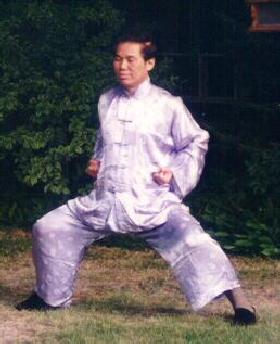
- Relax your body and mind. If this is your first time performing this exercise, find (or create) a distraction-free environment.
- Stand in a martial arts horse stance. Any stance will do. Remain in the stance for one minute or longer; doing so may enhance your results in the next steps. If you are extremely weak, then you may skip this step.
- Exit the horse stance, and stand up straight. Again, relax your body and mind. Physical, intellectual or emotional tension will degrade your sensitivity and impair your results in the next step. Rub your hands together for a few seconds. Close your eyes.
- Move your palms toward and away from each other, as if gently squeezing a small beach ball. Visualize the chi gathering between your hands. Move at a speed of 1-3 squeezes per second, within a distance of 6 to 24 inches. Continue this kneading for 2-4 minutes, or longer as necessary, until you notice an unexpected sensation in your hands. You may feel heat, tingling, vibrating, or strong magnetic repulsion. Many people will experience these feelings on their first attempt; others will need to repeat the exercise daily until a result is obtained.
 Warnings
- These sensations constitute the observation of a “chi-effect”, and not necessarily a direct experience of chi itself. Other exercises will produce different sensations and effects, in different parts of the body, or outside it.
- The exercise outlined above is a trivial chi kung practice; do not mistake it for anything more. Chi kung is an extremely broad and deep subject, and the ability to feel sensations via the steps above does not demonstrate mastery, or even basic competence. These results are only a hint at what can be accomplished with time, discipline and good instruction.
- Do not assume that Chinese chi, Japanese ki, Greek pneuma and Indian prana are all the same thing.
- Contrary to popular belief, martial artists are not the best source of information on chi, or chi kung, and their unsubstantiated opinions should not be taken too seriously.
 More Information
Chi kung (qi gong) books and DVDs
Renli’s Chi FAQ
What Every Martial Artist Should Know About Chi and TCM
Thanks for that – it’s really useful to have Chi discussed in plain English. I’ll be pointing people to this post!
The idea that somatic sensations correlate to qi suffers from subjectivity, suggestiveness and a lack of a positive correlation between perceived sensation and mastery of qi.
Several of the qi concepts presented above are irreconcilable with somatic sensations.
To say that no division exists between the physical and thus the energetic is vacuous, If this is accurate that all that can be experienced ever is qi. If this is true then the distinction between qi as a biophysical phenomenal and as term pertaining to energy become ill defined in the article and thus presents irreconcilable contradictions in terms of the total coherence of the qi concepts with the somatic sensations.
I implore the author to write a commentary on the classics and explain clearly what qi means in them without being vacuous or providing an interpretation that cannot be drawn from direct translations.
My chi is so powerful that if I so much as warm up, all of my internal organs will explode.
I think my blog might add to the confusion
http://tomikiaikido.blogspot.com/2009/03/ki_12.html
Energy is energy and matter is matter; that is the division. One can be expressed in the terms or the form of the other; that is indisputable under basic conventional physics or the classical qi paradigm.
If the perspective expressed above is apparently unique and troublesome, it is only because I did NOT take the luxury of redefining qi so as to be conveniently reconciled with other models–as most others do.
Yes, it is a big country. Pretending otherwise would be…vacuous.
Ergo it is unacceptable, and what is unacceptable is untrue?
Please identify a few of your irreconcilable contradictions.
On the contrary, I think it adds to the clarity.
Yiquan master Wang Xiangzhai liked to ridicule people who studied a Taiji form with 50, 100, 150 different movements, and never learned the constant underlying them all. Against a man like Wang, these people had no gong.
Now, some martial artists today are eager to tell you what qi really is. It is basically a particular movement or posture, or a side-effect of the same. How simple! How appealing! 😀
Well-written and informative! Like Josh, I do have some reservations about the nature of qi, but I do respect that you’re not trying to fit qi into someone else’s model.
With that said, I would like to see you flesh out the qi model that you do have, so that I may better understand this concept.
is there a possibilty that chi energy is a type of placebo effect where the brains pain reseptors are shut off making it impossible to feel pain as many people say you have to beleieve in it to feel its full affects and in the case of putting your body wheight on a spear takes years of toughening the body?
I find inherent contradictions in the conflation of inclusive definitions of qi with specific definitions, several of which are mutually exclusive. Identical problems can be found when we substitute a direct translation of qi, this word is energy.
Energy is a very inclusive word, we we talk about energy in martial arts we are talking about a specific thing, not the all inclusive vague sense of energy, but rather a context.
The nature of qi in taiji is not vacuous but specific, clearly the definitions being employed in archaic works are not inclusive but pertain to a context.
This means that although the word qi is ambiguous like the word energy, the use of the term in context is not nor can it be ambiguous without losing the meaningful content.
Take the three treasures of Jing, Sheng and qi, in this context qi means a specific thing, however what it means there is not the same as what it means in relation to using the qi of your duifang.
If we try to say that qi is ambiguous then we imply that use must be specific or the context is vacuous and thus the import of the term is as well.
To say that all we experience ever is qi; makes to address qi in martial arts utterly meaningless because there is no context specific nature. Moreover if this is the case then to say one sensation is qi is again without significance when we have implied that all sensation ever is qi.
I think the classics speak for themselves and make perfect sense.
The qi of them is specific, not ambiguous. In martial arts there are at least 2 context specific types of energy or qi, one is the qi of circulation practice and the other is the qi addressed in the classics. The differences between theses types qi is profound and using the term in an inclusive way strikes me as misleading.
However this is my opinion. I am not a martial artist though, I am a student.
I hate to break it to you but here in Taiwan as in Mainland China, the majority of Chi Kung is indeed something we could comfortably label cult magic. That is not to challenge the veracity of claims made about its potent health benefits, it is just utterly obvious that it is part of a religious tradition.
You don’t answer the question, why would someone invent the category “Chi” (or Qi in pinyin)?
The answer is that Qi is a description of the power of the gods. It is an attempt to make the naming of individual gods unnecessary since one can refer to all the gods associated with lakes by saying “lake Qi.” In the Daoist tradition whole categories (known as legions) of gods are visualized and made real in the body of the Daoshi (priest) in direct contrast to the trance possession of various types of trans-mediums in which specific gods possess the medium’s whole being.
Them is the facts. And yes martial artists, and painters and doctors use the term too, in a derivative way: Thus each medical herb has its unique qualities and actions, but all herbs can be grouped into qualities of “Qi.”
Which daoist tradition is this that has the visualization and possession?
Where was the term qi termed and in what context?
What is the oldest work it has been found in?
Where can I find the explanation that it is a description of power of the gods? What work is this written in?
What proof is there that the concept is Chinese and not a translation of another older term? After all much of Chinese religion is not of Chinese origin, rather just of Chinese development.
Josh, those are great questions. I deal with these topic a lot on my blog, but you are going to have to dig pretty deep if you want solid answers to those questions.
The way you phrased the first question is loaded and needs a lot of deconstruction, but the popular religion of China almost universally uses trans-mediums. When I say Daoism I mean the tradition of Zhang Dao Ling (beginning i the first century), but what I said could apply to an earlier form of Daoism too.
I believe the first uses of the term Qi were found in the Mawangdui tombs, but what matters is how it evolved into a concept. For that you want to look at Han Dynasty sources.
What do you mean Chinese? That’s a modern identity anyway, probably the written language and use of the term qi are the best definition of Chinese, and that’s not a very good one.
There is no good starter book, but the works of Kristopher Schipper, Isabel Robinet, and perhaps Jordan Paper would interest you.
Great reply. I’ll check into the leads you have given me.
Thanks!
I’ve been reading your Blog, Scott,
and commented on your challenge post.
I am most curious in your answer.
I hope to find the information I seek there.
My objective here is to provide a simple but reasonably comprehensive overview of qi, decidedly NOT limited to the context of taiji, or martial arts in general.
Josh states that, outside of a specific context, the term qi is vacuous. I disagree–even when described in intentionally broad strokes, the model has some interesting implications. Anyway, as I said before, I do not wish to redefine the term for our personal convenience, without regard for its broad history or current applications.
Yes, the Taiji classics mention qi–as do the Confucian classics, and Taoist classics, and many others. Some have never been translated into English, and much that IS has never been written down at all. While it is true that these mentions are contextualized, it is also true that they are (described as) forms of qi!
Scott says that we could comfortably label qigong as cult magic. I reply that he is perhaps too comfortable with cult magic. At various points in history, people have regarded airplanes, rifles, and television as “powers of the gods”; no longer. Today scientism is the dominant religion, so Scott may take pleasure in the fact that I am now labeling qigong as a science.
Science is certainly a faith based cult phenomena. I agree there.
I can’t help but feel as if chi is redefined in the article a couple of times for convenience. The chi of Confucious may not be the chi of Laotzu, I think now; that the true definitions are specific and that to use the term in an inclusive manner is to re-define it.
After all what classic works use the term in the inclusive sense? Do they not portray it in a specific context each time?
I like how stimulating this topic is.
I seek to undue some of the damage done to taiji, at least locally, by hocus pocus beliefs in chi, however I believe in several types of qi and think that some have very clearly been defined and demonstrated to exist in a measurable way.
The concept that energy and matter are the same, this is a very old concept that can be found in the Vedas. It is also found in Daoism. Western culture may be new to the idea, but it has been around long before Einstein.
disregard my variable spelling of qi/chi, to me the spelling is trivial and without significance so I do not mean to imply that qi and chi are different.
What are the distinctions between prana and chi? I can find none that aren’t regional.
Scientism is strong but there will always be contenders for the throne.
Dig, the pagan gods are constantly re-asserting themselves. Call him Davey Crockett, Hans Solo, or Vin Diesel. Our bodies are made by our commitments, and are commitments are fickle.
Here in a land of Qigong’s birth, Taiwan, Chemists and Physicists love to practice Qigong…and worship at the local temples too.
You are right about Scientism’s influence on the creation of what we often call Qigong, but fear and fascination with cult magic is still strong.
The ghost may no longer be in the machine, but it’s still a ghost and it’s still there!
Josh, “chi” can be defined in at least four different ways:
1. As a philosophical proposition grounded in ancient literature;
2. The force behind the observations we make ourselves during the course of chi gong practice (or the common element of discrete forces, if you prefer);
3. The union of all such observations, by chi gong practitioners, martial artists and others;
4. The subset of those observations currently accepted as “chi” by scientists after a formal experiment.
Hopefully we can agree, at the least, not to confuse one definition with another. The broadest definition is the most useful when communicating with outsiders, hence the title “Chi Gong 101”.
What classics use the term in an inclusive sense? I am not the most qualified to answer that, as I rely on translations. I do seem to remember one instance that I wrote about previously here: Mencius attributed his success to cultivating a “vast chi”.
Chris,
Mencius like Confucius agreed that there were four things they would not discuss. (With the reasons after)
1. Domestic Violence (too common)
2. Prodigies (too rare)
3. Natural Disasters (nothing that can be done)
4. Gods, Ghosts, and Demons (too much has already been said)
1500 years later during the Sung Dynasty, Zhuxi went on to explain what the relationship between Qi and Gods is. China, Japan, Korea, and Vietnam all use Zhuxi’s interpretation of Mencius as a base for understanding the original text.
The philosophical position is a possible interpretation, but less common.
Zhuxi on Gods and Qi is translated in:
Religions of China in Practice
Edited by Donald S. Lopez Jr.
Thanks for your contribution to Take Charge of Your Health Care Carnival. The martial arts can definitely help improve fitness and vitality.
Thanks for the tip Scott. I read Zhuxi’s interpretation, carefully, and I saw nothing there to substantiate a claim that chi is best understood as the collective power of the gods.
Actually, his explanations are in accordance with mine above–lucky for him. 😉
psst… it’s all in your imaginations….
Disappointing.
Not really – I’ve come to expect it.
What is the best source of information on chi and chi kung?
Waysun Liao has some great videos and books on the subject of feeling and developing chi
The martial arts can certainly help with focus and energy. Thanks for your submission to Take Charge of Your Health Care Carnival.
Hi, im a teenager from the UK, and i’ve came across the subject of Chi within the past year or so. To me this topic is like no other, as there are many different ways of explaining it-
Being in England the background knowledge of Chi is very dull, and i am really interested in the subject. I’ve started going to classes, trying to learn and understand Chi, as i think it is an amazing, but my knowledge is still short, ide like to know if anyone could help me gain a better understanding of Chi itsself.
I believe science has started to explain some of chinese medicine. The following article by Dr Mae Wan Ho and book by Dr. Robert Becker has helped me understand why structure (the bones, tendons) is so important in tai-chi/chi-kung and health in general.
The Body Electric: Electromagnetism and the Foundation of Life : Robert Becker
http://www.amazon.com/Body-Electric-Electromagnetism-Foundation-Life/dp/0688069711
The Acupuncture System and The Liquid Crystalline Collagen Fibres of the Connective Tissues (Mae-Wan Ho (Ph.D.)Bioelectrodynamics Laboratory)
http://www.i-sis.org.uk/lcm.php
Collagen (found in bone,skin, tendons) is a liquid crystal. A liquid crystal is a spring, an electromagnet, and conductor of light. Put a current through this molecule and it becomes a magnet and also physically twists, and extends (the opposite of muscle which contracts) The special properties of a liquid crystal are what make an LCD screen and for the matter the human body possible. The human body is far more complex and electromagnetic in nature than many realize.
When I saw the working of an LCD screen I could relate it to the movement of tai-chi and bagua. One can begin to understand how energy and motion are connected. Why stretching /extension is important.
Chi is what keeps the body alive. It is already inside you. When it is strengthened by chi-kung this leads to new sensations and health.
Lastly, for me new experiences of this energy only occured after daily practice of chi-kung (I miss a day or two a week at most). All my teachers have said practice daily, but how many students listen? It can take a long time to develop, but how many have the patience?
ok well all i have to say is that is chi powerful enough to know someone of their feet without touching them or make them faint. i would love to be able to heat up my palms or throw a chi ball but i think i have chi becuase i did the beach ball exercise and i did feel some gravitational force a little.
I try for so long……… and in the end ….. NO EFFECT
@ Ryan: you’re kidding right? after the peoples revolution in china, when they clamped down on all things traditional including t’ai chi/chi kung stuff, alot of masters went to london. Look into it.
Great article, I am a firm believer in using chi for relaxation and doing my best to harness the good energy around me. It is a rarely talked about topic in the mainstream and one that should be focused on more often. I am including it in the healthy blog carnival at: http://www.BestBlogReview.com Everyone needs to read this. Thanks, Deb
I have a theory pertaining to the idea of chi as being a sort of life force energy cultivated through specific movements as in Tai Chi or Chi Gung. Just as an electrical charge is generated when a conductor moves through the lines of a magnetic field, perhaps the iron in our blood picks up a charge by performing Chi generating movements by cutting through the Earth’s magnetic field lines. Just a theory
Kevin, your theory would seem to predict that stillness is non-productive, whereas practice shows the opposite to be true.
Chris,
I would neither suggest nor imply that stillness is non-productive as I do not subscribe to that idea. There are those, however, who maintain that Chi can be cultivated through practicing such movements as those found in Tai Chi and Chi Gung. I have often wondered if there might be some explanation for this. Hence, my theory.
I saw a documentary on PBS back in the 80″s entitled “Ring of Fire”. It aired over a period of 3 or 4 days in episodes. In one episode, one of the filmmakers became ill and sought out a healer. The filmmakers found a healer named John Chang who they nicknamed “Dynamo Jack” due to his ability to generated and release electrical charge. I found it utterly fascinating and still remember it these many years later. I have since discovered that there are excerpts from the original documentary on You Tube as well as some new information on John Chang. When asked how he was able to do what he did, he simply responded that he meditated every day. Clearly, stillness is important. However, that does not imply that movements should be discounted. I don’t think it’s that black or white.
I’m reminded of Siddhartha during his period of renunciation. How can one live a life of detachment while being so completely and devotedly attached to the idea of detachment?
I suspect that Chi cultivation cannot be attributed soley to stillness or solely to movement. I believe that Chi is all pervasive and can be tapped into and consciously used by those who have learned how to do it, just as the electromagnetic spectrum can be tapped into. I think it logical to assume that some mechanism is at work when addressing movement as a method of Chi cultivation.
Well, I discovered about a year and a half ago that I could move chi. Since then I have been using it to heal myself and others. I cannot move objects or start fires. But I can move it into other peoples bodies and make their muscles twitch.
To me chi is mind, where ever my mind is in my body, the chi moves. I am sure everyone else can feel it too. When I move chi for healing I imagine it flowing down my arm and out a finger. It feels like a tingly sensation, or water moving down my arm, inside. I move it with the breath, inhale chi, slow exhale chi. Try this and see.
JL
Jason Lee,
Might I suggest that you do an internet search for “Neil Slade cloud busting”? Your comment leads me to believe that this is something you might find intersting. When I first discovered it, I thought it to be absolutely laughable, completey ridiculous and total nonsense. However, after attempting it myself on numerous occasions, I must admit I had to bite my tongue as I discovered there indeed seemed to be something to it.
Additionally, I purchased a book many years ago entitled “Mind Machines You Can Build”. In the book was a device called “The Energy Wheel”. You might be interested in this as well. You can purchase one on the internet for a couple of dollars or you could just make one from items around the house. Essentially, it’s just a sewing needle held upright (you could use a cork) with a wheel or spinner balanced on the top of the needle (a small piece of aluminum foil or even a small piece of paper works as well). The spinner will indeed spin in response to your body’s energy field and/or thoughts. Interesting stuff.
I’ve been experimenting with Chi as a means for healing, although I have yet to be successful. However, I’m absolutely convinced this is real. There was a hospital in China (since closed down by the government) called The Medicineless Hospital. They utilized Chi-Lel Qigong to accomplish seemingly miraculous healings. The website is still up and there are even videos on YouTube taken from DVD’s that are still available. One of the videos shows a tumor being dissolved in real time using Chi (You can see this one on YouTube).
Don’t take my word for any of this. Look into it and come to your own conclusions as I’m not out to convince anybody of anything. I maintain an open mind on these issues, but not so open that my brain will fall out. I’ve researched and come to my own conclusions. But regardless of whether anyone believes or disbelieves, it’s fascination stuff nonetheless.
Thanks Kevin, I’ll check it out.
Hate to burst your cloud, guys, but it’s just a magic trick. It’s an effect that you can sell as supernatural power, but in the end it’s still a kind of stage magic.
Devin Knight and Jerome Finley have a popular book on how to perform the trick:
http://amzn.com/B0016C655K
And here are some discussions about the book:
http://www.penguinmagic.com/discuss/viewtopic.php?t=133617&sid=a2ed3595d3bcb2e85c5ab36d87645130
http://www.themagiccafe.com/forums/viewtopic.php?topic=219633&forum=110&148
Hey Thomas,
Thanks for the links. My “cloud” isn’t busted, by the way. I appreciate the information as I find it a curious phenomenon. I’ve never seen a magician perform the trick. All I know is that I saw a video where a guy was doing it and explained how. I thought it was nonsense and laughed out loud because I thought it ridiculous. However, I decided to play around with it on my own with nobody else around and I found it quite strange. Clouds will dissipate on their own whether anyone is there to see ot or not; this is a fact. But when you select one cloud out of a group and watch it vanish while the others remain intact is strange indeed. Neal Slade, the guy I mentioned before, doesn’t claim that it is any supernatural ability or magic trick. He admits he doesn’t know what’s going on. He also mentions that the selected cloud may have been getting ready to dissipate on its own anyway, but its strange that one could pick the exact one at the exact time. I only brought it up because I wondered if there might be a Chi connection. As I’ve already said, I’m open minded but not so much so that my brain will fall out. I’d be curious to what the authors of the book you mentioned have to say and what their explanation is. Thanks again.
It’s an issue with falsifiability. There’s no way to prove whether it’s brain power or normal cloud behavior that causes the dissipation.
Let’s say that a cloud dissipates naturally in 15 minutes. If you catch a cloud when it’s almost dissipated, you can say, “Oh, that was an easy one to burst!” If you catch one that takes longer, you just keep trying until it’s done (about 15 minutes) and say “Oh, that one was difficult!” Most cloud busting seems to fall within the 7-8 minute range anyway.
Slade doesn’t explain exactly what’s happening, but he does attribute it to using his amygdala and brain power.
is there no way of training and improving chi for e.g making it stronger. and how would i be able to. is there no classes or something.
It does no good to be too intellectual about qi and weather or not chi kung is real or can be defined or used in the proper context. Practice a simple exercise properly every day for 100 days, it may have an effect on your opinion. Every master has a different opinion because he discovered the truth for himself.
Chi is real, I said it before in a previous post on this page and I can move it and use it to heal. It is mostly about feeling it and moving it, with your mind and imagination. Certain exercises do manipulate it in different ways. But the fact is mind, strengthen the mind and your chi will be stronger. Also increasing the speed of the chi also intensifies it. It also moves with the breath. If there are any more questions please ask.
Just a little comment relating to ..”matter” and ”energy” ….matter consists of condensed energy…ie: as matter changes form we have a release of energy..ie: Our daily food intake…Thanks….”Live on & Prosper”…Dan
uh, hi. im nico, and i believe in dreadlocks
Ive recently started taking kojo kenpo, a friend of mine can generate heat with his hands. this fascinates me, i have tried to do the same but all i have done so far is become extreme relaxed, like im in a trance or something and i can feel my hands. my hands feel like magnets, but no heat. any help?
Chris,
Your initial post and all comments are great. THANK YOU for the simple clarity. This topic creates such an emotional response, its amazing. You’re very patient.
One point: to clarify what was meant, when it was said that “QI is in the air”. The air we breathe is a gas, which is molecules, which are atoms, which is energy. We inhale either positive ions or negative ions.
As far as leading energy in the body, I like this discussion of Yi/intention from John Painter:
““A presentation at the Society for Neuroscience conference in San Diego California in 2001 reported researchers had found a correlation between visualization and strength development. A report on the presentation appeared in New Scientist Magazine, November 21, 2001.
It explains that scientists studying the mind have proven that correctly imagining a specific exercising can increase muscle strength.
How could it be possible to increase strength just by thinking without physically moving a muscle? The answer lies in the fact that when we work out we are sending nerve impulses from the brain to the muscles. These muscles flex or relax in response to impulses from motor neurons. The firing of those neurons is determined by the strength of electrical impulses sent by the brain.
Exercise physiologist, Dr. Guang Yue, at the Cleveland Clinic Foundation in Ohio working with a group of researchers found that mentally visualizing exercise movements was enough to increase strength in a single muscle in the little finger, used to move it sideways. Dr. Yue states, “This experiment suggests you can increase muscle strength solely by sending a larger signal to motor neurons from the brain.”
Mind sends that signal. The signal is comprised of energy.
This correlates to the basic principle that the more you relax and concentrate, the stronger the energy circulation.
I agree their are cults based around most subjects on Earth, including qigong. Avoid cults and trickery. That is only a tiny percentage of qigong practitioners.
Traditional qigong is simply moving meditation, deep relaxation, and increased energy circulation in the body.
Without qi, we could not move our meaty hands to disagree vehemently in flame wars on the internet.
Ready…go!
One other point about this thread. It is not up to us to decide with our opinion what “Qi” means, or how to define it. It is not up for debate.
The Chinese word Qi can be directly transliterated to the English word “energy”.
Chinese language uses pictograms instead of alphabet.
In ancient Chinese medical and Qigong documents, the character for Qi consisted of two words, “nothing”, and “fire.” In ancient times, physicians and Qigong practitioners attempted to balance the Yin and Yang Qi circulating in the body, so there was “no fire” in the internal organs. Each internal organ needs a specific amount of Qi to function properly. If it receives an improper amount, usually too much which makes it too Yang or over-energized, it starts to malfunction, in time causing physical damage. The goal of acupuncture and the ancient qigong precursors, Dao-Yin (guiding and leading) and Tu-Na (utter and admit), was to attain a state of “no fire,” which eventually became the word Qi.
But in more recent publications, the character for Qi has been replaced by the word “氣” again constructed of two words, “气” which means “air,” and “米” which means “rice.”
Later practitioners realized that energy in the body is produced by breathing in air and consuming food.
Metabolic energy. Paraphrased from Dr. Yang, Jwing-Ming.
wow!!! this is all really interesting!!! keep the comments coming people!!! I am really enjoying these discussions. As a practitioner of the martial arts ( mostly Chinese gung fu) there is a natural gravitation to the internal arts. I was always very interested in internal arts and the study of jing and qi and prana and what have you. These discussions have increased my curiosity even more. To the guys providing all the wonderful information in this article please keep doing what you are doing!! As a point of interest, if anyone can get their hands on a book named Hatha Yoga: An Advanced Method of Physical Education and Concentration (1963) by Shyam Sundar Goswami, take a read. it will open your eyes.
What we see is not reality, but reality exposed to our method of questioning. That seems to fit with the response on this page and with the meaning of manifestations of Yin and Yang.
My chi is over 9000
l have practice martial for more than fifteen year and have not able to use my chi to move an object but telepathy and influencing people i have been able, l m still and hope l will able to move an object within a reasonable time reading your like tips from your perhaps l help
thank so much
I don’t know if you that practice Qi-gong are now listed with the Chinese Mental Health Board. The reasoning behind this was some practitioners came down with some Syndrome-A.K.A. China’s warning not mine_”Practitioners displayed odd behavior. Some felt that they were so full of mystic energy that we could not control. It is our place to inform the West.” Not to be overshadowed, the DSM-Vtr includes Qigong Psychosis-and is treated like other Mental Illnesses. I really don’t know the details, but the AMA bought into it. And if you are feeling “dissociated”call your doctor. I don’t post here. I thought it worthy of warning. Remember that the Chinese said it was a control issue,and take it from there.
Bear in mind, though, that nobody has ever demonstrated that Chi even exists, but when has that every stopped people believing the most palpable tosh? Never, sadly. It seems when considering claims like this people are quite happy to check the brains at the door. Look, this thing is produced, and the bizarre concept of Chi developed, by a nation which thinks using two sticks to eat with is a good idea. What does that tell you?
Ignorant and arrogant are a bad combination, House. Insulting an entire culture to make your point is weak.
Saying “chi doesn’t exist” is like saying “I don’t exist.” Qi is the energy in your cells, from the metabolic process. That’s all. You don’t know what you’re talking about.
Larry – you’ve made your point. I promise anyone else reading however that you can practice qigong exercises without being crazy. Please stop repeating yourself like a crazy person.
i can feel a magnetic push against my hands but i only feel heat in my right hand any answers?
do you think that people with high blood pressure have a natrually good chi, because the blood is going faster around the body? Just a thought.
Wow reading this has been thoroughly intriguing for a beginner such as myself.
Say i practice Qigong everyday as well as meditation… how long until i FEEL something?
I have done so much reserching my brain is going to explode, from documentries to Qigong/chakra apps for the iphone. I have even gone so far as to change my whole diet which includes the daily drinking of Qi Detox tea.
If you can feel Qi flowing through you please inform us of how long it took you to achieve this? and are there any ground breaking tips??
You should expect a positive result within 100 hours of correct practice. Maybe less than one month, with focused effort and a good teacher.
these days of practicing chi everyday, it feels that my hands are going to catch fire any second, but it doesn’t affect anything esle which really anoys me
“Squeezing the ball” is an minor exercise to whet your appetite only, you shouldn’t expect any other great results from it. There are probably a dozen important exercises not described here…and hundreds of minor ones.
Misha, with regards to energy, or Qi, heat is a symptom of resistance. The heat is not Qi itself, but its affect on your tissues.
That is a notmal experience and you should keep doing what you’re doing. Over time, the heat will diminish as your tissues are conditioned to circulate more abundant energy, and you’ll have a more “open” feeling”.
Also, a big part of qigong practice is training the mind to be calm and the emotions to be neutral. Be patient, humble, and positive. It helps.
Also! Here’s a new study in Seattle and Boston regarding one aspect of the bioelectric properties of human tissues, bone, tendon, muscles, etc:
http://www.bbc.com/future/story/20120302-body-shock-the-energy-inside
“Ferroelectricity is rather like an electrical equivalent of magnetism. In a ferroelectric substance, one side of the material has a positive electrical charge and the other a negative charge, created through an uneven distribution of electrical charges in its constituent atoms or molecules. Just as a magnetic field can make a compass needle change direction, so an electric field can pull all the little electrical charges into a different alignment, switching the charge in the opposite direction.
This “switchability” is what makes these ferroelectric crystals highly sought after for the likes of liquid-crystal displays. The researchers who discovered this strange effect – Yuanming Liu and colleagues at the University of Washington, Seattle and the University of Boston – usually work on synthetic materials like these to build energy harvesting and storage devices. But Liu knew that other unexpected electrical phenomena had been found in bone and other biological substances. And ferroelectricity was reported last year in the hard mineral coating of seashell. Li wondered whether soft biological tissues like blood vessels might show the effect too.
He and his colleagues took a thin slice of the main artery transporting blood from the heart, called the aorta, and placed it in a special microscope containing a sensitive needle tip. The tip detected the tell-tale signal associated with ferroelectricity, and what is more, they found that they could switch this polarization with an electric field.
Why on earth should any animal tissue be ferroelectric? Well, as I mentioned, the living world does make use of some unexpected material properties. Bone, for example, is piezoelectric, which as it happens is another useful kind of behaviour we rely on for everyday technologies. It is exploited, for instance, in pressure and vibration sensors like those in your computer keyboard, because piezoelectric materials produce an electrical charge when pressure is applied to it. It seems that bony creatures use this principle too: the electrical response to squeezing of bone helps tissues gauge the forces they experience. In seashells, meanwhile, piezoelectricity helps prevent cracks and fractures by dissipating the energy of a shock impact as electricity.
OK – but ferroelectricity? Who needs that? Engineers Bin Chen and Huajian Gao have speculated that the property might provide another way for the tissue to register forces, and perhaps monitor blood pressure. Or perhaps the property could sense blood temperature (because ferroelectricity is temperature-sensitive), or, as in seashells, disperse mechanical energy and prevent damage. Or maybe it could even act as a sort of “tissue memory” in conjunction with nerves. Liu, meanwhile, speculates that ferroelectricity switching might alter the way cholesterol, sugars or fats stick to and harden blood vessels…”
this is getting wierd, I’m practicing my chi but my hands seem to be getting hotter not less noticable. Any ideas?
I used to be quite a skeptic of all “spiritual” things myself. What you have to understand is that a few hundred years ago if you claimed the earth was shaped like a ball people would have deemed you very insane for it is obvious that if the earth were a ball we would all be falling off of it! Alas, how ignorant we were then.
And so it is now, we have the same situation today, that other forces exist, of which we simply have not advanced scientificaly enough to prove.
The evidence is clearly far stronger on the side of these “paranormal” occurences being true than false. I dont advicate you believe me based on my words, but on experience and good solid common sense, a thing very few people attain at present day.
It seems that nowadays if you cant prove something immediatley it makes everyone who believes in it an idiot or an ignorant moron.
People need to wake up and realize that science doesn’t know everything yet, if we did we would be building bases on mars, and would be living in peace, and have clean energy and honest politicians.
I learned myself that energy is very real, and I know many ways to cultivate it strongly. Even if you absolutley deny that for example one could have psycic visions… Please believe that through “energy-work” you can improve your physical and mental health muchly. What if someone were to come up to you and be like, hey if you run every day and lift weights it will make you sexy and healthy. To an unexperienced person it may sound stupid and a scam, but upon further reserch you see there are reasons for this effect.
And so it is that things like Kriya Yoga and QiGong can heal oneself.
If people want to know about the many methods of using energy work to heal their bodies, and if their open to it, do more amazing things, contact me at dacestone@gmail.com. I hope this forum alowws for email addresses.
If you want to understand more on your own, read the Seth books by Jane Roberts, or Robert Monroes books, especially Ultimate Journey, or any book on Astral Projection aka Out of Body Experience. You will find very easily that you can not only become lucid in your dreams, but be able to project into phsyical reality with a projectable double, you can prove this easily once the ability is aquired. You should look up Chunyi Lin’s Springforest Qigong, the Mayo Clinic sends terminal patients to him for healing, and two controlled stuides were done on him. He was on the news for teaching people to heal with their hands.
It should come as a pleasant surprise that it is not a matter of if there is a practice to develop energetic power, much as you practice your martial arts power, but that it is a matter of how you do so and how much you do so. You can gain amazing abilties in quite a short period of time… Maybe not things like lighting things on fire and moving objects, those may come with time, but other more important things will come at surprising ease.
Believe it or not.
This is not a post to non-believers who i could not posssibly convince, but to open mindedand healithily skeptical people who have the slightest sense of curiosity and common sense.
Remeber it is far easier to find a million reasons why something is real, than to find hard prove that EVERYONE will accept as real.
Great discussion here! people who think its not real should think again .. or do some investigation. Its real and serious stuff.
Ive read the posts above and some1 said chi comes from ancient words “nothing” and “fire”, and in a youtube video, a bhudist said it flows in the blood. Thats enough to understand a lot: I would say “nothing” was the defn back then, now i’d say its “invisible” or “extra-dimensional” and “fire” as some kind of e- charges similar to what we know about ‘our’ fire. For those skeptics, dont reject my theory, take antimatter for example .. no one knew it existed until the end of last century. And scientist concluded that many more dimensions exist simultaneiusly … as for antimatter, it has positive electrons. So for me, this is the basic defn of chi so far, and it explains the ‘fireball’ ; ‘shield’, even levitation … ive seen all these on youtube by qigong masters. However, I’m researching about the heat emanations aspect still.
And regarding chi and religion, until now I dont think we can completely separate them although you are not necessarily religious. You may still be unknowingly reaching out to the other ‘elements’ (beyond our dimension) that many people worship (that you may call spirits)
To conclude, I must say that not completely understanding chi is just normal, just as we do not completely understand ourselves or our souls. There are some things that are beyond the capacity of our brain. In fact, we dont even completely understand our material nature and whats around us. I hope this little contribution of mine was helpful.
I was thinking about muhammad’s commet, and maybe “fire” is more than what we think. ’cause I just had a thought and at first when practicing chi you feel warmth in your in your hands correct? So maybe chi is firenot spiritual fire or anything like that but just simply normal fire, ’cause if you think about it what is fire? I mean you can’t touch it, it “warm” (from a safe distance) and it reqires oxygen to “breathe”. (and it points away from gravity up at the sky ’cause it doesn’t have “any” wieght to it what so ever. So maybe Chi is Fire? REMEMBER IT’S JUST A THOUGHT SO TRY NOT TO BE ANNOYED AT THIS.
this actually worked on the first time . i felt heat and vibration and tingling but not any repulsion.
Why can one absorb and project energy? Because you are one with everything in the universe. Because everything is energy. Everything is vibration, including physical matter. The rising and falling waves of the cyclical yin and yang. Expressed in an infinite number of ways. We just think we are this physical body, a separate piece from the whole. When in fact you are much more than that.
With qigong / tai chi you are using your consciousness to transform energy. Into heat, into healing, into kinetic force, into electricity. I think at a very deep level one can transform energy to physical matter as well. The whole Jesus trick. Really, there is no limit to the ways energy can be transformed I don’t think. If it can be conceived it can be achieved but…it might require great practice, a very loving heart, I’m not entirely sure how one goes about “achieving anything” I just know it can be done.
Even simple prayers can heal people. If you really love someone, and if they are open to being healed (some people aren’t). Your thoughts are energy and can affect reality.
This sensation of energy from qigong isn’t necessarily linked to one’s breath. Unless in qigong you practice it being linked to your breath. Eventually it will just flow through you completely and always. At that point you can leave your body or go deeper into meditation. Personally I think this feeling is awakening your sense of your yin body (spirit). Which has really always been there you are just learning to perceive it. Your spirit which is not limited by form, which vibrates at a higher frequency than light, which can penetrate solid objects and travel across great amounts of space in an instant. In Taoism apparently one’s spirit is different from our soul. I’m not so sure. Perhaps that is just for the conceptual convenience of our consciousness.
Personally I think qigong kind of limits a person and makes it take them longer to go deeper into meditation. It doesn’t have to take years it can take days. It all depends on what you’re taught, what you believe, etc.
Eventually if you do the microcosmic orbit or other various exercises long enough you’ll start to feel energy everywhere instead of just at your point of focus. And not just on your inhales. (Inhale and imagine energy coming in to your point of focus, is what I was taught to do which I think now is unnecessary and limiting)
Energy is energy, not good or bad. I think it is the intention you have. Telling yourself “the energy is healing, the energy is balanced” and things like that. If you get some fear in your mind, or some unhelpful thought patterns…practicing lower dan tien energy breathing can actually make your stomach hurt. At least it has happened to me in the past. Best not to worry, let it go, have no fear or attachment to anything, transform it into something positive instead.
I don’t think there can be too much energy or too little, unless you are specifically quantifying yin and yang as separate energies. When in fact everything has both yin and yang to varying degrees, when really yin and yang are not separate at all. They are both necessary to form – energy.
An imbalance of yin and yang energy in your spirit (yin) body is what causes problems. From what I’ve learned. Everything begins with yin (spirit) and manifests as yang (physical). So they say.
Because yin is such a high frequency vibration, it is easier to transform using your consciousness. (My opinion). Healing is something anyone can do and it’s not that difficult as long as you practice. Heal your spirit and your body will be healed. Except it doesn’t work when you have for example severed your spine in an accident or lost your finger. In which case…that would be much more difficult to heal.
Healing can be simple, and the most simple can be the most powerful. You don’t have to know that your liver might have too much yin or yang.
Imagining light filling you completely, healing every cell, every part of you, rejuvenating you. With this intention your energy will become balanced. I have been taught that this works, I’m not just making it up myself.
This is also the meditation / visualization I used to first learn to leave my body…although I never did it with the intention of healing until recently.
And if you want to be your healthiest, negative emotions are harmful and so are some foods and other such things. Exercise is good too of course. I think the most important thing though is to have a calm and loving heart. Practicing kindness, love and forgiveness for yourself and everyone.
I know lots of people who don’t exercise and eat a bunch of garbage that live to be 100+ with very few ailments, because they are just wonderful loving people.
Qigong is good. It helps in more ways than just healing. But remember it’s not the movements or postures that give it power.
Note – always keep your tongue against the roof of your mouth when meditating. I’m not convinced this is necessary, or if it is just necessary because everyone who practices meditation tells you it is necessary. I do it because I believe it is necessary so therefore it is. And spinning / spiraling energy behind your navel clockwise when you are done meditating is apparently important as well which I also do.
Oh and if you do leave your body or experience other strange sensations, remember that what you believe is what is true. If you encounter unpleasant situations or other beings, imagine yourself surrounded in a sphere of light and you will be protected. Call out to a master that you respect greatly as well, do so with respect honor and gratitude to help you (any time) if you feel you need help (Jesus, Lao Tzu, Quan Yin, Buddha, whoever you respect the most). Nothing to fear, love kindness and forgiveness to every being no matter their qualities. This is what the Tao Te Ching and the Bible teach.
One more thing, what you project is what will be reflected back on to you. So do not harm people or any beings needlessly, in any way words thoughts or actions. You will be hurting yourself. Only kill to survive, and do so with gratitude for their sacrifice.
Chinese medicine states chi moves the blood.
Experiments done by Dr. Pollack shows then when a tube made of material similar to a vein is placed in water, the water will spontaneously move like MAGIC. Light (infrared) causes the water to flow faster and water surrounding the tube is charged and forms crystals. youtube watch?v=mdT9Li8vwQU
He applies this research also to joints (chinese call joints the energy gates of the body). Charged water forms within and between joints. If you push two like charges together it resists and springs back. Healthy joints work like magnetic levitation. This starts to explain the spring-like elastic Internal Power (Peng Jin) in western terms and its energy connection.
Without chi, life is not possible (no blood movement for one). To achieve extraordinary power and health one must strengthen and train the chi. Practice chi-kung everyday and experience for yourself. Western medicine is just in infancy with regards to this research. How did the Chinese without microscopes know that chi moves the blood?
Feel the energy in your navel chakra. It helps.
In my years of practice and use of chi, I lose myself in emotional attachement, my personal feeling and drive. Emptyness that exists, what I will write here and now is that you can lose your character. No caution no wary, just a statement.
Is it normal for my hands to start hurting? Well it’s more like they feel like they are burning badly… Plz tell me if this is normal?
yeah I have done it this way and others to for beginners I guess this works the best, all I have to do is place the hands like they are holding a ball and drawing in the field. Best effects is in a moderately dim room as you want at least a little light to draw from. You will observe the room getting brighter as you do this more and more and you will noticed that your left side pulls while the right side releases the vibration. Its also used for healing circulation issues and in some cases gravity manipulation, this is TK 101.
person who wrote this article is an idiot… qi and ki not the same? ok xD
it is same thing just pronounced different in japan and china. it is both a life force
日本語を話せますか?
I`m not sure if I had experienced the sensation of the flow of chi, but it`s a strange way to put it in context. Everything around me feels like they contain their own force. I feel the flow like it connects with my body, as I`m absorbing it. I can direct the sensation I feel in my hands to other parts of the body, but how can I ascertain that it`s Qi and not just my imagination?
I was sitting in my room hands like this ( )
All of the sudden i felt some force push back almost felt magnetic. Like when you push two magnets together the same push back.
I have never manifested an bright energy orb.
Been trying for years. I have managed to feel the energy and transfer it to my right or left arm. And my hands. When i concentrate real hard i swear i feel the energy flowing through my body like a wave. I try to focus that energy but i haven’t figured it out yet.
I did this and i felt a small electrical tingling in between my fingers and i also felt heat
I had a hit to my blog from here and so just wanted to post my latest – free pdf with lots of images on secrets of qi training – https://www.pdf-archive.com/2017/04/10/idiot-s-guide-to-taoist-alchemy/
So I read through the comments – some very good ones. Yes there has been peer-reviewed “randomized controlled” research on “external qi” healing of chronic pain, with results that Dr. Ann Vincent of the Mayo Clinic saying were “especially impressive.”
My blog has more details – free info – http://ecoechoinvasives.blogspot.com
I always feel it a longs ago I need it to improve..I just keep with meditation?
Well I think personally that Chi and Prana and possibly all the ancient “energies” like “The Great Spirit” as the American Indians called it are ONE and the same. But that’s just my opinion. I’ve felt the Electro-Magnetic Ball and don’t dismiss it as just an accident that any layman can get and pull out the pocket as suggested. In fact it’s a strangely misleading article but worth the blog/ comments.
Just Stand Still and wait for the Universe to Arrive· 😉
Best Regards and Practice to all.
Chi Funk. England.
I am experienced in energy (chi) manipulation. I detect it easily. A person who is attracted to me is sending energy regularly to my chakras, sometimes over long distances and many times throughout the day. Although the first time he “clocked” me he was five feet away and I nearly fainted. I trusted him, was not expecting it and think my confused attitude and dizzy/staggering behavior amused him. He does not know of my energy past. He has no clue who he is dealing with.
Since he is a cop, I thought he had ethics and principles. I was wrong. He is handsome and courageous and otherwise intelligent, but he thinks he is the only kid on the block with chi experience. His covert use of chi shows his serious lack of ethics. I am not a woman across a bar room floor to be selected for questionable reasons. His desires blind him to what could happen to him. What he did to me and is doing to me is initiating force against me. As this is a case of self defense I have the right to retaliate but don’t.
It may be that he thinks he fancies me … OR maybe he hates my guts and wants to ruin me (a power thing). In any case, I have been patient, since I don’t think he realizes what my chi could do to him. Mind control works both ways.
I know how to ABSORB, REFLECT and DEFLECT (for future use) energy. Previously, in my life, two other unethical men have tried to hook/dominate me with their chi. At that time I only knew how to REFLECT. When one REFLECTS, the energy rebounds with three times the force and will hit the sender in his most vulnerable spot … whatever spot that is. The first man was a Rosecrucian (sp?) and had a stroke. The second man was a magician (black) and was harder to deal with, but as he had a heart problem, had heart failure eventually all his systems shut down. I do not want to do that again. I do not want to destroy this current sender, ruin his health or affect his life in any way.
I hate energy wars.
I want to warn anyone who uses chi for nefarious ends, you may not know what or with whom you are dealing. I could reduce him to a cinder. But I do not want to hurt anyone and get karma for it. So, I bear it. When the chi comes, my partner can even feel it in my backbone. White hot and freezing cold shots. Sometimes agonizing. Depending on where the heat is located on my chakras, I know what the sender has in mind. Hint: it is not enlightenment.
I have been told that if one is attacked, to never give the sender feedback, so I have never told him what I am telling you. It has taken two years but finally I think he has selected a better target and has been easing up. But I feel he has harpooned me with such force and over such a long period of time that I will continue to have a tie to him. I almost never see him; only run into him at the shooting range.
Are the sender’s attacks hurting my nervous system or endangering my health? Only for those reasons will I retaliate.
Be careful with your chi. Thanks for letting me share my experience.
Peace.
What do we do with chi? Does it make us stronger or make chi ball?
does this really work?
My friend taught me the same thing and it still works it relaxes my mind but gives me a headache a few minutes after
Chi is also known as mana in polinesian Rouach in hebrew and holy spirit mana ro me!
As spoken of in Bible proverbs 3:8 in the joints and sinew of your bones!
Yo, just killed a couple families with my chi, thanks for the advice. I will definately recommend my homies this blog so they can join me.
Best way to get to know about your chi
isn’t chi just a feeling you get when your mind is concentrate for a long time on a precise point.Because even if you feel some heat or force in your hands, you’re the only one to feel it.It’s not like you can possibly heat something with it or make move an object(any physical effect). Sorry for the grammar mistake i’m french.
Hmm can anybody help cause whenever I think about chi or qi and say it in my mind multiple times or try to feel the sensation my back starts to get warm and I imagine to move it through my back to my hands but it doesn’t and my back gets warm even when I am sitting under a fan and sometimes I feel cold or mildly cold sensation in my stomach when I inhale and think about qi what with this??
Everything is an interesting hypothesis until proven otherwise.ones experience with energy will differ from others as we differ from one to another.somethings are too complicated for the human mind to comprehend.as the dao say effortlessness acceptance and awareness.these are the things we must learn to be intune.all energy is borrowed and must be returned.also there is no good or bad energy only negative and positive energy.meaning energy is baseline how we focus that energy changes it to either negative or positive energy.some believe if one controls thought controls the flow of energy thus not needing to.manifesy such energy into a metaphysical form.
I Love Yuen Wah Martial Arts Skill he is very outstanding Martial Artist
Since there’s so many experts in the comments, would you experts point to a good material where I can learn about Chigong as a beginner (websites please)?
It’s very confusing to see others saying “this ain’t it”…or maybe I shouldn’t have read the comments saying that this is wrong or whatever big words because it just confused me and I wanna master my energy field but with a method to do it.