Let me tell you a dirty little secret about black belts. They have no particular meaning at all.
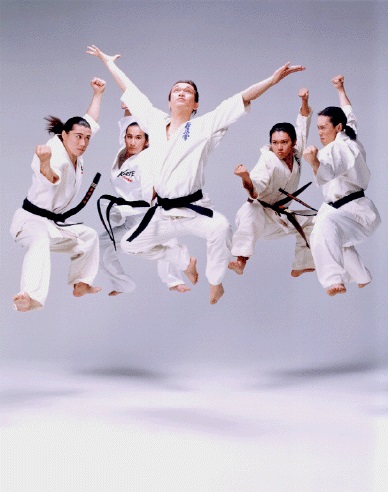
Black Belt Club
Every school of martial arts chooses its own set of arbitrary requirements for black belt ranking. There is no standard, and there never was. Even within a single dojo, testing is usually based upon subjective criteria, and students are promoted at the pleasure and whim of the sensei.
Despite this lack of an agreed-upon definition for shodan, martial arts enthusiasts love debating how much time and effort—mostly time—should be required to attain it:
- One year? Too short! It proves you attended a McDojo, the martial equivalent of a diploma mill.
- Ten years? Too long! Obviously a scam to maximize tuition payments and testing fees.
- Three to six years? Just right. That proves your dojo is legit, and your skills are genuine. You must be a True Black Belt™.
The community consensus seems to be that a black belt should take about 5 years to earn. Is this an error of false specificity, similar to insisting that an inch should weigh about 4 ounces? Or is it sour grapes from insecure dan-ranked martial artists, who fear their own time and effort were wasted?
How Long Should it Take?
The Just Barely Good Enough principle is widely used in engineering disciplines. According to this guideline, the best component/document/tool is the one that meets its specifications and requirements, and nothing more. Any additional “improvements” to the component/document/tool would result in an added cost with no associated benefit.
For example, imagine you are shopping for a stopwatch, to time your stance training. The store has two different models: their basic stopwatch is accurate to one second, and costs $4.99. The deluxe model utilizes a cesium isotope for nanosecond resolution, functions underwater and includes an attractive silver carrying case. The second model is $89.95. Unless you have money to waste, the cheap watch is a better deal. The additional cost of such luxurious accuracy is $85, but the additional value is zero.
We can apply this same principle to the black belt product: the most valuable black belt is the one that meets your needs at the lowest cost. All other things being equal, a 1-year black belt is superior to a 10-year belt. But instead of obsessing about time spans, I suggest you ask yourself this question: what do you need your black belt to do for you?
I know what you’re trying to say, and I generally agree with you, but your language has some implications with which I disagree.
I would disagree that 10 years for a black belt is a sign that your school is scamming you. In certain styles (a notable example being Brazilian Jiu-Jitsu), it commonly takes 10 years or longer.
You do, however, ask “what do you need your black belt to do for you,” at the end of the article, which addresses this issue. I remember in Tae Kwon Do that earning a black belt meant that one had a solid base in the style on which to build mastery, equivalent to a Bachelor’s degree in academia. In this case I would agree that 10 years is far too long. In short, it all depends on what a black belt is supposed to mean, and you weren’t clear about that.
Wait, one more thing. In the part about the sport watch, you say that one shouldn’t attend a school in which they have to put more work into achieving their black belt than they think they should.
Belt rankings were invented by Judo founder Jigoro Kano so that he could easily discern who had the technical proficiency to learn or perform a certain technique. This is what belts are: an indication of proficiency used to segment students in class or competition.
The point of martial arts is to become an effective fighter. If people are picking a school based not on how well they will learn to fight but instead on how long it will take to be awarded a belt of a given color, the martial arts are not for them.
I present the “ten years is too long” and other time span arguments as all too common, not as my own beliefs.
On the watch analogy, I fear you have misunderstood my point. Spending more money on a stopwatch does not make it more valuable; neither will spending extra time to earn a black belt–especially if you regard it as a symbol of proficiency.
James is spot on here. Black Belt means different things to different people. In the far East, it’s NOT an indication of mastery of a specific martial art, which is the common translation in the Western world. To the Japanese, Koreans & Chinese the black belt merely symbolizes the students completion of “basic” training and their readiness to “begin” proper training.
Surely you do not mean to suggest there is a unified pan-Asian perspective on black belts?
Er, yes.
On a side note, I’ve been training for almost 10 years and no Dan grade for me yet. I’m certainly not being scammed by my instructor though – you don’t pay anything to retake a failed grading at my club, and we only have the one tag between belts. Basically I’m not in a hurry, and not great at learning patterns!
I’d support the idea that clubs/instructors insisting on two (or more!) tags between belts are certainly milking their students for money.
Andy, Asia is a big place. There are dozens of styles of martial arts, and they don’t even agree on the best way to throw a punch, much less the significance of belts, patches and other pieces of flair.
Fair enough – we agree to disagree then! TBH I thought my comment supported the post, rather than arguing against. Preconceptions about what a black belt means are generally wrong.
Regards
Andy
Please don’t take it personally. Hong Junsheng was one of the many masters who utterly rejected the modern phenomenon of colored belts and fancy silk training uniforms.
I have just passed my black belt and in my style (goju ryu) there is a common standard.
As we all agree there are many styles of Martial Arts out there, some are simply sport orientated, others are a mix of self defence & sport…then there are a few that are pure self defence.
The art I train in is pure self defence (Hapkido), we do not have patterns as we do not see it as street effective. We train to survive, not to compete so out syllabus is very streamlined, simple and effective.
The average time to achieve black belt for a student who trains consistently 3 days per/week is 4-5 years. Alot take longer, but most do not train consistently.
We say you get out what you put in.
i am a 2nd dan black belt in karate ju-jitsu
LOL Only in America! A shame that the western world has diluted the martial arts in so many ways since mass commercialization of the arts beginning in the 1980s. The dan rankings, or colored belts, work for some and for others the sash ranking works. And, yet, for others no belt ranking works. Whether a belt is worn or not, proficiency has to be measured in some way.
Since I began training in the 1970s in New York, the thing I always found interesting is the abuse of Black Belt ranks in Tae Kwon Do……
It should take however long your teacher (assuming they are qualified) decides for you.
1 year? Fine, in Japan and Korea, promotions came that fast, and faster.
Who are we to judge another’s student? Those who do are nothing more than arrogant, and there is no shortage of that quality among martial arts teachers.
Al Cole
Cleveland, Ohio
One part was missing from my post.
10 years is fine too. DAN has no set limit of time.
Al Cole
Cleveland, Ohio
Chris, that story of Hong Junsheng has nothing to do with rejecting the idea of colored belts. It’s about not pretending to be something that you are not, and the courage to stand firm for something one believes in.
Perhaps he did reject the idea of colored belts, but we cannot infer this from that particular story simply because he does not use colored belts. He might, for instance, advocate that any teacher should use whatever method is deemed best for the school, which might include use of colored belts.
Let me quote two sections from the article:
Now, Hong Junsheng does not decide who can and who cannot wear a black belt today. But it seems clear he did not wear one himself (it is part of a uniform), nor did he have much respect for the practice.
P.S. I looked for pictures of his student Chen Zhonghua wearing a black belt, and found only this one:
Hong Junsheng practiced and taught only Chen-style Taichi. Did it meant he “utterly rejected” the other styles of Taichi? Did it meant he “utterly rejected” all the other martial arts he did not teach?
PS: do you know what certificate Hon Junsheng and Chen Zhonghua were holding in that photo?
It is the lineage holder certificate.
leí el artículo, pero no coincido con tu opiñon aserca de cuánto te debes tardar para ser cinturón negro.. en mi caso, yo practico Taekwondo desde hace 10 años, y según mi experiencia, creo que lo que dices de que un cinturon negro de 10 años es inferior a uno de 1 año.. eso no es cierto.. yo soy cinturon negro hace 4 años, y soy mucho más superior a los que solo llevan un año con ese grado.. cuanto más práctica mejor sos.. por lo tanto no importa que cinturon tengas.. lo que importa es cuanto tiempo le haz dedicado a las habilidades que sabes. Eso te hara un buen practicante de artes marciales.
I have seen people who hold the black belt, who have trained for 20 years, who were terrible and idiots.
I have also seen students who hold a black belt after 12 months of training, who have excellent skill and a great attitude.
what matters is the combination of a good teacher and a good student.
I have found an error in one reply by Jame W Johnson. Dr. Jigoro Kano did not invent ranks, he used a black belt to denote an advance student. That is the only thing he did, he did have various degrees of Black Belt though. However, beginner and intermediate students did not have a rank.
Bolverk,
Where can I find this information about Kano and ranks?
Thank you
A black belt is totally insignificant.
What matters is strength,knowledge,technique and endurance.
A martial art teacher should be an experienced martial artist who knows how to defend himself and how to teach others that.
A black belt can be bought with simple cash in a martial arts supply store.
Martial arts skill and strength can only be achieved with years of devotion and hard training.
Black belts means nothing,it just looks cool,nothing else.
When one has terrible technique and bogus knowledge, but believes they have the real thing, then the Dan (real black belt) seems insignificant. If your knowledge and technique had any validity, then a true Dan would hold great meaning to you.
Al Cole
Well…i need a black belt to teach unarmed combat in the army
I study sin moo hapkido. I have recently achieved my blackbelt after 4 years of training. I originally thought that I was not ready to be a blackbelt, as I believed that one should be able to defend themselves from attackers using any technique they had learned thus far in order to qualify for a blackbelt. But then the Grandmaster of the style came thousands of miles from Korea to teach us and said that he was promoting me to first dan, even though I was two grades down from it and I didn’t even know the full blackbelt syllabus. I know that this man is an incredible martial artist, so who was I to argue? But I still wonder whether or not I deserved it. Your disscusion has given me alot to think about…
The whole point of a black belt from my perspective is primarily to demonstrate a proficiency in all skills learned from previous belts, and to show a basic mastery of the art being taught. Although there are many many schools out there whose goal is simply to make as much money as possible, there are still some schools that hold true to the old principles. To me, the time that is required to attain a rank of Shodan is all based on how much there is to learn, and more importantly, based on how quick or slow a student learns. There is no reason not to award a student with a black belt if they know all of the material, simply because it’s “too early”. If they know the material for the art, and have the skills that have been outlined, and have put in the necessary dedication and effort, why keep the student from what they deserve? However, for the same token, I feel as though it is inappropriate to award a student a black belt simply because of their time invested, even if they don’t possess the necessary skills to proceed. A problem that I see is that there are many schools that choose to award a black belt simply because the student has “payed” for it with their monthly tuition, rather than earned it with their blood, sweat, and effort. So, there is no way to classify what is necessary for a black belt between all arts and styles, because all styles require a different level of dedication. However, this does not make the black belt less legitimate, it simply means that the art is perhaps more simple, and less difficult to master.
“I feel as though it is inappropriate to award a student a black belt simply because of their time invested, even if they don’t possess the necessary skills to proceed.”
No two students are the same. Someone may have struggled hard and put in tons of work to get where another student got, physical wise, in a few months. Black Belt is not based on narrow interpretations such as technical skill, athleticism, etc.
In the old days, like today, you had a wide variety of differences, many people earning black belt degrees in less than a year, and moving even fast at higher dan ranks. Research the Dan promotions of some famous Karateka and Judoka.
The Dan’s were issued not so much about skill, but about courtesy, loyalty, respect, responsibility and mainly about Leadership”
I apologize that my quoted sentence might have been taken out of context. When I said skills, I didn’t specifically mean natural athletic ability, or even prowess over all of the technical material presented. Skills include skills of leadership, honor, integrity, and most importantly skills of character and personal growth.
My comment was meant to more or less illustrate that there are some people out there that feel as though they can simply “buy a black belt” by going to class, putting in half effort, but still paying their tuition so that i the end, they will get their rank. However, we wouldn’t have this kind of a mind-set if money-hungry systems didn’t exist. If they didn’t exist, there would be no place for the student who doesn’t care about respect and effort, and only cares about having a black belt to show their “superiority” to bully etc.
The point that I try to make is that there are many black belts out there that have been earned through all the aforementioned qualities, rest assured. However, there are also some that have been produced by systems and schools that I would view more as a corporate company whose main goal is to land a large profit, rather than educate the student about what is really important.
I understand completely that it is very narrow-minded to assume that a Dan ran king is given solely on athleticism and physical skills alone. In all reality, even though a knowledge of the kata, techniques, combinations, etc. is required, a demonstration of growth into a better person is what truly makes one deserving of black belt.
So, considering the above, and back to my original point, it is ludicrous to think that there could be a common standard even within a system (aside from basic technical credentials). Because no student is exactly the same as the next, the personal requirements for growth will be different with every individual. So the bottom line is – considering the fact that there is no way to define a standard within a system of martial arts, it would be beyond impossible to define a standard for the US, or the world.
I just got my black belt. I waited for 10 years and I finally began to feel that my school was milking me. So I challenged my master to an all-out throwdown. Before anyone knew what had happened, I was wearing the black belt and his pants had fallen off. Needless to say, he is not a black belt anymore, he hightailed it out of there in complete and well-deserved shame.
I’m… I’m a little confused. I studied kobudo for a year at my college and we didn’t do belt tests or any of those things so I don’t know much about them.
Doesn’t a student progress through learning the skills of the art? I always thought that the focus was supposed to be on studying the art and becoming proficient than on what holds up one’s pants. I was led to this site after I looked up ‘black belt’ on Wikipedia after my siblings’ Kovar class last night. I was curious where all the focus on black belt excellence came from and why I wasn’t clued in on this… experience. My sensei taught forms and such, we didn’t ask when we could test. We had four green belts that we were sad to see leave us at the end of the year because their dedication to practice was a model for us all. I realize Kovar’s class was for kids last night but it seems from the comments above that even adult classes are like that. What gives? Am I just not living in reality here or is my perception of the martial arts totally wrong?
Just because a person is your teacher, does not automatically qualify them as an expert at anything. Including providing you with the correct definition of what a DAN (Black Belt) means.
I don’t like to follow up make-believe definitions of any sort, that is why it is good to find out how the martial arts leaders in Asia define their styles.
Al
“there are some people out there that feel as though they can simply “buy a black belt” by going to class, putting in half effort, but still paying their tuition so that i the end, they will get their rank.”
I agree with you here, and unfortunately, even though my instructor is an extremely accomplished martial artist, he does tend to let people coast their way to blackbelt without any work. Yet he has also trained some of the best, including European and World champions. My problem is that I cannot see whether or not I am one of those who deserves their belt or did I simply recieve it because I had paid my tuition and spent the nessasary time there.
i like martial arts. i’ve been doing it for 8 years and have 2 different black belts. i am just wondering, how do u know what school is bad or not
I haven’t gotten around to writing on that topic specifically. Here are some indirect responses to your question:
How To Choose a Bad Martial Arts Instructor
You’ll Always Have The Sensei You Deserve
I don’t believe in ranks and belts a white belt could be able to deafeat a black belt in a fight and yet it takes him 10 years to get a black belt. Belts are pointless they are just part of a uniform they do measure a martial artisit power and abilty
Belts were never about who could defeat who, or a measure of power. The belt is about the student teacher relationship. If you want to think of martial arts in those terms, there are street fighters who could pound you into the ground, and they have zero martial arts training, that would make your Kung Fu worthless in your terms.
I was just saying that belts are inaccurate at measuring skill and i could deafeat a street fighter since that is what i train to do thats what martial arts self defense and your saying is you get a good realtionship you get a black belt that means some one with no experience could get a black belt if they were best friends with there teacher its about skill and power the better you get the higher belt you get.
crap i got to many typos i my messages curse my key board
Kind of. You, nor I can beat every street fighter. That does not make us any less a black belt. Black Belt means that we have in some way, contributed to the benefit or our practice. Maybe we are the parent who gets a College Gym for free to hold the State Championship, or we are the Mayor of the City that helps bring in some special team or person to train with that cities martial arts members. Maybe we are the dedicated, un-co-ordinated student who works very hard every day and struggles, and never complains, and follows our teachers, never to achieve what the gifted Jock student can achieve, but is satisfied with the challenge. These are the people who deserve the Black Belt (DAN). However, there are those who are judge mental, who are not aware of the struggle, or the sacrifice, or the extension of kindness and free giving that come along with the earning of RESPECT FROM THE MASTER. When the Master-Instructor respects you, they will award you with a DAN. That DAN is a membership into a special fraternal/Sorel society.
Do not belittle the Dan by speaking in terms of fighting, etc. The Dan is much greater than that.
Al Cole
al cole i have no idea what you mean all i get from is that once you are loyal to your sensei and dojo you get a black belt i thought you got a black belt when you showed that the skill and ability to earn one but you have your opnion and i have mine
Search Al Cole Taekwondo, or Master Al Cole to get an idea of me. I am not a novice. I am no know it all either. I am who I am. I have been to Asia and I know what a Black Belt means there, I do not care what a black belt means to people in America. my brother Americans are ignorant when it comes to culture. That has been our American History, and why should Taekwondo not suffer the same ignorance.
Al Cole
I’m Australian but i like to call it amercia number 2 since we copy amercia so much any way that is what you have been taught and think i know what i know and personally i think belts are nothing but uniform people should have to wear a belt to show what they have done.
Bleh, none of it matters really. Whoever is still alive at the end, they are the master of that moment.
kyle i like the way u think
I’ve practiced for 14 years in many styles, (maily due to moveing ). My main focus has been in Wing Chun and Drunken Boxing. I have had my ass handedto me by noobs and defieted “champions”.
I have been asked to teach at a collage in WA and i have been considering how to organize my rank structure. But i do not agree with belts per-se. I hold three black belts according to the association i am apart of and i don’t fee two of the are deserved. I think ones dedication, effort, understanding or martial arts as a whole and skill all are factors. If i were to come and spar at one of your schools my attire is color cordanated. I will put on the sash that fits the clothes, i will take off any thing that distracts from my porpus.
I like many standards I’ve seen (Go-Ju, ShotoKan, BJJ) but i will have my students carry themselves as martial artists, not egos. If a rank is required for an event they wish to atend i will award a “piece of paper” that only reflect what they have satified with my association.
I feel this will raise up more Martial Artist and less arobic profitiant belt hunters.
I am a 14 year old white belt judo player. I weigh 82 kilos. I am 5 feet and 8 inches tall. I beat a black belt 18 years old 6 feet tall and weighing 63 kilos. What good is this guy’s black belt? I trashed him in my first fight.
No offence, but Judo is pretty simple, and if tou weighed that much more than him and your center of gravity was that much lower than his, you were bound to win.
Well, the definition of ‘Shodan’ literally means “First step”, not “expert” as some people refer to it outside the martial arts.
For you to understand what that really means on a down to earth level, you basicly have learned all of the basics of the martial art that you are studying.
If you look at some of the more ‘advanced’ techniques that the color ranking systems use the newer moves are just your basics with a slight ‘twist’ to it.
Although the color belt system is flawed, much like a lot of the other systems, I only see it as a way to seperate techniques into sections. I have a fellow student in my class that is going to “academy” and through some weird twist went from beign “Senpai” to “Sensei” in only a few weeks.
His rank went from blue/green to somewhere in between black belt and brown belt. Not quite good enough to be a Shodan but better than the rest of the class.
Any one else see a problem with this method? Given I would like to become an instructor myself, I would not do so until I reached at least a green belt; where I would hopefully have most of my flaws worked out, or greatly improved.
So in short there is going to be flaws in every martial arts ranking system, regardless of fighting style or country of origin. You just have to find the one that works out with you; not ridiculously hard, not insanely easy, but challenging enough to make you want to push yourself harder to improve yourself and your technique.
It really comes down to the person’s dedication to the martial arts and the attitude that goes along with learning it.
there is a story where if you get a white belt after years of traning it will get dirty with blood and sweat and stuff it will turn a mouldy green then a grey colour then brown then black and it will be infested with germs unless u spray it with germ killer i think this is the best way to get a black belt if u want one
I fought the same skinny black belt again and this time I got a submission out of him ( see entry 51 )
I beat that skinny black belt again – and this time I got a submission from him. Yeaaaahhh!!!!
On a planet where an 8 year old “black belt” can compete at the “World Karate Championships” with a “kata” that he made up himself and set to “the Eye of the Tiger”, I certainly do not compare my rank to his. I’m fairly sure that I could demolish that kid in the kumite ring, but what purpose would it serve to beat up a kid half my size?
I am a healthier and stronger person from the years of training that I did before being tested for shodan, but really – the belt is just a piece of cloth. The point of martial arts training (IMHO) has little to do with belts or gis or even what kata you do (or don’t do). the point is that you are following a disciplined path of self improvement.
If you expect your black belt to do something for you (other than represent a milestone in your training), you will be sorely disappointed.
Yes GojuGirl. I’m still a white belt and I’ve thrashed quite a few coloured belts – including a black belt. He played brilliant judo. He is very agile and athletic, but being only 63 kilos against my 83, he is the one who went on to his back. He could not match my strength.
Gentlemen and ladies, forgive my tardiness to this conversation however, regarding the initial statement at the start of this blog, I would have to disagree with the opening comment that black belts have no discernable meaning.
Every school is unique and similar. Various techniques, defense, kicking and striking movements are defined and practiced. These are arts that have been in constant evolution and as such, have expanded. To put a “standard” to martial arts is in itself a way of limiting it’s potential. To put a “standard” on each and every student, hinders growth. A “standard” can be the goal however some are not meant to achieve this, yet benefit from the path.
To me, as a student and an instructor, the black belt is a definition of an individual’s accomplishments within a structured environment. Do instructors have or use subjective criteria for promotion, absolutely. As individuals, we are alike and dislike. If a student progresses from determination, practice and effort, it is within the instructor’s right and ability to compliment that student with a belt. As individuals we have a tendency to compare ourselves with others instead of within. Having made this statement, do instructors promote for money and time, absolutely. It is what it is. Do I necessarily agree with it, no, but then again, it is what it is. In short, the black belt should be a personal goal, as would an MBA, achieved from an accredited school. The belt alone is empty without meaning.
Who cares about belts? I’ve studied many forms (Aikido, Wrestling, Tae Kwon Do, Karate), I’ve held many belts, passed many tests, and had many medals and awards bestowed upon me. The only thing that’s been important to me though has been the skills I’ve learned. Belts, medals, ranks, (even time spent learning), they mean nothing compared to ABILITY…
That may as well be the case for you however some people need assurances and reinforcement, hence the belt, tape, stripes and/or markings to show advancement. Ability is a measurement of skill and commitment. You may not appreciate the belt as a means for completion of a program, some do. Some prefer physical achievements as a means of denoting ability, others must be nurtured (I will leave it at that). If we as martial artists and teachers were to look for only the students that chose the hard way of learning, we (the industry) would have very few students. For some, the black belt is comparable to a college degree. What you do with the degree is left to the individual. As far as ability, it changes and matures with age. Some may never achieve your standards, you are blessed with skill.
One does not “grade” his quality by his belt for if you all remember one thing…You took classes to defend yourself from attack…You also remember we all started someplace and either wanted it or did not…Either you know how or you do not…There is no competition unless your in a ring and even then it can be the luck of a simple mistake…No matter what your belt-rank…Train hard/learn well/grow eagerly but be consistent in everything you do…KEY WORD “CONSISTENCY”…
Be Positive…Be Physically healthy (Mind & Body)…Self Discipline…Know when to use your skills…
Don’t assume everyone takes martial arts to defend themselves. Very few schools teach effective street techniques. I am assuming you have never competed for anything by your comment. Most of us have been competing with many aspects of life from grades in school to positions at work. Not withstanding, how about internal competition? Are you saying you have never challenged yourself to anything? You are correct in being consistent. I am questioning who the “you” is directed toward? Each student has personal achievements and goals related to their training.
Martial Arts is an artistic expression where self-defence is the medium. It is not impossible to be peaceful and a warrior.
It is the discipline of practise that develops character. It is strength of character that will keep you alive on the street.
Forgive me Koryo for you are right I should not point fingers as there are usually 3 pointing back…However if you took classes simply to go out and compete more power to you…My competition is my self improvement which I apply each day…My goals are never reached as I continue to strive to be a better person each day…I was simply commenting on those that hold black belts…I have seen many ranks and they seem to be very impressive as they apply themselves through each rank…
So otherwise I meant no harm to your self pride and your achievements…Please continue on your path as each student finds there own meaning of holding a belt rank…I am far to old now days to compete but I do still train…I love it and will never give it up…
Oh by the way…I have succeeded in many areas of my life which you know nothing of…But thank you for you opinion…I’ll be sure to file it under “F” for flush down toilet!
Thank you for the clarification, we are on the same path. It is not about right, I am simply trying to clarify your comment audience and provoke thought. If my words were considered an insult, I appologize. Your commentary was quite specific about the only competition being in a ring, hence my retort! I never questioned your success nor do I state mine. My point of view is a culmination of various students’ reasons for taking up an art.
I for one did not start training for self defense or competition and I to am getting experienced in age.
The original topic commented on the uselessness of a black belt and all I am saying is that a black belt’s meaning is unique to each and every martial artist, regardless of skill and experience. Because of this, their dedication and consistency reflects their belief. Accordingly, their level of commitment is reflected in their abilities, knowledge and skill. GojuGirl is correct in her assessment of self-defense.
i need my black belt and teaching accreditation so i can offer students an accelerated black belt program in mixed martial arts where they can earn it in about 8 months why make people wait for years to earn a black belt when a quality fighter can be easily trained with the right program?
Mike – Why don’t you just go buy a black belt and tell everyone you are a master? You can buy one of the “teacher’s certificates” on-line and it only takes a couple of weeks to come in through the mail.
The black belt itself doesn’t matter – as many have stated, it represents many different things to different people. However … if the common perception is that a black belt represents the attainment of a high rank of skill in martial arts, than an “accelerated black belt program in mixed martial arts [that takes] about 8 months” is borderline fraud. People will think that they are really “experts in martial arts” when really, they are just beginners. Good fighters, sure. But not martial artists.
Technique, skills and conditioning can be developed to a fighting level in 8 months. No dispute. But martial arts isn’t about fighting – it’s about personal development.
If you don’t plan to “follow a disciplined path of self improvement,” why even bother with a black belt at all?
Mike – I am not directing you toward a course of action, however if you are truly going through an accreditation process, then your program should be longer in length. I agree with GojuGirl, the concept behind martial arts training is personnal development and meant to be a life-long journey. I also think an 8 month program will generate a false sense of accomplishment and understanding.
The development of mixed martial arts has been a long time in coming and is a welcome sight. In the past, instructors refused to allow students to train in styles “outside” of what they taught in class. Students could get dismissed if they openly showed an interest in other arts. The benefit of MMA is a well-rounded understanding of multiple arts, however I truly believe it should take just as long if not longer to develop these skills.
As an instructor, you need to ask yourself if you are really helping or hindering your students? It is your decision, especially if you are developing curriculum for student advancement. Think back to your Black Belt training, do you feel it was sufficient or adequate?
I recently saw first hand the type of damage that “no-standard” ranking systems can do. A family who was new to town came into our dojo to enquire about karate classes. Their teenaged son had been training in karate for 3 years and had been ranked to brown belt by his previous sensei. (That’s a little bit rushed by our standards, but still reasonable) As we do with all students who have been ranked in a different style, we asked him to participate in our intermediate level class without his belt, so that we could assess which level is most appropriate for his training. Usually, we give the student a green belt to recognize their previous training, and they can grade up when they are ready. After all – a punch is a punch and a kick is a kick. At brown belt level, you would expect that those two concepts would be understood.
Unfortunately, it was blatantly obvious that this student had been defrauded by his previous sensei.
This “brown belt” did not understand how to make a proper fist – had never punched a target or kicked a shield and did not seem to understand “fighting stance” or “blocking” concepts. His conditioning was terrible. He should have been in a beginner’s class with a white belt on – but instead – he has been told that he’s almost a black belt. Can you imagine how devastating this must be? Any sense of accomplishment that this kid felt about his previous efforts just went down the drain.
I would hate to think that this kid believes that he can defend himself….
Goju Girl, I know how you feel. I have seen it a lot of times. And its not fair to the students.
And i disagree in this but I have seen a Sensei give a belt to his student knowing in his mind he didnt deserve it. But they give in to the kids parents and of course money. I understand some sensei’s that have these kind of people training. But if we know that a student doesnt deserve something we should not give it to him, its just gonna hurt him, sooner or later.
And about what Mike said. For me it would have been a shame to get my black belt in 8 months. Yeah maybe I could have learned a couple of things, lost a couple of pounds, but where is the experience. How can someone say “Im a black belt” in 8 months O_o…. Even if the person is a good fighter he will still lack technique and most of all respect for himself and others.
As GojuGirl said “It is strength of character that will keep you alive on the street.” You cannot gain that kind of stuff in 8 months. I doubt even in a couple of years.
have a nice day
I wonder about your statement that 10 years means you are being scammed for tuition. In Judo the typical time to black belt is seven to ten years. However, clubs run not for profit. The coaches are not paid. Their interest is with the value of the sport.
“Martin Brass // Mar 28, 2008
I am a 14 year old white belt judo player. I weigh 82 kilos. I am 5 feet and 8 inches tall. I beat a black belt 18 years old 6 feet tall and weighing 63 kilos. What good is this guy’s black belt? I trashed him in my first fight.”
Was this in randori? If so I would suggest that the black belt was going very easy for the benefit of teaching and to reduce risk of injury and frustration. Enter an open class at a competition and you will see a different kind of Judo.
Judo has an international body and each country has a national grading board that oversees blackbelt standards. Grading for sho-dan is done by building a resume, gaining a specified number of points through participation and contribution, and appearing before a grading board that is recognised by the national governing body.
The original blog laid out a positive question and deserved the good response it received. One of the perspectives worth mentioning is the kind of student a dojang is wanting or willing to take and train.
If the orientation is family, or all demographic segments of the population (given reasonable health), and the emphasis is on the discipline and moral-strengthening attributes of the martial arts, then an accelerated belt system is helpful in terms of reward and motivation.
Any reasonable person who receives a black belt under such an orientation has to have the common sense to realize that skillwise they are no Jackie Chan or Jet Li. One of the key features of any Black Belt under any system should be humility and greater self-awareness.
Duncan // Sep 26, 2008
“Martin Brass // Mar 28, 2008
I am a 14 year old white belt judo player. I weigh 82 kilos. I am 5 feet and 8 inches tall. I beat a black belt 18 years old 6 feet tall and weighing 63 kilos. What good is this guy’s black belt? I trashed him in my first fight.”
Was this in randori? If so I would suggest that the black belt was going very easy for the benefit of teaching and to reduce risk of injury and frustration. Enter an open class at a competition and you will see a different kind of Judo.
———————————————————————–
It was in a competition. My opponent fought well and hard. I put the skinny malink right over my shoulder. He was very upset at being thrashed by a younger beginner.
are black belts athletes?
quote: are black belts athletes?
Depends on what you mean by athlete. I believe that a principle of diligent training is striving to become stronger in body, mind and spirit. Does it mean that I am an athlete? I do athletic things 6 days per week. I’m fit, but I don’t consider myself to be an athlete.
I think you might find that the search for the meaning of “athlete” is almost as elusive as defining the meaning of “black belt”.
To be successful at a sport, like taekwondo or judo, I think that the player must be an athlete. To be successful in non competitive arts, you just need to keep training. It’s the path that is important, not the prize.
I understand the value of competition-focused arts – I am a competitive student. The competition helps me to focus on a training target. But like open tournaments, the black belt is only as meaningful as the training that came before. By that argument, Martin Brass’ white belt is as meaningful (or meaningless) as the black belt of his opponent.
Its an interesting perspective.
Bullsheet.
don’t lie. It looks bad, even on here.
Not my best regards,
Al Cole
White belts and black belts competing in the same class??? I have never seen this. This makes me question the truth of this story.
I am the blackest of the black white ninjas. Belts hold up your pants and quite frankly I prefer suspenders. I want a bleck set of suspenders.
I believe its the martial artist rather than the art they study. Everyone has their own skill level. Becoming a black belt is more than just being the “tuff” guy. Respect and honor come in a great deal, if you have none of those no matter what strength or conditioning you have you will never go any further than you are if you already believe your the best. I run into too many MMA fighters that believe just that. I am friends with a lot of them and to be honest I get the impression they think martial artist are jokes. The funny thing is, they really only fight people with their same skill level. So when they win a fight they think nothing can stop them. Its going to be interesting when they start fighting fighters that have honor and martial arts backgrounds, and I can’t wait until the day they do.
the most aggresive fighter will win and no belt will ever change that
I can only speak for Judo. But don’t forget that aggression is reflected in the belt. Points towards promotion are earned through competition. Grading also has a competative requirement.
Now… older recreational folks are excused from competitive requirements because they break easy. They have to take a longer route to black belt through workshops, coaching, etc…
the most aggresive fighter will win and no belt will ever change that
Yes. The skinny black belt I beat fought gracefully but not aggressively. Better for him to do ballet dancing!!
I am a 1st kyu which means in my ranking structure that my next test is for Shodan. I have been in Karate for 8 years. I took my Shodan test once and failed it because I was nervous. I attend Tournaments every year and compete with black belts in Kata and Kumite the last two tournaments I have taken first in Black Belt Kumite and 2nd in the last tournament in black belt kata. I’m not bragging but what I’m trying to say is that If I put on a Black Belt it won’t make me any better of a Karateka. The way I see it is the color of your belt doesn’t matter one bit. I understand the reason it is put into play but to understand the level of someones skills by looking at their belt you must first understand the style they train in. Their is no universal checklist to tell whether or not you are a black belt it matters what style you study.
Hi,
it also depends on the age, judoka’s have to be 16 in order to get there blackbelt, it took me 11 years to get my blackbelt because I started at the age of 5
and martin, maybe you completely ” trashed” the guy because of your weight??
kind regards
Rini
A VAST majority of martial artists will never be able to fight, regardless of what rank they hold in a system. Fighters are born. The martial arts just capitalizes and hones the skill but you either have it or you dont.
Of course it was my weight. Everyone said he played the best judo. His techniques and skills are fantastic – but my weight won over these.
The most important thing done in attaining a black belt is paying your testing fees
There is no “real” time to get a black belt, it all depends on how long youve studied and how well you are prepared, and remember this, 1, 5, 10, 20, 100 years!!, it doesnt matter unless you have the skills and the knowledge to call yourslef black belt!
Forgive me if I am repeating on this subject. In reference to post #56 and the handful prior by the same individual, the thing that you might learn between your current white belt, and the rank that you so bragingly schooled is humility.
“Through defeat we gain wisdom. Through victory we gain humility”
Some never learn it, but every black belt should know it well…
The coloured belts I beat showed great humility towards me.
Yeaaaa…. that was a WHOLE lot of comments.
Anyways, I think it’s kind of unfair about all the American bashing. It’s the foreigners who think they know us better than us. But anyways, back on topic…
I worked my butt off for 7 years for my b/b and still feel it’s a status symbol of sorts. Sure people can buy them, but what do they have, a fake belt, simple. Even doing the bare minimum won’t get them anywhere. To me my blackbelt stands for how hard I worked, not how long I worked.
I like the analogy between getting your black belt like finishing boot camp more than getting a b/a in college. The black belt is just the start to the real training, where both intellect, and skill is challenged. One has to study, and take in all has to offer to move forward, not slack. It takes knowledge to move forward… and I think that is one thing not mentioned enough.
A dan should be the result of self motivated study, knowledge, dedication, determination, patience, and SKILL. Its the SELF MOTIVATION that is what will earn you the next step. Simple.
You guys all make it so complicated.
!!!!All asian martial arts agree with self motivated study, knowledge, dedication, determination, patience, and SKILL as their core guidelines, period!!!!
Tim, you are correct in your assessment that the belt reflects how hard you worked. I am sure you can look back over those 7 years and identify the challenges and achievements, as well as your progression and skill level. When I used the analogy of a college degree, I was referring to exactly what you mention in your comment. Yes, one can obtain a degree/black belt, however one’s skill and application of knowledge reflects the amount of dedication spent on obtaining that degree/dan. This is the tip of the iceberg as they say and the start of a long and hopefully fruitful road.
Once you have attained that level, what are you going to do with it? Can you successfully apply what you have learned, or better yet, what you should have learned? Do you act and interact with humility, respect, honesty and dedicate yourself to continued study? There are many facets of the arts and to keep it simple, do you challenge yourself (motivation) to commit to continued education, training and skill enhancement? Overall, each person has a goal and the training may end at the black belt. You comment on the real training beginning after the black belt is spot on. Not everyone is committed to go further.
Additionally, there are many fighters, martial artists and street fighters that have trained continually and some hardcore. Do they have black belts? Maybe, probably not! The belt is not as important to them as the skill and knowledge gained from continually challenging and testing themselves, as well as seeking out the hardest challenge and instructor. Can we say they are not martial artists, competitors or athletes? I think that is a stretch of the imagination. If a white belt beat a black belt, I think there may be more to it and the situation needs to be looked at from all angles.
Im going to have my black belt test soon and I’m scared
I’ve been doing Karate for four years
You have only been in for 4 years and are already testing for your b/b?
That just doesn’t sound right.
There is more to martial arts than just learning the basics. I had to do bookwork, learn the history, and all about why stuff is the way it is. No point in having a b/b unless you are truly ready for it both physically, and mentally, or you will just be another random person with a no meaning b/b.
but then again victoria, you can be one of the very few actually really ready for the test that early. I know my school wouldn’t have tested that early unless ya donate your life for those 4 years and be mentored by the instructor both in, and out of class.
Anyways, good luck. As long as you are working to learn more, rather than just working for the next step you are going to move ahead. After all, its the dan ranks that will really mean something.
Book work for a black belt now that does’nt sound right. It’s martial arts not a history class. Dans are pointless in my opnion oh look at me I am a 63 degree black belt. Belts are part of a uniform I think it’s about time most martial arts schools give up on black belts .They have no meaning at all they just look cool.
There is more to martial arts than kicking and punching. Learning the history, ideology, and over all though processes that true martial artists take years to learn like mentioned is what it’s all about. By book work, I meant independent studies. The same as school. After all, martial arts is a form of schooling, and the guys on top, have done plenty of it.
I think you are not understanding what a dan is, and more or less talking about the normal belt range. A dan has a different meaning. One that just doing the steps won’t let you progress. A Dan is awarded to someone really pushing it both mentally, physically, and stepping up the plate to help teach other lower belts. Nothing about look. A dan just signifies ones very long term dedication, progress and work, unlike belts, which just show what level you are in the basics.
take it for what you want, but like I said before, to me, a black belt stands for how hard I worked at the basics, and a dan stands for how much of your life your willing to pour into the art. Simple.
When your book work helps you in a street fight then I might go out and learn the history of martial arts. You do not need a belt to tell you how hard you have worked your blood sweat and tears should tell you not some piece of material.
Just the point that you made about a street fight shows you don’t understand what this is all about.
Most if not all martial arts teaches that violence is not the key, and should only be a last resort. But yet, since you don’t believe in knowing why your learning something, it shouldn’t matter none the less. Enjoy watching mma fights…
I don’t watch MMA and that whole violence is not the answer thing is bull try talking to someone hell bent on smashing your face in. The whole pacifist approach to martial arts is rubbish.
I learn martial arts so I don’t die on the street not to learn some make love not war crap and get a fancy uniform.
Cobra-kai and Tim here’s what I say on the subject take it for what you wish. I study Karate-do and in studying karate-do I am learning the Art, Sport, and Self defense. The style that I learn encorperates more of the self Defense aspect of the techniques. However learning the basic history of the art of Karate-do and the history of our system is still important. If the modern ranking system was good enough for Jigaro Kano, founder of Judo then obviously he saw a reason for it. Now today there are some people who don’t meet what standards you may think are required but the Belt is still a part of tradition. Plus you saying that belts have no meaning is not a valad point considering there are many legit styles of martial arts were the Black Belt holds a great deal of meaning. to attain a black belt in my style is to become a student were the real path of learning begins. It also says that you hold a good knowledge of the basics and are ready to begin your path to perfect them and yourself as a human being. Also You must remember the reason that Martial Arts originated. For self Defense at a time were it was between life and death. Studing the writtings of the founders of Karate and other martial arts styles would greatly help in giving you a greater understanding of what techniques are the most effective in which situations. The more you train the more effective your self defense will be but also the more you study your art the better understanding you have of the techniques and the better you will be at applying them in a real life situation. I do agree with you though that a belt is just there to complete the uniform and it matters what you know and not what rank you hold but there is a purpose for the belt.
I see I still believe that a belt is nothing I do not need one to tell me how hard I have worked and I do not need to study the history of martial arts since it will not make me a better fighter.
I always chuckle when I see belts or uniforms.
Not for me.
“I do not need to study the history of martial arts since it will not make me a better fighter.”
Developing the mind is every bit as important as conditioning the body. I have found that using my brain has been very helpful in making me a better fighter. I can protect myself against bigger, stronger opponents because I have an understanding of strategy.
Musashi had some pretty good insight into strategy and self-defence in his Book of Five Rings. Try it, you might just learn something.
I love his book of the 5 elements (I find that a truer translation than “rings”)
have you read his other written works?
I’ve also heard “Five Spheres” used as an alternate translation. I love this conceptually but I really have no linguistic basis for my preference.
I’ve read the Dokkodo (which is found on this site, I think). I’ve heard of “The 35 Articles of Swordsmanship” but can’t find a clear copy of it.
Are you familiar with any other works by Musashi?
Yes the mind is the best weapon. But telling my attacker about some guy who lived 1000 years ago will not defeat him. Book work is pointless in a fight I would rather practice my choke holds then read some dusty old history book. The only way a book is good in a fight is if you hit people with it.
Dude cobra, you keep going back to talking about being in a street fight. I’ve only been in 2 fights in my life time. If you are getting into a lot of fights, or need to worry about fighting, your issue is your missing what all of us are saying to you.
I have yet to lose a fight. Simple. Book work or not, I think it has bettered me as an over all person… which is what martial arts is about, not street fighting. I think you need to stop thinking about stuff from a street fight point of view, and think about it from a bettering yourself point a view. You would probably never ever get awarded a dan rank because you fail to understand that… and that’s something martial arts is based on.
Last off, I will say it again, fightning should be a LAST resort in ANY case. Period. You would learn the basics to defend yourself working for a black belt, but you will learn why stuff is being taught working for your dan ranks.
May I ask, what belt are you (if any). Just curious because I’ve had a similar discussion with a friend who dropped out of the class at green belt because he thought it was a waste of time. Seems its more of the new commers who don’t understand why things are the way they are. Time would help teach you otherwise.
You miss the point, Cobra-Kai. I agree that practising technique is essential, but including reading as part of your training regimen helps to prepare the mind and spirit for battle.
It sounds as if you are in a fight club, not a dojo.
I never went for belts I saw how pointless they were so whenever I was offered to go for one I declined. I do not want a belt or a dan and I could’nt care about bettering myself as a person. I train for the street because where I live I would die if I did’nt fight. As for preparing my mind for battle “everyone has a plan untill they have been hit”.
Those are pretty much the only musashi I have read or heard of. ..
Some people can’t learn from books, others can. It has more to do with how you apply it than if it is in a book, but there are things you can’t learn from a book. A book won’t replace practice or condition the body, however it can be a good tool for those who know how to use it,
Well cobra, I guess your just another kid who didn’t want to put the time in, nor understand why stuff is being taught. Just the attitude that you type with alone tells me you weren’t interested in anything to begin with other than tools to fight. I grew up right next to a major Norte’ hub and some how I only have been in 2 fights. It’s really not that hard to stay non violent. Don’t provoke, don’t think your a badass in a neighborhood people carry guns, and just get educated and move on… like I did. Simple. If it’s too unsafe for you to be a normal human and now always have a fight state of mind y0u should re think your view on things. Maybe a disciplined martial arts regime would really help ya.
I don’t provoke I try to avoid and it never works. People are stupid. Yeah your right when I started martial arts I only cared about fighting and that has’nt changed people learn martial arts so they can fight to defend themselves. I learnt most schools do not understand this and focus on other things that no one really cares about untill they have being brainwashed into thinking it matters. And if doing martial arts for 4 years and traning 2 hours a day 5 days a week is’nt “putting the time in” then maybe I should follow your example how often do you train?
“And if doing martial arts for 4 years and traning 2 hours a day 5 days a week is’nt “putting the time in” then maybe I should follow your example how often do you train?”
Sounds like a national guard regime to me.
I trained in a studio for 7 years until I got my black. From then its been independent study.
My regime was 4-6 hours a day 6 days a week. I was an ace in Forms, but didn’t like sparring. Would rather train with weapons than waste time fighting like little kids over candy.
I personally didn’t start martial arts to learn to defend myself because I already could. I started martial arts to better myself, and train for what real life would bring my way. In the end I have excellent patience, insane determination, good reflexes, and a high pain tolerance. All things of which translate into my daily life.
Then maybe I should train that often and 7 years for a black belt seems a bit much.
It was what I felt was needed, not my instructor.
I knew when I was ready. Simple. I went into it with dan ranks in mind. No point in getting a black belt early as it will just make you work harder for a dan… well unless you are really gifted.
Haven’t you read any of the earlier comments about how long it should take. 7 years is very well acceptable. Its when you get up in the 8-10+ years for you that they are either milking ya for money or the person just doesn’t “have it”.
Read all these comments. No thanks
Most of us have read all of the chat concerning this blog and have contributed to its discussion thread. Cobra, you seem to be someone with a much different viewpopint than many of us. That doesn’t mean you are right or wrong, it is simply what you have taken from and received from the arts and training.
What others are trying to mention to you is that there are others aspects of the arts aside from fighting. Whether or not you believe this or want to acknowledge what is being stated is up to you. The point is, maybe delving into other relative aspects of the arts may enhance your skill, knowledge and/or perspective. Without trying it, you have everything to lose; trying it, only wastes some time if you get nothing from the task. Or you can say that you have learned a way not to train.
We all seem to have a passion for some part of the arts, or focus on a particular area of expertise, otherwise we wouldn’t spend the time blogging here.
Well said.
Old methods of training concern mind, body and spirit. The idea goes far beyond being able to defend the self from attackers, one must learn to defend the self from the ego and stagnation.
There is far more to martial arts than physicality and violence.
I like the Yamabushi traditions for an example of this.
Better yet, if your purpose is to win in fighting and self-preservation as Cobra prefers, read “The Art of War”, by Sun Tzu. This book will help you and enhance your strategy. Or a military view of the subject by NICCOLO MACHIAVELLI. These are especially geared toward this particular vantage point.
I tried all the aspects of martial arts not just the fighting and in the end I found I really just wanted to be able to fight and did’nt care about the other stuff. I did’nt care about the disclipline or values only the fighting. And thanks for recommending the book.
it is my opinion that without study and mental practice no real skill can be had, The mind works with the body, the mind needs to be strong. A weak mind and a strong body results in a weak person. I’ve yet to meet someone good at fighting who didn’t have a sharp mind.
I don’t think that anyone can develop real martial skill without addressing, refining and integrating every aspect of their being.
Wait cobra, you tried all aspects of martial arts but you dropped out how long through.
It takes YEARS if not DECADES to try indepth all aspects of martial arts.
Just the fact you said “Yes the mind is the best weapon. But telling my attacker about some guy who lived 1000 years ago will not defeat him. Book work is pointless in a fight I would rather practice my choke holds then read some dusty old history book. The only way a book is good in a fight is if you hit people with it.”
really speaks for its self. And if you think you “choke holds” would work on a veteran martial artist you are wrong. This is not wrestling. Odds are most would drop you before you could even lay a hand on them. Simple. Choke holds are a joke. Once again… this is not mma.
How old are you again?
btw cobra, I think kickboxing , boxing, or wrestling would be more up your ally by the way you talk.
Like me and others have said, true martial artists look at all sides of martial arts, not just the “fighting” aspect.
People who don’t, well, they are normally both not good fighters, and make very bad decisions in the end. Martial arts teaches you to use your mind. Simple point in it.
I don’t want to spend decades on something I know will not do anything for me except make me some confucius wannabe. I also don’t plan on fighting a vetran martial artist and I’ve done kung-fu kickboxing a little bit of wrestling and now i’m doing krav maga.
And please do not over exaggerate a “vetran martial artist” what would you do in a fight then. I would put them in a choke hold would you do some flying move kick? How many times have you tired a choke hold in a fight. Tell me?
Ok this is getting a little rediculous. Cobra all we are doing is trying to tell you the benefits from studying martial arts as a whole. Take from it what you want other than that I really don’t understand why you are still trying to defend what you believe in. You choose your path, nobody else. And the same goes for everybody else. They choose their path. It doesn’t mean your path in martial arts is better than others or vis versa. As far as I look at it you would not be able to get a Seasoned veteran karate-ka in my style in a choke hold and apply it properly. (Seasoned in my eyes Yondan or higher) But that doesn’t matter either. Martial arts are a case by case basis and people take from them different things. What doesn’t work for you may work for others. Everyone should just let Cobra train how he wants without critisizing him, obviously he won’t change his mind. But think about this if you read a martial arts book and you take from it one defense that is of value to you and it helps you in a situation then wouldn’t that have been useful? Also on your first comment when you said “Book work for a black belt now that does’nt sound right. It’s martial arts not a history class” Thats obviously what the persons sensei felt necessary and thats the end of it. it’s case by case. Is it wrong? No. Is it Right? To them but not to others.
“Read all these comments. No thanks” That is where I wanted to end this debate. I used to be all about TMA and weapons, forms and belts I used to read and all that stuff and I am saying it did nothing for me. People went to my dojo saw that more than 50% of it was traditional martial arts and walked out a week later. People want to learn to defend themselves fast without 20 years of practice. In my honest opnion TMA is dead MMA is a sport made for the ring not the street. I am not a MMA or a TMA fighter but people see me as a MMA guy. I have seen many veteran martial artists get there heads bashed in by street punks trying some rubbish that never works. If want to listen to what I am saying go ahead if not please do not tell me crap I have heard 100 time before.
“As far as I look at it you would not be able to get a Seasoned veteran karate-ka in my style in a choke hold and apply it properly.” ಠ_ಠ
because I wouldn’t put you in a choke hold… I’d knock you out before you could even think about doing your fancy wrestling moves. Simple.
Anyways I’m done replying to you as you don’t even bother to think about stuff, and just be stubborn and hard headed. In the end, its yourself that your hurting… not us. And telling us otherwise would be far from the truth.
Have a good one!
(sorry to turn this thread into a “sh!t fest” as it shouldn’t have gone as far as it has).
Btw guys, I forgot to say, all of you but one had some VERY good comments. This will definately be good reading for people thinking of starting up in the world of M/A.
Hopefully we all learned something 😀
Tim it seems you are being hard-headed as you cannot have a proper debate about martial arts without getting fustrated and upset. 1 hit KO moves are easily blocked or defended against and don’t have a 100% of working. A choke hold when used properly knocks some out in 8-15 seconds and can cause brain damage if held for longer. Tim I read what you are saying and find arguments against it. Many armed forces and police deparments use choke holds due to the fact they are easy to learn and work. Please do not get angry and start insulting me it makes you look bad 😉
Who said anything about one hit or KO moves?
I could have more than 10 effective, not blocked hits by the time the avg person, or martial artist could react. I understand more than usual, but still I’m not invincible.
I can have a debate, it’s you that just say certain things, rather than give real data, or even reasons to back it up. I’m sorry but by saying everything revolving about fighting, you have nothing to back up what you are saying. You need to learn to go into depth of the ideology about things, rather than just keep relating to fighting, choke holds, or books making you a poser. All are not valid arguements. I think it’s you that need to learn how to debate. In other words… just open your mind once for discussion, rather than try to be a hockey helmet.
Tim where is your data where is your statstics or evidence to back up what your saying? I relate to fighting because thats how I view martial arts as figthing it was made for fighting and it was used for fighting. But then people mixed all this crap into it. But today people are making martial arts about fighting again but a few people hold on to 1000 year old tradtions and flawed ideas.
The fighting aspect of martial arts should be seperated for people who wish to learn to defend themselves on todays violent streets. I know more people going out to buy self-defense videos and books rather then go to a dojo because they don’t want a belt and a black gi they want to protect themselves and there loved ones from killers and crazy gangsters. I am opening my mind and it’s not changing my opnion do not expect me to agree because I have been over this before with many other people.
Had to post this quote “There is what looks cool in the dojo, and then there is what will save your life on the street” – Jeff Jimmo
Unless this is somehow related to black belts, I suggest you two gentlemen finish your conversation in the forums.
Ok, to me “Belts” and “Dans” are useful but only in the school you come from. That’s because you and your classmates share the expectations of the belt. Blets are used just for dividing steps of your training BUT ONLY IN THAT SCHOOL. For example if i get a black belt in Tae Kwon Do and go to a different school i can’t be expected to be at the same level as the other black belts. So what im trying to say is vitually belts don’t mean sh*t outside you MMA school
P.S. if you were taught properly then you should bragg to other that you know how to fight it’s only suppost to be used in a “self deffense” and/or ournament situation ( Unles of coarse you win a neat trophy) but many people forget that and only do it for attention. That’s why so many people drop out quickly.
P.S.S. Last thing i swear… The only good thing about black belts is it can show you dedication to the sport, nothing more or atleast to me
Sorry typo i said this “if you were taught properly then you should bragg to other that you know how to fight” but ment to say “if you were taught properly then you should bragg to other that you know how to fight”
It’s interesting to read all of the different opinions of what time frame one should earn their black belt. My ten year old daughter is testing for her first DAN this month. I put her in Tang Soo Do karate when she was 6. The first dojo I had her in I wisely only signed her up for a 6 month basic contract so that I could feel the school out and determine if she could indeed benefit from lessons. To make a long story short, during the 6 months she attended this particular dojo I watched some kids go through belts with the quickness. In one summer I watched one child earn 2 belts. (I’m talking a two month time period.) Needless to say when my daughter’s 6 months were up I yanked her out of that school right before she was to get her orange belt. I do not know martial arts, but I know enough to know that it takes time to learn the basics skills and you do not earn a black belt in a year.
When I put her in a new karate school the Master allowed her to stay a yellow belt. I explained her dojo to him and he informed me that several children from her previous dojo came to his school as black belts. When he tested them to see what they knew he said they were only at a yellow or orange belt level. They did not know even half the techniques a first DAN should know. A few students accepted this and were demoted back to wearing a yellow or orange belt and others turned around and walked out of the door. My daughter spent an entire month unlearning her yellow belt form the “wrong” way and relearning it the right way.
My only point is this, belts can be bought which is a shame. Not only are those types of instructor giving people a false sense of security in believing that they can actually defend themselves, but they are basically robbing whoever is paying for the lessons.
Unless a person is just extremely gifted (as on tv) it takes more than a year to skillfully learn the basics. My daughter nor the other kids testing for black belt are pros by any means. Earning your first DAN simply means you have studied the basics. They’re only beginning their training.
I understand alot of forms do not use a belt system. I agree with one of the earlier post that a belt system is merely to identify where a particular student is at in their training among their peers. I like the belt system primarily for the children. It gives them a visual of their growth in their training and can be encouragment to work at earning their next belt. Most children need to see what they are working towards. At this point I “make” my daughter take karate, but I know that when she is further along in her training she will appreciate all that she has learned and will learn.
L. Drew: Thank you for a very insightful post… you must be very proud of your daughter.
I think that the idea of 4 or 5 years is completely reasonable for a first dan, but there is also a question of age.
In our school, in addition to the technical requirements, there are time and age minimum for each dan rank. You can’t qualify for a shodan until you are at least 16. Kids 12+ may be tested for a junior black belt, but must re-test again at age 16.
With that said, I teach a kinder program where the belts are awarded for in-class effort and attendance. There are a few benefits to this, a big one being that very young children (4-6) can benefit from the discipline and exercise of a karate class, but aren’t subject to the more rigorous grading requirements of our Kyu belt tests. This means that a child who started at age 3 could take 3 or 4 years before attaining his/her first kyu belt at age 7. (And will have earned 3 white-striped belts in the process).
You could say that these ranks are “bought” (the fee isn’t much) but it keeps the kids motivated without compromising the integrity of our standard ranking curriculum.
I like black belts. They are fun to teach martial arts to. When I have black belts (or any-rank) students come to train with me, I know this: they have some experience in movement arts. That helps. Experienced yogis and athletes are welcome too.
The tough part: unlearning some excessive tension habits.
But I don’t need to teach black belts where their feet are, and they tend to learn movements much more quickly than beginners.
Hi GojuGirl, It sounds like you have a wonderful program. My daughter’s school also has a program for the younger children called side kicks which prepares them for when they are at the age to begin as a white belt. Any remarks I made to belts being bought was solely directed at the previous school my daughter attended. As I mentioned these kids were going through belts super fast and didn’t know anything. I in no way compare that to having younger kids in a program to prepare them for when they’re older.
Oh and yes, i’m very proud of my daughter.
S.Smith, I totally comprehend what you mean just by being an observing parent over the years. Thank you both for your input.
I think it is the instructor’s duty to set the standard for his students and award black belts to those who earned it. The belt is worth as little or as much as the instructor, school, or individual make it. In comparison, many sports award trophies, certificates, player of the year, etc… What is the real worth? Is a local soccer league championship worth less than a professional soccer championship? To the person playing, and putting their heart into it, I would think not. Point is, as black belts, we set the standard, regardless of style. There is no wrong or right, there is only diversity. Some styles emphasis soft techniques, others hard, some are more philosophical, other are more practical in the ring, then some are more prepared for the street.
I personally have two black belts, 1 in traditional TKD (ITF) 5th Dan and 1 in WTF TKD (1st Dan). Which is more valuable? lol
In one school, I can teach everyone, in the other (WTF) I am the student.
The belt does a fine job of symbolizing the standard requirement for a particular club or style. That is the point anyways. Other than that, people like to see something tangible in life. So long as students are working in to progress in their style, belt or not, this is a good thing.
I’m a muay thai guy, and I always find it interesting when my friends who do other arts (TKD for instance) ask me about belt ranks and then have trouble grasping the idea that we don’t have them.
In muay thai at least, it’s very easy to tell who has better technique; it all becomes clear in sparring.
This discussion always interests me….especially now, when I am about to test for 1st dan in tae kwon do in 2 weeks. There’s no right answer to how long should it take….every school, every master, every student is different. My brother in law trained in TKD in Seoul and acheived 1st dan in 10 months. I have been training 6 1/2 years, so the usual Asian/Western martial art comparison doesn’t work in this situation. Some in my school have been training almost 10 years and have never tested for 1st dan. Certainly no milking tuition fees though, as all classes and tests are free. The master we train with holds one color belt evaluation and one black belt evaluation each year. If you’re ready at that time, you advance, if not, maybe you advance next year. No stripes, only six colors total including white and black. At first it was hard to get used to but over the years, the students who were only interested in the tangible fell away. The high belts have all been training together for years now, and the school is very close-knit. It might not work the same way in each school, but with any school with an instructor and master who is not only technically knowledgeable but also loves his/her students will develop strong students and individuals no matter the belt progression. 🙂
President of Lithuania DALIA GRYBAUSKAITE is a karate black belt, she is 53 years old.
There is only one reason i went out and got my black belt and it was to compete at a higher level. The faster I could get there the better. If i did not need a belt to compete I would have been fine. But lucky me I was able to absorb what I was taught very fast and my body responded very well to the riggers or training and it only took me 2 years, but I was going to classes 5 days out of the week and taking two 1 hour class. So that totals 10 hours of training a week.
3-6 years is the accepted timescale for a Karate black belt but most certainly does not apply to all martial disciplines. I’ve been studying Aikido for 22 years now with 3 different masters over that time. Belts and competitions have always been optional and as I’ve never felt the need to be competitive I’ve entered for any. It is enough to receive the respect of the Dojo and help other students and my masters. My brother is a sergeant major in the RMCP (Bitish military police) he got a black belt in Tae kwon Do (1st Dan) simply to help him ‘get the job’ and has studied since then but not been bothered to do any further belting. However in training on the job (so to speak) he regularly puts down 3rd dan and higher recruits. he guesses he could be 4th or higher dan given the amount of practise (real and practical) he gets in.
Really belts are for show and to provide a personal reord of acheivement. In our Dojo (mixed arts) belts with full gradings are only ever worn on ceremonial or official occasions. other than that you only see white or black. Studying a martial art is about learning a life skill set not what you are wearing.
I received my BB in Okinawa in 1971 while station there in the USMC. I arrived in Okinawa with my 1st degree brown and was anxious to get my Black belt in Asia. I received it in Shotokan. I taught self defense for a number of years both in the military and later after being discharge. That was a long long time ago. What I have not forgot I can no longer do because of age and past injuries. I recently started studing Krav Maga and have been getting back some of my flexibility. It has motivated me to practice some of my old katas. Unfortunately when I looked for my BB certification and award to show my new instructor I could not find it. I tried to contact the Okinawa Karate Association because I thought that is were I was registered. My old Dojo is long gone I’m sure. Is there any other resources I can try to obtain a copy? I do not need it for classes but I want it especially to show my grand children and friends that the old man was once a BB, besides I worked very hard for my certification
Chuck
Haha, thanks for this post. It’s so true… after getting a black belt, I half wish I could have gone back and not taken the test. I’m starting to want martial arts “without belts” now. Too much focus on rank is not good.
I think the real issue here is, “What do you want from Karate?”. My son has Aspergers and doesn’t do well in organized sports. With all the anti-social aspects of his condition it’s hard for him to be accepted. He recently obtained his Black Belt in SongahmTaeKwondo (ATA) after 3 1/2 years of effort. The confidence and respect he receives as a result of his rank have done so much for him from a personal perspective I would trade it any day for a ton of Prozac. Can he fight real well? No I never went beyond Yelloe belt in Moo Duk Kwan and could dismantle him in second ( Ok I was trained by two different military combat trainers in two different styles and yes I street sparred many times, but…) The point here is that some people are born to fight and Karate will make them better and others are not. For them it’s about sport and attitude. Hopefully they would know enough to protect themselves, but they would probably never be a premiere fighter. There are things in Karate that go way beyond fighting capacity and I think it’s important to keep that in mind. For these people having the structure of Karate is more important than anything else.
I’d like to note I am an aspie and the condition is most often genetic and tends to be passed from father to son. Martial arts has a nice ordered social system that can be good for aspies.
im a first degree brown belt in shotokan karate.
it took me 5 years to get to this point…
in shototkan we have a belt system,that when you master a kata(a series of technical moves)you are then “tested” on that kata.you are being “tested” your on ur technique and the way you execute these moves.if you pass this “test” you will be promoted to the next belt.thats how the belt system would generally go in okinawa.i would stay after class every day. just to train and work on my katas. and when i look around i see people skipping belts just to get to black.i ask myself sometimes “do these people even deserve a black belt”
they seem to treat black belts like trash.anybody can go to the store and buy a black and not have to a damn thing or even break a sweat.when it took me blood ,sweat, and determination to get to first degree brown.
this is just my out look on it you can say im wrong but this is how i see it
one can think the black belt as the dollar bill
a hundred years ago one dollar bill meant the world to some people
a hundred years ago when one would see someone wearing a black belt walking down the street they would look in awwh,knowing that this person is diciplined conditioned persistant and most importantly determined to acheive a goal
and now if a black belt walks down the street the average person would probably think the same
but for someone like me, you will always have that “what if”
the part that tells you all these things about that person then you realize he/she could be another one of those people who walk in the dogo with half effort and earn their black belt because they have a deep pocket
this is just how i see it
you can say im wrong
if you want
im only open for dicussion and ready to consider some more points and see other peoples outlook on this topic
I am a First degree black belt and I took four- to five years and i am 14 years old training in mixed martial arts. My martial arts is not at all like the UFC fighting and I learn different styles like Krav Maga, taekwon do, Muy Thai, and very little of Brazillian Ju Jitsu. sorry to but into conversations but time should matter and belt rank also doesn’t matter like right now I have 1 and a half years of black belt training. I am guessing most of you are older than me so I don’t have much say but right now I probably have a lot of skill but I can’t really judge myself so read on if you want.
The beggining of my career was at the ymca.They were not proffesionals at all so I left.When I left I found a great place that I didn’t know of before.When I started I was doing forms and techniques like everyone but then I got moved up because of my time spent there.Although I didn’t mind being moved up, I had no skill moving up but I was still a yellow belt.I was in a generation with some tough people that way when I needed to sparr him I was totally outmatched.At that point I knew it was going to be hard if the yellow belts were hard but as I went more to train and time progressed at my black belt training I beat them so easily it was strange but then I noticed how they started to look up to me like I was unstoppable with unlimited stamina and speed and power.
I sparr against some blue belts and some beated me so obviouly I haven’t trained enough but they were afaird to sparr me because of them seeing my class. so belts do not matter. Also time does matter if you work hard and have effort your skill woud be incomparible and the other hard working people just challenges your self to do better.
Last thing is don’t worry about anything other that training yourself and improving thats what matters the most and improvement takes time.fight to break your own limits and you will definitely successful.
P.S. I hope i have been helpful to clear things up.
I took one semester of karate in college, and I rather liked it. Many years later now, I think I would like to get back into it. Mostly for exercise and self defense.
Can anyone give me an idea on what to look for in a good school and sensei? I’m more concerned about getting good training rather than accumulating belts.
Thanks for any ideas.
My opinion of a good school is that there probably is a good number of students.Also the teacher must seem like he wants to teach and he should care about improving his students, being able to correct his students critically, and seem like he knows what he is doing. The teacher should not cherge over $138.00 if it does then it might just be a rip off.The last thing is the teacher must have at least 5-10 years of experience and be able to answer most karate related questions.If this doesn’t help then i’m sorry i couldn’t help
I remember my first street fight , was about 16 years old and about 6-7 youngsters jumped me , first i was a bit confused and little scared … but then my training took over , my body moved on its own avoiding kicks and punches , then i punched the biggest of them , one right hand punch in solar plexus ..
Next few minutes were the best time of my life , just running after one … not really a run , 3 or 4 steps and punch or kick … and they just fell down , gasping for air.
Well , few minutes later some 10 other friends of theirs were running to join the fight so i took off , but i was laughing while i ran .
Next day i went to my dojo and told my fellow mates about it , they told our sensei .. and he gave me my green belt … he said that experience was all he needed for an exam.
(btw my karate style has a blue-yellow-green-brown-black code for belts)
that is great but you should have been tested and the instructor should need to see your skills first hand and just because you won that time doesn’t mean that everyone is a poser, just as a tip.
i read mostly all of the post written here ,and strangely your all right
there isnt an incorrect statement as such from anyone ,youve all given your veiw from your perspective
im still a student i will be for life to see so much confusion when you all have the answer is sad
enlightenment is very simple…..
i was given a story about a boy in search for a cow lost in the forest and consumed with worry (the aswer is here)
to me shodan means someone who has some technique and knowledge who needs guidance as they cannot progress alone just as the above story
please keep on the path
i agree as long as people that have claimed they are black belts have skill, power,speed, grace, stamina, good reactions and determination. These days you rarely see that kind of person.Being a “true black belt” is the state of mind and the experience of learning is the main point.If you can execute your techniques swiftly and strongly; anybody with these qualities could and should be a “true black belt”.
I have been studying the martial arts since 1969.I also boxed in between and in between that just weight trainned period ,because thats all I had time for.Throughout my life I made a living in law enforcement,I studied 3 different styles in my life ,presentley on my 3rd one ,it is an excellent style with an excellent instructor, a really good person and a great fighter.The one style I studied years ago only promoted on your fighting skills {self defense-not competition }.It was a COMBAT KARATE system.I have to say that should be the only way to promote anyone. Any one who can remember forms mosy likley can also remember some fancy dance moves,but it takes a certain sense of combat tactics to retain fighting skills {self defense}.I remember this one girl a black belt had absolutly no power behind any strike what so ever and a big mouth to go with it,any half ass street fighter would take her down but she could remember every form going past her.There is a reason for learning forms ,yes ,but there should not be such an over importance on it as it is today…..the system that I just mentioned did not teach one form…but turned out the meanest mother f—-rs I ever seen come out of a karate school and they had what it took to back it up.
Another point though….I study traditional ITF tae kwon do. One major focus is the aims to achieve, which are courtesy, integrity, perserverance, self-control, and indomitable spirit. I know that due to my style of training, perhaps I have a more traditional mindset, but of the higher-level dans and masters I look up to, “mean” is the last word that would come to mind. There are also many of them from my school in different areas of the country that we see at major events a couple of times a year. Sometimes, they are injured or sometimes, they have aged over the years (true! it even happens to us martial artists!). What they have to teach goes beyond the physical…and if I think for a second that their training is worthless because I could “beat” them in a street fight, then I’d better go put a white belt back on and work on lesson #1: humility.
I just wanted to apologise to all people I upset and annoyed. I am 12 years old, and I am an idiot. I made everything up to make myself look and sound better because I am an overweight kid. Sorry.
Oh don’t apologise. I am an overweight kid too. When I was a 14 yr old judo white belt I gave a hiding to a 18 yr old black belt – a 6 foot skinny freak of around 18.
I can post with this name too. I doubt the last comment was from the same guy as the ones above
I just said to myself as I faced him – that lanky, droopy, skinny malink is not going to put me on my back. I’m going to give him the licking of his life – AND I DID.
Remember tht the main point of this debate is the requirements for a black belt. Although i believe there are good points on this site, the requirements are very different from dojo to dojo. Many people think that there is a set requirment but that is not the case.when you “test for your black belt” you just apply what you have learned to get to the next level of training. Of course there are minimun requirements of your physique to at least be able to defend yourself from someone just as strong as you or stronger.
Sport competition is very different and is on a differentview of martial arts.
My master’s instructor told him upon promoting him to Sho Dan, ‘Now I teach you Karate’. In our dojo, Black Belt means poficiency with the basics of the style. It also includes the meaning, ‘Teacher’. It takes as long as it takes. However, it is not possible to earn in under 2 1/2 years, due to ‘time in rank’ requirements. That is the fastest you can go. IF you train consistently, work independently at home and test as soon as possible it can be earned that quickly. Most people do not do this, hence it takes us 3-5 years on average. We have seen ‘belt selling’ in our town and abhor the notion completely. We’ve seen schools charging $35-$100 per test! We’ve seen Black Belt tests priced at $1,000! Rediculous! A good dojo IMO wants you for life, not for your money.
I would also like to add that it takes a fighting spirit and true physical and mental strength to earn a Black Belt. I agree with a number of the posters here that too many people ‘earn’ a belt like they are taking dance class. They learn the steps but fail to employ them correctly. This is not allowed at our dojo. Once a student begins training they are expected to advance not only in form, but in strength, wisdom, ability and spirit. If you have a belt from Haggarty’s you EARNED it. We don’t GIVE anything!
A black belt should never be awarded based on time. It should be based on competence of the techniques and skills. You don’t get a bachelor’s degree just because you’ve been to 4 years of college. You get a bachelor’s degree because you understand what is required of the degree.
My teacher requires us to wait a year after showing we have the skill to be 1st Dan to get the certification from the World TKD Federation headquarters in Korea because she wants to know that we will stick with it instead of just getting a black belt and leaving. We also are essentially required to help with class as black belts.
Also, to even get past 3rd Dan, my teacher had to have her own TKD program, while my friend is a 3rd degree black belt at her karate studio. She’s done it for 10 years, I’ve done it for almost 7, and it will be between 8 and 9 before I get my second degree.
Always think of your black belt as just a belt, if you have the skills of a black belt then consider yourself as a black belt.the time you spend earning your black belt is necessary because most people just quit and give up after they get their black belts. By spending time getting your black belt, you show loyalty to your school and to the art of martial arts so the time is definitely need to show experience to loyalty to the school.
I have been studying TKD for 3 months now by December I should reach Green belt by December that is 4 belts in my first 8 months, but i am fully aware that it will take me a year to get to red or maby red/black, and then a full year to get my black.
I am ready for the commitment of 3 years to get black.
I have earned 2nd dan black belt in my life and working on the 3rd, i know a guy who told me he earned his in 9 months, i was like how? it took me 5 yr to get 1st, 3 to get 2nd, now 11 for 3rd. he said we dont practice forms, i said ok, i said we do alot, he said lets spar i show you how good i am , well 20 secs later he was on the ground. i was like your all your hard work paid off
Shawn T.-Way too funny. He learned the cost of that 9 month black belt!
Andrew-I love your college degree analogy. I’ll have to borrow it.
thank you Trish, i don’t like to brag, but i been in tang soo do for 11 yr, i just got my 3rd this past Saturday, this guy is a co-worker, he got really mad at me, he claims i cheated, because i swept his leg, that’s not cheating, that’s fighting, maybe all my katas have taught me a thing or 2, have good one sensei Trish.
Every school has his own book, too many masters out there as i call them “bunch of Clowns” promoting students to BB, just because they need somebody to do the class, they just want to collect money and wacth TV on their offices…. go figure, they should be a shame of the few very serious Masters who dedicated time and efforts to prepare their students to be a great proud BB…..
No standards? Then how about I promote myself to Shodan? Hey why not just call myself a Kyoshi and get it over with? Or maybe I can just start my own style and call myself Sosei, like Mas Oyama did!
Charles,
No need to promote yourself to Shodan.
I hereby promote you to Shodan.
Congratulations.
Now, can I interest you in a membership in our Black Belt Mutual Admiration Society? It is a prestigious group with very reasonable annual fees.
Hi I am in my late 30s – started Tae Kwon Do at a studio that opened right around the corner by a Korean two-times Gold Medalist and 7th degree black belt holder. I did get my first Dan after 1 1/2 years – I did go 5x a week to class – once a week I had also private lessons.
I worked very hard to achieve my belt – something I wanted to do for a very long time. I did all the requirements. And I am proud of my achievement.
But then sometimes I get the feeling I am not good enough to wear that belt. I don’t do tournaments because I am a Mom of 2 who have stuff going on on the weekend and my kids cone first. So I have no experience in that arena. My master is ver specific about having a good technique and basic skills meaning a solid base. He has approached me to get my next degree. I don’t feel ready for it though. I feel like he is taking this sport very serious but then it is also a business for him, so he never let’s kids fail their tests. My master is affiliated with Kukkiwon and when you pass your black belt test your belt is entered in the Kukkiwon database and you get an official Kukkiwon certificate. I will take my time to get to the next degree to make sure I know what I am doing. I love helping assisting sometimes showing the little ones how to do kicks and punches right. I do agree that especially in the US there are a lot of Martial Art places and not all legit and they take advantage of peoplenot knowing what to look for when choosing the right school. My masters black belt class us very interesting – I am the only non-Korean person in it as of right now.
Just muscle up in the gym. I’ve thrashed judo and karate black belts on mere muscle power.
I just moved into a new area a month ago, and I was looking for a class to workout with; I had studied tae kwon do for the past 17 yrs, and have a 4th dan, well, I seen a school of martial arts, listed as MMA. I stopped by and inquired and this guy was wearing a masters belt, and he stated he was a 5th dan. I figured this would be a great place, but after the first class I realized this place was a joke, I asked the teacher how long he been in karate, he goes 5 yrs. Well this shocked me I said i thought you was a 5th dan, he goes I am, I trained in 3 styles over 5 yrs so I made this system up and gave myself a 5th degree, I said thats a disgrace and walked out.
None Of You Probably no karate or Tae Kwon Do Is none of You would Laste IN my karate school today i got my black belt (October 31, 2010) If u wanna know how to train your WHOLE body as in your mind and heart You can come here
169 union Blv , Totowa Nj
And Martin if your reading this i promise you you wont be any of our top black belts
A black belt does not mean much but it is nice to have one and wear it. I have been studing martial arts for years. I first started in Karate, I was in a school a the time and went to green belt level in that school.
Not long after that I realized that I knew the basics and that to reach upper levels I just had to learn new forms and the techniques included in these forms. I now train by myself and with some friends since that time and learned a lot of forms and techniques through DVDs and throught friends who also practice Karate. I also attend seminars.
Today I know 15 of the 26 Katas of Shotokan and I can use most of these techniques in sparring or even in a real fight. My goal is to learn and master the 26 katas.
So am I a black belt ? I never earned one from a dojo who would give it to me according to their subjectif criterias and the good will of the sensai but I still wear mine and I know what it is worth because It was a lot of works and hours of practice to learn these forms and techniques and to condition my body for the worth scenario.
Other things, some people earned black belts but they really do not deserve it. Knowing the katas and techniques and meeting the minimum requirements of a dojo is nothing without body conditionning and hard training. During some sparring sessions in the studio where I was I was able to defeat 2 black belt at a yellow belt level and I put a third degree black belt in trouble when I was at green belt level.
I continue to train my Karate but now I attend a Kung fu school where there is no ranking and it is a lot better. The belt system is just crap and does not mean anything.
Jeff said: I never earned one from a dojo who would give it to me according to their subjectif criterias and the good will of the sensai but I still wear mine and I know what it is worth
~~~~~~~~~~~~~~~~~
If you didn’t want to test to a rank at your dojo where the “belt system is just crap”, that’s completely understandable. But to wear a belt that you didn’t earn, and then say that it “does not mean anything” – well – that’s just stupid. Why wear the belt if it doesn’t mean anything?
Hi Goju Girl.
The main reason why i need a belt is because when I wear my Gi, I need a belt to keep it closed and look nice :-). I chose to wear a black belt because it is more representattive for other people of the effective knowledge that I have in Karate. Now most of the time I train with a Karate pants and a tee shirt and do not wear any belt.
Now, how can you say that I did not earn my belt ? I did train as much as someone else in a dojo and probably even more. I train between one hour to two hours almost everyday in my personal dojo. The knowledge I have from this training is worth as much as someone else who train in a commercial dojo.
Do I need a Sensei to validate my knowledge in order to know that what I learned from my training is worth something ? certainly not. My knowledge of Karate would meet the minimum requirements to earn a black belt in most shotokan dojo anyway.
Miyamoto Musashy, the famous swordmen of the 17th century who wrote the book of 5 rings said that he never had any masters. What he meant by that is not that he never trained with a master because he did. he even trained with several of them. What he meant was that he never had any masters giving him a “belt” or a certificate as it was more common in ancient Japan. Officially he did not have any level. He was still recognized and is still recognized today as one of the greatest samurai of all time. He earned his reputation by defeating his opponents in duels or in battles, not by having a certificate.
What counts in martial arts is to be the last person standing when the fight is over, not have a certicate. When you are dead, a certificate is not worth much.
“What counts in martial arts is to be the last person standing when the fight is over, not have a certicate. When you are dead, a certificate is not worth much.”
I have never posted before but have followed and read martial arts ‘arguments’ for many years. I chose to comment on this statement because I think it reflects a lot about the arguement, partly what is missed in it but partly some of the truth. I’d have to disagree with the above. Certainly, we can all agree that the black belt is literally just that, a black belt. It is of different materials, sizes, some have embroidery, some are built to wear in a way that makes them ‘look’ better than others. Ultimately it is just a belt. When mentioning Musashi and considering that most of us can agree also that the judo belt system hadn’t been created during Musashi’s time and the highest rank wasn’t even black at all; he probably didn’t have a belt as well but had the skill that we often use as the litmus test for a ‘true black belt’. My question is, what about those he defeated? What about the ‘arts’ in martial arts? I’ve seen people who have amazing technical skill in joint and pressure point manipulation whose flexibility prevented head kicks but when compared to the fighter who could hold a foot at another person’s head for a minute, the were considered less skilled. Skill is certainly subjective just as the argument of what a true black belt is. I have read many times over that we expect to see a certain skill level, a certain knowledge and ability to defend themselves before we would say the black belt has any validity but what are we comparing them to? How many martial arts champions have truly gone undefeated (and are they champions because they were the best under the rules of the game or are they truly able to defend themselves when there are no rules?) If they lose to another does it mean their skill is inferior and they should therefore be stripped of the black belt they claimed to hold? My opinion is that black belt arguments are empty. I love reading the stories of “when I was a white belt, I beat up 6 black belts”. The black belt has meaning only in the school where it’s received. It’s not a number of techniques (and believe me, it seems every system has a different number needed to learn before you reach black belt), the ability to fight better than anyone else or how long you’ve been in the school. Let’s face it, I personally have 20 years of experience in martial arts; however, I moved a lot with the military, started and stopped several times and during my most dedicated period, trained one hour a day for 5 days a week. Doing simple math, if a person trains 6 hours a day for one year, how do their experiences compare to mine? Ultimately, it’s not the belt, it’s the spirit of the person wearing it, their intent to continue practicing and ultimately passing on their knowledge. The black belt is the beginning.
From what I read here GojuGirl makes the most sense. To understand and believe a black belt is a proud achievment can only be felt by the wearer. It has different meanings and effects on the type of individuls who tie one around their waist and typically everyone will have a different opinion as to who should have one and how long it should take to get one. I believe for what it is worth that 5 years with at least 3-4 hours training a week as a minimum in any normal martial art.
Jeff said: “how can you say that I did not earn my belt ?”
“Do I need a Sensei to validate my knowledge in order to know that what I learned from my training is worth something ? certainly not.”
~~~~~~~~~~~~~~~
You’ve missed my point. If you don’t need the validation, what does it matter that you wear the belt or not?
If you really wear a black belt just to “look nice” – well, I guess that’s a valid reason, but it basically proves my point – your black belt is a fashion statement, so why do you think you earned it?
However… if your school or style has formal testing as part of the curriculum, your black belt falsely implies that you’ve experienced some kind of testing process. At the very least, a black belt in a traditional dojo implies that you’ve been sponsored by a senior instructor. Don’t you see how your *fashion* choice undermines the style? (Unless you’re starting up your own style, which is another conversation).
I know a kung-fu master (40 + years of training) who doesn’t wear a sash and thinks that ranking systems are for children and the weak-minded. He may well be right. For that matter, Musashi never wore a black belt either. 🙂
OMG Jeff you are a joke man! I have been training in tae kwon do since 1986, i have a 5th degree black belt, I agree that rank doesn’t mean your a better fighter than someone else. Any joker can buy a black belt from a martial arts supplier, but to wear it like you have earned it, please, back in 2005, this guy came to my dojang(Korean version of the dojo) and said he was a 2nd degree black, I was like great who was your instructor, his reply, Chuck Norris, and Bruce Lee, I was dumbfound, I said how? He goes book and videos, I said how many schools you studied in, he goes grade or high? This was another WTF look, no karate schools, or none, then I said your not a 2nd degree black, he goes, I learned all the material that was in the books and videos up to 2nd, he still didn’t get it, I said, lets have a sparring match, now mind you, I didn’t spar him, I put him against a brown belt, and he got his clock cleaned up and down the floor after 1 min I stopped it. He goes that is not possible am a 2nd he couldn’t beat me, the guy accused me of having a high ranking black belt wear a brown to spar him, he said I am a real black belt and left, this is what books, videos, and TV gets you, there is nothing wrong with these medias, but nothing replaces real in class training and these are to only supplement your already acquired knowledge of the martial arts.
Hi Eric, thank you for taking it to a personal level by calling me a joke.
What I would say is that the guy that you are talking about and who learned fron Chuck Norris and Bruce Lee was may be a joke but if you think that videos are not good for learning, I would say that you are for sure missing something.
Who should I trust more to learn Karate ? the guy who own the dojo or dojang at the corner of the street or some very reputable masters ? Through videos you can learn from masters of different styles and from people like Morio Higaonna, Hirokazu Kanazawa or even some great western teachers like Tony Annesi for example. I would not have access to this kind of knowledge in my local dojo. If you just learn from the teacher at your local dojo you are limiting yourself and that “corner of the street teacher” usually (but there are exeptions) does not know one tenth of what these masters know.
Now, do not compare me with your guy, first I learn all my basics from a good teacher in a traditional dojo and I agree that if you do not have good basics to build on you are doomed. Unfortunately that good teacher still had to promote some people who did not deserve it in order to pay the bills. Also, I do not only learn from videos, I train and spar with people and attend some excellent high level seminars.
Since you made it personal, I have something to say about Tae Kwon Do. I really think it is an excellent art when practiced by real martial artist but I think the biggest number of weak martial artists come from that specific art. The way to “earn” a black belt in that art is to learn the 8 taegeuk forms and perform them all together in order to pass. It is pretty easy to do.
Also, if you do not want to do it, you can buy the WTF black belt certicate for $6.99 on Amazon.com. http://www.amazon.com/WTB-certd-Black-Belt-Certificate/dp/B0016HNWQU/ref=sr_1_1?ie=UTF8&s=sporting-goods&qid=1297279996&sr=8-1. So where is the real joke now ?
Gentlemen, if I may comment on the current discussion. There are advantages to both types of study. However, the classroom does provide feedback which is crucial in development and growth. Media is a great tool to increase knowledge base and learn material that may not be a pat o f the current system of study. Be warned, if there are no checks and balances, how do you truly know you have mastered the techniques? Feed back, both positive and negative, is a functional and developmental method for growth and progression.
Jeff, I prefer to stay neutral. I am a higher black belt in Taekwondo as well, yet I would like to make a clarification. As with several styles of martial arts, there are key organizations that certify your training. What most people do or do not realize is the WTF certificates that can be purchased on-line and from many suppliers is a representation of the real thing. A true WTF certification comes from Korea (Kukkiwon), is identified as such and can be verified on their website. These copies are for instructors to use, but by no means, are a true WTF certification.
This has been a problem for many martial artists as well as the WTF. I myself fell prey to this falicy many years ago, because I was not educated as to the true process and certification.
As for the belt issue, I have commented on this issue several times and I still hold true to my original comments. A belt has many meanings and in particular, to many people in different ways. As an instructor, it is used to gauge development and progress. Some people see it as a goal, some as a joke, some as a sole means of comparing their skill to others. With as many martial artists as their are in the world, as with any sport, there are variances in learning styles, training regimes, methodologies and commitment. The belt is and probably always will be a personal reflection of ones beliefs and achievements.
No offense to any one of you people but when do you guys think a black belt rank is earned/achieved?
If you (all of you guys) think there is a set time or set skill there might be a misconceptions.The best martial artists should be proud of their rank and should trust instructors to give them a rank to deserve. Sure if you do not believe someone deserves the rank then just don’t believe it just know in your mind that you want the benefit out of it and plus, if you really cannot stand him/her being that level ask for his rank to be changed or just try to bring him up to your level.
Everyone knows black belts are the ultimate form of power in the martial arts. All you people who dont beleive in belts dont know what you’re talking about. Its been scientifically proven that a black belt show you know how to fight way better than everyone who has a lighter colored belt and especially better than no belt at all. The only thing better than a black belt is a certificate that says you are a master of martial arts. I saw a drunk guy at a bar start a fight with this dude and the dude just whipped out his certificate and the drunk guy dropped dead on the spot. True story. Even my unborn nephew knows that materials like belts and certificates are the true measure of knowlege and ability. How else would we be able to spot a master? Amateurs….
Koryo I understand that you wish to stay neutral, but let’s face facts, Jeff is really kidding himself, and Jeff the 8 taegeuk forms you speak of are not what I had to learn for 1st black. I had to learn 25 hyungs and 6 weapons, joint locks, and take downs, and I had to spar 10 full contact matches, this is only for 1st degree black, so Jeffery what do you know? One more item, don’t call us weak until you prove your superior.
It is interesting how the conversation continues to go round and round. Just proves the point many of you are making. Because there are so many styles, so many instructors, so many different schools and so many interpretations of excellence, there is no defined answer.
Here is a definition of excellence: the quality of excelling; possessing good qualities in high degree
an outstanding feature; something in which something or someone excels. There are many interpretations of this concept and each one of us will have varied definitions based on our beliefs and experiences.
What makes a black belt? That question is up to the instructor and the student. The instructor assesses the student and the student aspires to achieve the goal and meet the instructor’s expectations. Can you put a time limit on learning the required curriculum? That is very hard to say. Sometimes compromises are made, because each student is unique. Each student has defined what a black belt should be and each student has varied physical abilities. We cannot compare ourselves to a Gracie, Funakosi, Lee, Chan or even in todays Taekwondo sport, Steven Lopez. Many of us may never attain this level.
Martial arts is a sport and like most sports there are athletes and then there are superstars. To compare each of us to each other is like comparing apples to oranges. Which one is better? Again, it is a matter of taste, timing, environmental stimulus and species. I went out on a tengent, yet I hope I have communicated my belief on the belt system, timing for attaining a black belt and the effectiveness of such.
The belt is a relationship between the master and the student. A means for reinforcing training, experience, achievement and setting goals. I for one do not think there is any one best style, any one better black belt. We are each unique in our skills and abilities. To compare ourselves to others only invites disaster.
I have read these posts, and in my eye anyone who hasn’t trained in an established dojo is only a fake and a phony, I first went to a school in 2002 and signed up. I was so excited to be part of the martial arts, the teacher called the style shaolin soo kwon. I have never heard of it, so I did some online research and couldn’t find any info on it, so I asked my sensei about it, this was his reply, i have a black belt in kung fu, a green belt in tang soo do, and a red belt in tae kwon do, so I combined the best of all in one style. I had no problem with this and trained in it for 3 yrs and got my black belt. I decided to go to a state event, when I was asked why system I represented, I said shaolin soo kwon, they snicked and said there is no system called that, well I informed them of my background and was told that I was considered an MMA stylist and couldn’t compete cause it was for traditional only. I felt so cheated, I was a senior in high school then, well later that yr I started college and they offered a hapkido class, and it is great and now I can compete in these tournaments. I am currently a 2nd dan.
Good evening.
Interesting thread that seems to have slid off course and back again. If its not too late, I’ll throw in my view. The length of time it takes to make rank, regardless of the methodology (belt, certificate, etc) should be entirely dependent upon the student, teacher and knowledge being absorbed.
Like the above analogy using Degrees, a Bachelors in Engineering takes a different path than a Bachelors in Arts, and a different focus. And just like some students take three years to get a Degree in Engineering (very gifted) some take five or six years (perhaps due to repeating a course or two). Just because it takes one person six to eight years doesn’t mean the art isn’t valid; perhaps the student needed more time.
Apparently, I really liked your Degree analogy.
I will add, you get out what you put in, and if you achieved your ranking in super incredible time frames (read as 8 or 9 months), perhaps you should re-evaluate how good you could possibly be, or the knowledge you’ve learned. It takes olympic athletes years to arrive to their level of skill, regardless of the sport. Martial Arts, though in my opinion not a sport, is no different. It takes a life time to master, and even then you’ve still more to learn.
It’s my view, as passed to me from my teachers, but a Black Belt to me is essentially consistent level of proficiency in the basics. Advanced techniques are reappliction of the basics, so by proving technical proficiency in the basics, you have proven you are ready for advanced techniques. What a Sensei/Sifu/Sigung or other advanced teacher needs to see to declare a student proficient enough to earn a black belt should be entirely dependent upon the student and the teacher, but a black belt should never be given away as an award for being a nice person or likeable.
As an example, a student bound in a wheel chair can earn a Black Belt, regardless of whether they can perform the leg maneuvers so far as the student understands the basics consistently and can further teach. That isn’t to say that a person in a wheel chair should simply be awarded a black belt upon learning “enough” of the basics; but must show proficiency in all aspects to the best of there ability (like everyone else), regardless of the handicap, and be able to discuss the rest.
Regardless of how earned, it should be apparent someone is a black belt or advanced sash or certified or simply an advanced student, regardless of how you term them. Even Tai Chi players show levels of proficiencies.
As for the value of Black Belts with regards to fighting. Hmmm. Martial arts are after all martial arts. If you cannot fight or emply the techniques, perhaps you need to practice more. Further, I know many styles will not promote children under the age of 16 to advanced levels (again, black belt, etc) due to the fact that they may be proficient, but they don’t have the physical or internal strength to back up the moves effectively. But there is much, much more to the martial arts than “street skills” – and I must say that apparently I am one of the only people in the world who didn’t grow up in the roughest neighborhood that ever existed and had to fight consistently daily (ok. . . I’m being facetious. . . but it does seem like a good deal of individuals are pretty rough and tumble street fighters having been in numerous rumbles).
I digress. The Martial Arts are arts. There is more than the physical. Much more. But each to his or her own.
For those of you who espouse having beaten a ranking black belt while still a colored belt, that should give you an indication you may be in the wrong school. Perhaps you missed the lesson being taught (sometimes black belts act like punching dummies for underbelts to give them targets) or the black belts just weren’t good. Find someone better.
I’ve rambled a great deal. In closing I address the individuals who on one hand say belts are meaningless while on the other self-promote and wear a black belt. If you believe you are a black belt in an art, take the test. It’s similar to walking around calling yourself a Doctor when you’ve never passed the medical exams. Sure you’re read the books. Take the test. If you’re not looking for validation, wear another color.
If belts truly don’t matter to you, don’t wear them. Practice what you practice and enjoy.
Have a Great Night,
Anthony
WTF Anthony was that pile of crap about? You must be in some art that is all blow and no show, I have seen a few of these, I have 4 black belts and 3 brown belts, few years back I seen an ad for a style at the local fitness center called kyojutsu, never heard of it, but they said learn the pressure points and take downs, why not the instructor had no black belt and was preaching don’t ever fight back if your attacked, if you can’t hit a pressure point or get them in a joint lock then run! This was BS please, the teacher tried to put me in a lock and throw him to the floor and knocked all the wind out of him and he couldn’t get up for 5 mins, this is the same kind of attitude I am hearing from you, passive kick me in the nads and am ok with it, as for the rest of these posts to all of the true fighters, keep kicking, peace!
Good evening. Sorry, Jimmy. I don’t believe I understand your concern or your comment. Sounds like you and I might be in agreement on an issue or two. If the teacher can’t defend, and as you put it, tried to put you in a head lock but you easily defeated it, maybe you need to go to a better school with a better teacher. Gratz on your four black belts and three brown belts.
You may have missed my intent on a teacher sparring with a student. Smacking a student around would be too easy, and wouldn’t teach the student anything. It would pretty much be an ego trip for the teacher. So sometimes a teacher lets a student target them to train them.
Before you question whether my art is all blow and no show, why don’t you ask what I do. I never touched base on how I train or fight, nor did I insult any art, or style of fighting. Although everyone here can probably launch into longwinded spiels on how much skill we all have, the conversation seemed to be about black belts. I gave my point of view. I guess I was a bit long winded. I’ll be succinct in the future. Peace back at you.
Jimmy – I’ve seen a million meatheads like you who talk a big talk and simply ramble on about how many instructors you’ve beaten (in endless run-on sentences I might add). It’s guys like you who simply illustrate the point Anthony is trying to make.
I would imagine you must be at least 50+ in order to have 4 black belts and 3 brown belts that mean anything at all. While time isn’t everything in martial arts, you’re not going to master anything overnight.
The subtitle of this website reads “Unlocking human potential through martial arts.” I personally don’t agree with any art that promotes bullying others to show your own superiority as “personal growth.”
There is much more to learn about yourself in martial arts than how strong you are or how much better you are than other people. The quest for a “black belt” is more than a physical quest, it is more than knowing the moves that could injure, maim or kill someone. It is knowing how and when those moves are necessary.
Jimmy, I just d0n’t see how your comments are beneficial in the least to this conversation.
i love these posts, here is my story which just happened 3 days ago, i teach martial arts, been teaching since 1999, i have a 3rd degree black in kung fu and 1st degree in kenpo. tues evening this guy shows up right before the classes begin, and mind you, i dont own the gym, its a public community center, he comes out of the mens room wearing a gi and a black belt with 7 stripes, meaning 7th dan. never seen this guy before, one of my yellow belts asks me if he was from the home school i said i dont think so, i go over to him intro myself and said can i help you. he replies am gonna help teach your class real martial arts, i said excuse me who are you? says his name is leo, i said this is my club he said no its mine now i out rank you. i said only my master gives me orders in my school. this guy was a jerk, he goes you either listen, or i show your students just how good you really are, a threat, i go leave and go out to the floor to start my class and he comes out in front of me and says bow to him, he isn’t from my style so i wont bow to him, he orders me again, i m getting annoyed, my students and spectators watching, i dont want to fight, nor will i be intimidated in my class, i asked him again to please leave, well he goes you asked for this, he gets into a low stance and come out of it to strike me i guess with a front kick and as soon as he goes to kick me, i knock him down on the mat, he gets up starts crying i am in shock, and runs out of my gym saying you be sorry i will tell on you. this guy had to been 30 to 40 yrs old. well last night before class one of my students told me they knew this guy and it was a little on the strange side never ever studied martial arts for real, only watched a bunch of ninja and kung fu movies, now the moral of my story is this true believers, he came in my class threatened me and i only knocked him down if he went out and threatened someone on the street like that, he probably would have been beat half to death is not worse, just because you wear a black belt dont mean much more then it holds up your pants, if you didnt earn it during years of intense training i started in 1992.
This is a no win argument. The truth is that both sides are full of it! On the one side you have those who revere the ranking system in Eastern MA. There is nothing wrong with this reverence on the face of it. But somewhere we’ve seemed to have lost our way. Somehow we’ve allowed martial arts to become more about $300 gis. It’s about whether or not a player has a cotton belt or one made of satin. In some styles no one wants to be caught dead in a black belt because midnight blue is the new black! Technique and knowledge is going out the window and egos reign supreme. All is well with the world as long as you look good in the mirror in your Tokaido in the comfort of your air-conditioned dojo.
On the other side u have UFC boot lickers that think that all wisdom and knowledge of practical fighting flows from the lips of Joe Rogan and Dana White. The same idiots that say the black belts are meaningless are only all too ready to promote themselves to a black belt and then put one on. These idiots think that only good fighters are qualified to teach. They think that being able to defeat an instructor invalidates that instructor’s status. They never stop to think that Angelo Dundee would never have been able to defeat Muhammad Ali or Sugar Ray and Custamato could never have beaten Tyson. Nevertheless the gentlemen trained those fighters. Because it’s not about being tough or being hardcore! It’s about having a fighting strategy and tactics. It’s about being an intelligent fighter and out smarting your attacker. I see too many artists from both camps who rely on brute force, swapping blows for blow with the opponent and idiocy of that sort. This is what is lacking in the Eastern MA as they are practiced today.
James Johnson said earlier: “I remember in Tae Kwon Do that earning a black belt meant that one had a solid base in the style on which to build mastery, equivalent to a Bachelor’s degree in academia.”
That is an analogy that I use, except I say it’s like graduating from high school. All that a First Degree Black Belt really signifies is that the student has learned the basics of their style. Now it’s time to go to college and learn the art of their style. One truly does not begin to learn their style as a martial ART until Black Belt; they simply don’t have the foundation of the basics to do so.
I am an instructor and received my first Dan 11 years ago. Since this day I have trained harder and longer than I did before. This is because when I first received this honour I took a very close look at myself.
Sure I spent 5 years training as many others have done for about 3-4 hours a week to achieve 1st Dan, however I asked myself if I was fooling myself like the many instructors I had witnessed who believed they were good instructors but in reality struggled with much of the physical and technical applications.
I have met new senior belt holders who have this theory that they are somehow an expert and proficient teachers of their art because of their rank.
I know how much training it takes to be able to achieve a senior ranking, however it takes a hell of a lot more practice to become proficient and I have always been of the belief that you should be proficient in the subject you teach others.
A senior belt fogs the journey for many. In reality these days the belt offers very little to positive personal development and to reflect the humility of the person who has achieved the ranking. This is contrary to what the martial arts of Asian origins were designed to achieve.
Martial arts are not just about fighting, nor are they about any one thing. The whole point is they are about been true to yourself as much as your students and understand that the greatest opponent you will ever meet is yourself.
I am in agreement with Chuck and YJD. I have used the school analogy in this discussion thread as well in the dojang where I teach. The road to Black belt and beyond is an inner journey that can come with achievements and anguish. You will work harder to defeat yourself than to defeat others. We all experience this in some form or another and in many ways, it is usually the instructor or fellow students who assist in supplying valuable insight.
To me, the martial arts are not about how many people I can beat up or defeat, it is about confidence and goal setting. Having said this, there are many lessons to be learned by competing in tournaments, above all perseverance, humility and valuable insight for oneself to improve. The hardest step to compete is to go there and do it. Many students have a hard time getting in front of others and demonstrating their skills, or better yet, testing their abilities in a controlled environment. We have much to learn in this situation and we feel it is a valuable learning tool for our students. We learn the most when we are at risk.
So back to the point. As YJD mentioned, too many times have I seen instructors that are 1st degree black belts open a school for profit and notoriety. That is like a high school grad teaching college courses. Anyway, you do not necessarily need to be a great martial artist to coach and train students, you need to have valuable and viable insight into what is to be accomplished and how to do this better than the opponent. Most coaches cannot beat their students, however it is the coach who propels the student to greatness.
all martial arts are a joke except for Brazilian Jujitsu, I studied for years and all I accomplished was making my wallet smaller and some guy wearing a useless black belt richer, I discovered the ground system and finally realized just how pathetic stand up karate is!
Belt in martial arts they where only to keep your pants in place, in ancient martial arts every one create his own style, if two persons fight the looooooser will follow the lead of the winner as a new master, he suppose the teach him his style…
Very sorry for your opinion Ryan, Martial Arts is about discipline, not beat each others…… I can see you have a lot to learn …..
Ryan you have to be kidding me brazilian jujitsu, is nothing but guys rolling around on the floor being touchy feely, is nothing more than high school wrestling, to me its a joke and a half to even call it a martial art. Give me good old karate anyday, your past experience means one of two things either you wasn’t a good student or you had a poor teacher, don’t blame every martial art on one bad experience.
Ryan said: all martial arts are a joke except for Brazilian Jujitsu
==============
I tend to snicker when I read comments like this, because they are a clear indication that the person making the comment is clueless and has a very long way to go before beginning to comprehend what martial arts is all about.
It’s not the martial art that is important. It’s the martial artist. Someone who is more skilled in their discipline will usually beat someone who is less skilled in another discipline. Having said that, I’ll also point out that no one should be fighting anyone else unless it is sparring to practice skills.
I started taking Karate when I was little. Than I got bored and switched over to TaiBae when I was 11. I’ve been doing that art sence 2005, I gratuated from that in 2008 and started teaching with a 10th Degree Black Belt. I am now the GrandMaster Sensei for the Certified TaiBae Association of Alaska. (CTBAA) My students call me Sensei Smiley because I’m almost always smiling. 🙂
Over the past 5 years I have been in 21 different types of Arts, I got my level 2 Red Belt in Ninjutsu last year. I took three Karate classes graduated from one of them. I also took; Kung Fu, Tai Chi, Judo, JJ, Chi Kung, KG, JKD, TWD, Jinn Ruu, TaiBae, MT, TSD, Ninjitsu, Boxing, Kick Boxing, MMA, KM, Woman’s Defense and Quick Skills Defense.
I have 8 Black Belts and I am very dedicated. I am on an Elite Demo team for TaiBae. I try learning a new art every chance I get. I spend most of my time on the mats.
Martial Arts has become a major part of my life, I don’t know what else I could use for a hobby. MA is all I got so I’m going to make the best of what I got and accomplish all of my goals.
Okay…this topic has clearly gotten way off track, and has apparantly attracted a whole bunch of wingnuts…
I’ve been following this topic since it’s inception and I just wanted to remind everyone out there that the topic of discussion is the value, meaning and purpose o a black belt, and what that means to you. Now, while I think it is just wonderful that half of you claim to be experts in 12 systems, brag about how tough you are, or simply harass other posters, I would love to get back to the discussion at hand. Thanks 🙂
Concur with Ryan W. This has skewed off course.
To a degree, individuals who have so many first degree black belts might actually prove a point of view. If as it seems a few of us tend to agree, a black belt signifies an ability to perform the basics (consistently), then an individual who gets a black belt in one art can easily cross over and demonstrate his/her basics in a second art (and earn a second, third, fourth “first degree” etc in various arts). In my view, an individual who has earned 10-plus First Degrees has demonstrated they know essentially the basics.
Fighting is not good and should not be taught.
With the risk of getting of the track. I believe a multitude of senior belts must be a distraction to a practioner. I can understand utillising a grappling art with a striking art, however if you are to dedicate and focus on the unique aspects of any one art that you love practicing it requires many years of training to get anywhere near the highest standards as many on this blog have suggested. You have to choose one path. A man cannot walk on more than one at a time if he has any desire to reach the ultimate destination that is perfection.
I agree with YJD. Too many arts can be a distraction to most students. I have always listened to my teachers and now say the same to my students. If you wish to learn BJJ and ground tactics, go for it and learn them. If you wish to learn stand-up Gung Fu/Kung Fu/Karate, go for it. But focus on one initially. Cross training from too many schools at once can be confusing in the beginning and take much longer to get to any level of proficiency for most.
OMG smiley, your a 10th, that isn’t even funny and taebo is a dance not a fighting style lol, I been in tang soo do since 1983 and only 5th degree black, and to claim your a grandmaster is a pitiful, how much did that fake certificate cost you? you must have study at diploma mill central, am a college professor, and we have ppl who got master from a diploma mills and you must have got yours from a karate mill lol
I just found this site and may I say it is something else! I began studying kung fu in 1991, I got my brown belt and quit, the fees was just way to much for someone making minimum wage, 5 years ago I seen a class for MMA style in the paper, offering free classes, I decided to try it out, I loved it, been at it every since, got my black belt after 26 months of training, the free tho didn’t last long, we had to move the club and the place before let us use it as a public service, this one requires $300 a month, each student pays $25, which is a steal compared to $85 I was paying 20 years ago, Karate in part for some is about the money nothing more.
Ah well. Not sure what to say at this point.
One sensei / sifu notes that the teacher / instructor must have some way to judge proficiency. Really? IMO, that’s a hell of an incompetent instructor!
ANY instructor should KNOW the proficiency of EVERY one of their students at any given moment in time. Otherwise, that instructor either 1) has too many students and is NOT providing the level of personalized instruction the student is OWED, or 2) is simply incompetent. Period.
“Sensei Smiley” is not being truthful about their experience / ranking. Period. NO martial art would bestow upon anyone a 10th dan after 3 years. That’s EXACTLY the same as simply ordering a martial arts belt from the the back of a karate magazine, and wearing it.
There is NO level of proficiency that could be demonstrated in 3 years that would EARN a practitioner a 10th dan.
In fact, claiming such simply proves the claimaint is a charlatan, as they do not even under the most basic concept of how belt rankings are awarded. IOW, they are simply lying.
The other REAL problem, especially in this country, is the simple aspect of the martial arts (ALL of them) simply being a money game. A con, a hustle.
For those here who are instructors: How many of you have taught (other than your own immediate family / circle of friends) taught a student WITHOUT compensation? And no, a demo or two or a few weeks of “tips” or posting crap on YouTube does NOT count.
Why have you not taught students for free? “Well, I got bills to pay” is a truckload of bullshit and you know it.
If you are not / have not taught students WITHOUT putting money in your own damn pocket, you MAY have a teachers rating, but you are NOT a “teacher” in the true tradition, and should re-assign your belt rank back to white until you GET IT.
And before you ask, yes. I have taught students for free. Many. And have never asked for a dime to line my own greedy pockets.
For those of you that CLAIM to be instructors, but tout “I make a good living sucking money out of unknowledgeable beginners for lessons and m.a. gear”, you are a sad, sad, sad testament to the honored world of martial arts.
WhatSensei said:
“For those here who are instructors: How many of you have taught (other than your own immediate family / circle of friends) taught a student WITHOUT compensation? And no, a demo or two or a few weeks of “tips” or posting crap on YouTube does NOT count.
Why have you not taught students for free? “Well, I got bills to pay” is a truckload of bullshit and you know it.
If you are not / have not taught students WITHOUT putting money in your own damn pocket, you MAY have a teachers rating, but you are NOT a “teacher” in the true tradition, and should re-assign your belt rank back to white until you GET IT.”
——–
Sorry, your statement is incorrect.
I’ve taught folks for free while they went through hard times, and I’ve forgiven dues in some cases. But I do have bills to pay: minor, trivial things like the rent on my school, the phone, the lights, etc. If they didn’t get paid, we wouldn’t have a place to train.
I suggest that you might rethink your point of view until *you* get it.
I can relate to “What Sensei” has said in his blog. Regarding “Sensei Smiley,” I believe is a young lady who is part of a so called martial art that was made up by whoever. I guess with the way things are going these days anybody can feel they are entitled to make up a martial art and call themselves whatever Dan ranking they want to with or without credibility. My reaction to hearing someone spout about their belt colours and high rankings does not impress me any more. I am only convinced when I see them perform at the level they claim, and not just as a credible martial artist but also as a person. There are so many pretenders with huge egos that have high ranking belts wrapped around their waists and some that even go as far to attempt to teach the techniques to others either in a class or on video outlets.
I charge my students the cost to hire the room we use as a Dojo and as we are a small club my costs are never fully covered but it is my choice and I enjoy what I do and I can not put a price on it. This is in contrast to the popular large martial arts classes in the area who have many more students than they can handle. I have watched these classes over the years churn out young black belts, some of them are only 9-10 years old. Unfortunately because of poor tuition and the willingness of parents to part with high monthly fees these so called black belts are not getting what they paid for and the overall standard is very low.
To summarise I believe that even if these classes were reduced in size the standard of tuition from the instructors is generally poor. This is because they are a victim of their own rat race for funds business system where the technicalities and philosophies were rarely taught or explained properly and the focus is solely been on getting through the grading, competition fighting and learning some patterns.
I have taught students for free, but I don’t have to charge a monthly fee, I rent a gym 2 days a week, 3 hrs on Monday and Wednesday, these 2 days each week costs $120, times 4 weeks = $480 a month, now how is my question, as much as I love teaching, I can’t pay out $480 a month in fees, I roughly 60 students, and each pays $30 a month, I won’t lie I pocket $250, the rest is rent and put in a club savings, for gear and training equipment, there is a club 6 miles away, this guy charges $100 a month, now if you think I am a rip-off artist am sorry, but not everything in life is free, sincerely John W. 4th Dan Tae Kwon Do black belt
sorry i made a few typos in my post, but i think you all get the idea of what am saying.
I’ve been practising Martial Arts sence I could remember and I have learned from students in my past classes that it dose not matter how long you have been taking classes for or how much you have paid for them but what you do with your knowledge that makes you a true Black Belt.
my top student is only 11 and has been in for one year and can already domonstrate tecneques that higher ranks struggle with, so in my opinion, time in the art dose not show your ability to complete the art and gain the reword of a darker belt. my teacher always told me that a belt is nothing more or less than something that gose around your waist.
Brian, I have done alot of Arts in my life and one that I recomend is something without alot of rank, like kickboxing or MMA. I have done bolth of them, its alot of work, but its so much fun and good exersize.
GrandMaster Sensei, to say age is not an issue, I must agree on some part of that statement, but I see you are an inexperienced instructor. I have 4 black belts, 1st degree in tae kwon do, 4th in kung fu, 1st in aikido, and 2nd in MMA, I teach a class based on MMA, I teach the MMA style and weapons of the other styles.
By the way who made you a Grandmaster? I don’t consider myself a master
When it comes to advanced ranks (ie Black Belts) in Martial Arts, I see a lot of emphasis on technique but precious little in terms of strategies. People spend a lot of time paying attention to things like hip rotation and bio mechanics. But what good is it if all you’re doing is standing there and swapping blow for blow like some idiot? The idea is to avoid taking punishment, not to win an idiotic tough man competition. As far as I’m concerned most Asian martial arts are guilty of this charge into the machine gun strategy. This includes MMA because they are also Asian influenced and they manage distance horribly as a result. So what’s the point of having a black belt if all you’re going to do is run straight into the other guy’s fist like a moron anyway? You don’t even need to train to do that!
The other issue is the transfer of knowledge. Too many people are practicing forms and they have no friggin idea what the applications are! The idea is to preserve knowledge from generation to generation. It does not matter how good your students can fight or do kata if the old knowledge is lost! That is the most important role of the Black Belt as far as I’m concerned. Therefore, a black belt is one who can put together all of the pieces that are handed down not only from their art but other arts as well. He/she knows how it all fits together through diligent research and can see and teach these applications in the kata as well as execute them in sparring thus making it functional. Quite different from the dumb point fighting isn’t it? Let’s make it real people!
Advancing the black belt argument to grandmaster or master level of a martial art is something not to be compared to the CEO of a company, the manager of a team or the president of a club, or even the Prime Minister of the country. If you do you could not be more wrong. All the people in these positions are only as good as their last decision or action and a lot of them are not what we would always call good examples to the community or country. Granted there are some good ones around and they must all have some ability to be in these positions.
A grandmaster in the martial arts sense I understand to be not just a leader but a revered figurehead, more compared to religious leaders that support high morals and a decent society such as a Pope, the Dalai Lama or High Priest. Of course these leaders can also be suspect in behaviour however this is rare and they overwhelmingly acquire the respect of the people who realise they are special due to their dedication. This is a life commitment and this is a quality not often found in man.
Therefore it is impossible and a joke to have young grandmasters. The many years of knowledge and experience accumulated in the journey of a true art can not be obtained in a few years with the possession of belt colours in a dozen different arts.
The concept and traditions of martial arts has been lost in many areas and this I expect is another one and is the sign of the times; some would say advancement, however, as the grandmaster certificates are hot of the press it is just another nail.
you know something about the martial arts, there is times its the greatest thing in the world and times it sucks! I was sparring with a guy not long ago and ever time i scored a pointed he hollers i wasn’t ready, i was like wth, then our sensei said ok go, i came out hit in the face he goes that doesnt count we didnt touch gloves, another wth, then we touched one glove and he hit me with the other when i touched his glove. ppl like that kill me, i didnt say i wasn’t ready, i said ok, for each point i got, he complained about something then i kicked him good and he goes that enough, i wanted to go on, but what the use, he might have got me this time, but they will be another time. maybe this a good place to vent, but i love my kempo, i just wished others didnt act like children out there.
“I have 4 black belts, 1st degree in tae kwon do, 4th in kung fu, 1st in aikido, and 2nd in MMA”
I was not aware that Mixed Martial Arts operated under a belt system. In fact, considering I have a professional record of 6-1, I for one would like to know where YOU were GRADED.
A Black Belt is all you want it to be and nothing you dont. I hope to one day reach my Shodan in Judo. That will be an exciting time for me as I know I have worked hard for the achievement.
Other than that all else is moot. Argueing over “Martial Arts Philosophy” and saying that “Only those at one with themselves have earnt their Black Belt” is laughable.
All Martial Arts are effective in their desired use, some more than others. Same goes for Black Belts. Some are earned some are bought.
Yes MMA does have a ranking system, I have been in an MMA style since 1997, and have achieved a 3rd degree black belt. My instructor has studied 3 styles, he has a 6th degree in kempo, a 1st in jujitsu, and a 1st in hapkido and he teaches from all of these and calls it jukido-kempo, you said like a novice to me, what are you 6-1 in mortal kombat?
I am stunned by what I am reading here. It explains completely why, of the 3000 black belts I have known over the past 45 years, only a couple hundred continued to train after they became Shodan. It is also one reason why the general public has such contempt for martial artists today.
William White –
One of the reasons that people quit at 1st Degree is that they have been taught that is their goal. No one bothered to explain to them that it wasn’t their final goal, it was just a waypoint on the journey. At 1st Degree, one has learned the basics. Now it is time to learn the martial art, and that takes a lifetime.
why worry over a belt , belt is only good for one thing , holding up your pants .just be a martial artist
why worry over a belt you say? why go to college and worry over a degree than. you attend karate class with the notion of obtaining a black belt ranking. Just last April, I earned my fourth dan, alot of people say isn’t that enough, the answer is no.
What I find frustrating is that there is no universal meaning to having a black belt. I did Taekwondo for 5 years and Muay Thai and Kickboxing for another 3 years. I have done a total of 15 gradings, some of them very grueling, yet I have not reached black belt even though both kickboxing and Taekwondo share certain similarities. If you go to another federation or slightly different style you will have to start from scratch all over again. I want a black belt to teach martial arts but it seems it will take me about ten years!
William, your being ripped off if you trained all that time and still no black belt, it only takes my students 32 months to first black, sounds like your in a money racket class, they use to be a club a few miles from mine, they charge $85 a month and tested only ever 12 months, well times that by 7 belts to black, mine tests every 4 months and cost $30 a month. they finally shut down, i have some of their students, and unfortunately you do have to start over, i teach karate, they taught tae kwon do. i hope you obtain your black soon from a decent martial arts club, best wishes!
Steve C you are an idiot. What you are training in is a correlation of different styles, you have a muddled black belt. Well done. MMA itself is not a graded concept, its not even a “Martial Art”. Its a functional develoment of a variety of styles. There is no MMA style. Jukido-kempo is what you have attained a “Black Belt” in not MMA.
Chuck C: I agree fully. The general concensus is that once the black belt is awarded then it can be hung over the fire place and thats the end of it. A close minded approach that too many people share regarding recieving a reward and resting on your laurels.
In response to William Mabin and Tommy, its possible William isn’t being ripped off. I concur there isn’t a set amount of time to obtain a black belt, and black belts mean different levels of proficiency in different arts; I believe we can all agree on this. It’s possible William is quite exceptional with whatever belt he is wearing and would be able to obtain a black belt with Tommy in less than 32 months, if his skill sets and ability to perform the requirements are up to Tommy’s standards.
No offense meant, but it’s also quite possible that Tommy’s black belts wouldn’t be awarded a black belt in a different school (it’s also quite possible they are exceptional black belts). I find it distasteful whenever I hear a timeframe set upon earning any belt. However, I believe Tommy is simply indicating the average time frame to obtain a black belt for hard charging students.
There are students who come to class diligently and practice well and advance rapidly, and there are students who don’t. There are also arts and teachers that require more from their students, and as Tommy points out, there are teachers who rip their students off.
All black belts are not equal.
Question to William Mabin is do you feel like you’ve learned anything and can you fight (or defend yourself, or perform adequately)? Do you feel the standards of your school are adequate for making a martial artist or are they too low? Have you asked your teacher why you haven’t progressed to black belt yet and do you know what elements you are missing?
v/r
AMC
Students need to be less concerned with how long it takes to develop their skills and more concerned with the effort they apply to acquiring them, this and one’s natural ability will determine amount of time to reach an advanced level.
The black belt is only a rough guide to show you have been doing the techniques long enough to understand the basics. Only when you achieve this level a few practitioners will go on to become very proficient. Anyone can progress through the black belt levels; however these should not be awarded on time but on dedication as well as obtaining skills to move into proficient ability. For example, any given student may be able to execute a side kick however just to be proficient and as close as one can be to an expert is well into the black belt levels. It is easy to pick out a proficient martial artist when you see one as they are far and few between. These guys or gals do not practice the normal 2 or 3 hours per week with their clubs they would at least double this practice time training at home with repetition of techniques and extra stretching year after year. Many black belts and instructors fall short of this standard.
good points there Anthony, I wasn’t by any means putting down on his skills, but the time he has spent, if he has truly trained hard all those years and hasn’t obtain a black belt, then to me something isn’t kosher. I have been in shotokan for 16 years, and just this past may reached 5th dan. I have trained over 100 people to black belt, and if they didn’t train hard they never make to that level. I have 6 of the students from the tae kwon do club, and one will be testing for black belt in 3 weeks, I did let him double belt once, because he was a brown belt ready for black when he came to me, he had trained for 6 years and he is good! Also Hamish, MMA maybe the wrong wording for this guys class, but I know a many who call any club that teaches multi style MMA, some say hybrid, or non-nontraditional. We’re all martial artists, so why can’t we all be proud of the other for all each has achieved?
To me, this is bull shit. There are alot of martial arts out there. Not all are then same, Therefore they shouldn’t take the same time. Some take longer, some shorter.
I just came across this thread and read it in its entirety.
I am almost speechless. I have trained since 1978 under the original Japanese masters who were sent fron Japan to teach JKA Shotokan Karate-Do to the rest of the world, including Sensei’s Nakayama, Kanazawa, Nishiama, Okazaki, Yaguchi {my Sensei}, Tanaka, Osaka and several others, as well as their senior American students.
This is traditional Karate-Do, no pads, no games, serious martial art and applicable and effective self defense, including the full rounded essence of Budo. Internal as well as physical.
My humble opinion is that in this entire thread there are perhaps 4-5 people who by their words understand the fullness of the conversation, and possibly what an inane and immature question started this thread, and further the delusional and artificiality of 95% of the responses, mostly based on EXTREMELY limited understanding of Budo at all, and almost entirely about self.
For those who believe you can learn The Way of Budo from books or cd’s, you delude yourself. For those who comment on their abilities, the same. For those who call themselves Master, as well.
For those who say I am a 4th deg etc, the proper understanding should be, I have earned, not “I am”. You are not a black belt, but you may wear one.
For those who award themselves rank, I laugh.
If my words seem harsh, just be glad you didn’t bring that attitude into one of our Dojo’s, where we don’t teach by words only, but by actions. If my words seem harsh, my technique would convey the truth much more effectively.
This thread is a sad comment on the bastardization of a tradition of passing knowledge of martial arts from one generation to the next, in person, from one who comes before to one who follows.
Those who teach a little of this and a little of that, teach exactly what they know. The lack of discipline that led them to founder about.
Each legitimate art is a study, and not to be denigrated by comparison. Some are more effective than others in different ways, but none can be mastered in a short time. Those with 5 rankings are a jack of trades and a master of none.
I am glad that I stumbled upon the JKA and had the opportunity to train under as many original masters as I have.
And, while I have also trained in Tai-Chi as a supplement, it is just that, to round out my understanding of how the soft and hard styles integrate, but wouldn’t claim to be a master and certainly wouldn’t open my own school and call it Shoto-Tai.
That would be arrogant and delusional, and I would have to call myself Sensei Frownie. 😉
In truth,
Sempai
Sempai? Well if memory serves, it is Senpai or senior person in a club or school, and your fooling yourself to believe that traditional martial arts is the only way to train? My GM tells us never ever study one style, but study all you can and be enlightened by each new style. I once trained from a guy who taught tae kwon do, well i got my 1st black and decided to add more to my knowledge. well i started in shaolin kung fu, studied it for almost 2 yrs before i told my korean style instructor, he went off on me, saying i had muddled up myself. i was beside myself of how he acted, he told me get out, i had shamed his club, well i went to his instructor and he couldn’t believe how he did, he calls him to confirm what i was saying. the guy says yes he did tell me to leave, his instructor told him he was narrow minded. here is the issue, my teacher american, his was korean, and his teacher said if you still want to train, you can come to my class. this was 1991. today, i hold a 3rd in kung fu, 2nd in tae kwon, a 1st in aikido, and a 4th in karate, yes i did train here and there, and for the past 5 yrs i have trained my students in martial arts, and yes they get stuff from them all, so there, they get the best of all i have studied, forms, weapons, self defense and history. this is America, not Asia, what does that mean, non tradition hybrid martial arts. for all you so called traditionalists good for you, just dont put down on us.
The most interesting thing is the ongoing ego shown by many apparently high ranking grades.
My own Art is aikido though have studied some iaido as well over the years. , soo no not speaking from a sport perspective here, competitions etc. Started when i was 20, am 50 this year. I gained Shodan after 8 years or so of practising 3/4 times a week in various clubs. We did not have coloured belts. just white and black, although the clubs I train with these days do use them and I can see arguments for both approaches. A student needs to understand methinks that a belt is something to hold your Jacket closed.
You are as good as you are and claiming other wise is merely fooling yourself.
My students with my approach to aiki, i would suggest 7-8 years is reasonable, assuming 6 hours practise a week and study at home. but then I do a lot of weapons work outside of the usual curriculum. Ego and arrogance are not commensurate with achieving it.
Once achieved, shodan is the equivalent of passing your driving test. You are allowed out by yourself, you know the basics to a reasonable level of understanding, you have a foundation in understanding principles. You can demonstrate that you live your live with integrity and honesty.
Now you can start to learn your art.
Each degree of belt thereafter should represent a doubling of knowledge from the belt before, an exponential growth.
I know personally that if i devote the rest of my life to this wonderful art I may just begin to understand the real basics.
I would of course argue that the reason for learning your art is to revel in the love of learning the art. “Fighting” has little to do with the martial arts, self-defence however it is a by-product of correct training, though not an an aim in itself. Those who scrabble after belts and receive them too early always have ego issues that ruin their technique and usually a foundation based on quicksand.
I will add that the concept of paying for gradings seems very alien to me, a grading should be a pure realisation of the work the sensei and student have put in over the years. Commercialising it seems very counter productive.
The above is of course a very personal view based on my experiences and observations over the decades about this very subject. I hope it may help the discussion.
– John
Achieving first degree black belt in MOST martial arts is only the beginning. Basic mastery is expected, but there is so much more technique and ability to master beyond first degree. And really, it makes no sense to lump all martial arts together. They all require differing amounts of time and the expectations of what a first degree black belt needs to be able to do are all completely different. After achieving my first degree BB in Hapkido, I realize how much I have to learn and am not only practicing Hapkido harder and in more ‘live’ sparring, but also adding Kicckboxing and Brazilian Jiujitsu. First degree black belt should be the first significant STARTING point for any serious martial arts practitioner.
If you are focused on what belt color you have, everything you have learned is meaningless. You simply become a stupid badass who is fighting the world.
it does not matter what continent you live in, any martial artist with any brains knows that a black belt only means you have mastered the basics, nothing more.
And as you mentioned different schools have different requirements, for anyone thinking of beginning a martial art, join a school which is a member of an accredited organization.
If your black belt is given to you by a school with no affiliations it isnt worth much.
This is coming from a highly experienced Martial artist, 4th Dan Karate (Japan karate Association), 3rd Dan Judo (international Judo federation).
And do not listen to people who tell you they have Black belts in a about 10 different arts, they are the teachers to stay away from, two or maybe three is ok, but you cannot give the time to master anymore than that, better a master of one than proficient in many.
Also to answer your question, how long does it take to get a black belt does not depend on your school, it depends on you. if you are not good enough it could take 20 years. it takes time and dedication.
In my opinion once you have earned a black belt you will be able to learn your chosen art. Coloured belts are just ways of saying ” you are learning to learn.