Below is the second half of our exclusive interview with qigong researcher Drew Hempel. (Here is the first half.)
Through this intensive practice, you progressed rapidly. What experiences and events marked this progress? In what manner was your brain “transformed”?
The first energy transmission I had from Master Chunyi Lin was this flash of light (while my eyes were closed)…very bright, and my whole body filled with this amazing deep bliss. [Read more →]
In the latest episode of America’s Best Dance Crew, each team was asked to incorporate a unique style of martial arts into their routine. The styles chosen were: Capoeira, XMA, Kali, Karate, Muay Thai, Taekwondo, and Shaolin Tiger. You can watch every performance below.
The year was 2002. After a decade of expansion, our nation’s economy was reeling from the devastating effects of the dot-com collapse and 9-11 terror attacks.
No industry was immune to the slowdown. Sales of karate-themed entertainment products—long considered a bellwether for overall financial health—were sharply impacted.
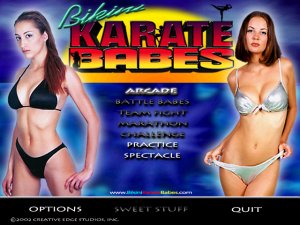
Forged in this bleak crucible: a masterpiece of video game action. Creative Edge Studios, a small but courageous band of developers and artists, released the world’s first digital bikini-based fighting adventure. [Read more →]
Excerpted from Professor Lu Zuyin’s “Scientific Qigong Exploration”, a survey of qigong research experiments conducted in China between 1978 and 1992.
Scientific research in the last ten years has captured many external qi phenomena and qualitatively recognized certain characteristics of external qi. On the whole, research on external qi is still at a qualitative stage. It is not easy to establish quantitative laws and phenomenological theories thereby moving to a quantitative stage.
The difficulty is mainly due to insufficient investigation of external qi and the resulting lack of scientific means to express the level of external qi. With more than a thousand qigong schools and numerous different qigong methods, it is difficult to establish common standards.
In addition, a qigong master’s qi-emission power is closely related to his own physical, mental, emotional state at the time of qi emission. As a result, each external qi emission is at best only roughly the same, and it is not as precisely reproducible as an instrument. Experiments seeking basic laws of external qi are not easy to accomplish because they require tens or even hundreds of strictly repeated experiments.
[As demonstrated by our previous experimental results,] qigong is more advanced than contemporary science, thus it is difficult to fit into the framework of contemporary science. However, like all fields of scholarship, if qigong research does not pass strict scientific examination, it will not survive in contemporary society, let alone be accepted in international academic circles. This is a fundamental contradiction. [Read more →]
Science is what we understand well enough to explain to a computer. Art is everything else we do.
~ Donald Knuth
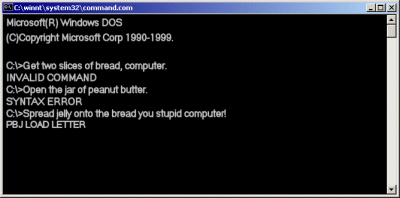
You’ll never appreciate the true complexity of a mundane, everyday task, until you’ve tried explaining it to a computer.
Contrary to popular perception, computers are not smart. Actually, they are stone dumb. Given a lengthy set of precise instructions, your computer can follow them well enough, most of the time, but when asked to exhibit the tiniest bit of reasoning or creativity, your cutting-edge laptop PC is helpless and hopeless. Ditto for the Mac. Sorry, Linux won’t help either.
Consider the simple act of making a peanut butter and jelly sandwich. You can teach the average six year-old child this skill in a few minutes; writing the equivalent instructions for a general-purpose computer could literally take weeks or months of effort.
Knowing all this, I was amazed by the concept and promise of Spike TV’s new show, Deadliest Warrior:
In Los Angeles, CA, we’ve created a high-tech fight club, with scientists, martial arts experts, and lots and lots of weapons. It’s all here to create a virtual battle between two legendary warriors. We’ll test their weapons and fighting techniques on high-tech dummies—stand-ins for human victims. Based on this data, a battle simulation program will stage a true-to-life fight to the death. The winner will be The Deadliest Warrior.
Could it possibly be true? Would the endless debates over the ultimate fighting style finally be put to rest, by indisputable scientific evidence? [Read more →]
Spike TV, the unabashed cable channel dedicated to all things manly, has created a new show in the same vein as the moderately popular “Fight Science” and “Human Weapon” series. Like those other shows, it uses modern scientific equipment to gather data from historical weaponry and techniques. Unlike those shows, however, “Deadliest Warrior” makes no effort to be a cultured or sophisticated study of the martial arts. [Read more →]
With more than two years spent in filming and production, Ong Bak 2 presents Thai martial arts star Tony Jaa’s attempt at an action masterpiece. Jaa shares writing and directing credits, in addition to his leading role as the slave-turned-rebel-hero Tian [Read more →]
Karate kata (formal exercises) was the only way karate was taught up until the 1930s. In the kata, all the elements of correct karate practice are stored. The vast majority of kata that are practiced in the dojo today and used on the tournament circuit can be traced right back to China or Okinawa.
They appear to be dance-like drills, constantly repeated by students, yet hidden in these movements are hundreds of kakushi waza (secret techniques). These appear to be one form of technique, but in fact may be doing something completely different. [Read more →]
“KATANA” is a martial arts web series that premiered January 7th, 2009, on Strike.TV, an internet network created by Hollywood writers during the 2007-2008 Writers Guild of America (WGA) strike. It is the first ever martial-arts based internet television series by Hollywood professionals to debut on the internet.
In the pilot episode, John Koyama (The Last Samurai) plays Toshiro Sato, a former Ninja forced out of retirement to do the evil bidding of his older brother Kenji, played by action legend Yuji Okumoto (Karate Kid 2, Johnny Tsunami). “KATANA” is also Yuji Okumoto’s producing and writing debut.
Shot in Seattle, the series pilot stars a host of top A-list stunt and action talent from Hollywood to Hong Kong, including Thai action star Don Tai (Rush Hour 3, Fast & Furious), Al Goto (Letters From Iwo Jima, We Were Soldiers), and Sam Looc (Mask of the Ninja, Tropic Thunder).
Totally Nude Tai Chi: A DVD Review With Pictures After writing this, I learned that Tai Chi is just one disc in an extensive nude martial arts DVD series. Other titles include Judo, Kendo, Karate, and Changquan. I kid you not!